Wow! eBook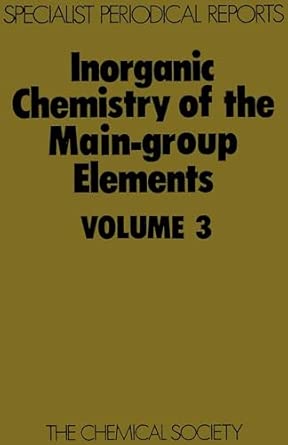
Inorganic Chemistry Of The Main-group Elmts, Vol 3: Volume 3 Edition. ed. Edition
Author(s): C C Addison
- Publisher: CRC Press
- Publication Date: 30 Nov. 1989
- Edition: Edition. ed.
- Language: English
- Print length: 550 pages
- ISBN-10: 0851867723
- ISBN-13: 9780851867724
Book Description
Reflecting the growing volume of published work in this field, researchers will find this book an invaluable source of information on current methods and applications.
Editorial Reviews
Excerpt. © Reprinted by permission. All rights reserved.
Inorganic Chemistry of the Main-group Elements Volume 3
A Review of the Literature Published Between September 1973 and September 1974
By C. C. Addison
The Royal Society of Chemistry
Copyright © 1976 The Chemical Society
All rights reserved.
ISBN: 978-0-85186-772-4
Contents
Chapter 1 Elements of Group I By R. J. Pulham, 1,
Chapter 2 Elements of Group II By R. J. Pulham, 64,
Chapter 3 Elements of Group III By G. Davidson, 95,
Chapter 4 Elements of Group IV By P. G. Harrison and P. Hubberstey, 190,
Chapter 5 Elements of Group V By A. Morris and D. B. Sowerby, 314,
Chapter 6 Elements of Group VI By M. G. Barker, 403,
Chapter 7 The Halogens and Hydrogen By M. F. A. Dove, 469,
Chapter 8 The Noble Gases By M. F. A. Dove, 495,
Author Index, 503,
CHAPTER 1
Elements of Group I
BY R. J. PULHAM
1 Introduction
In this chapter individual references which are inter-related are grouped together to make a section and, therefore, reference to several alkali metals may feature in a single section. Each reference, however, appears once only within this chapter so that, if described in one section, it will not be duplicated in any other. Single references to topics are presented systematically in the section on the appropriate metal.
The elements of Groups I and II are so closely linked in some instances that a section describing them jointly is presented to avoid duplication in Chapter 2. Such a case is the section on ‘Molten Salts’, which covers the chemistry of the molten salts of both Groups I and II but is presented only in this chapter.
2 The Alkali Metals
The electron affinities/eV (±0.05), determined from the threshold energies of the photo-detachment cross-sections of the atomic negative ions, are 0.61, 0.53, 0.50, 0.48, and 0.47 for Li, Na, K, Rb, and Cs, respectively. The values for Rb and Cs were obtained by extrapolating the cross-section below 0.5 eV. All values for the alkali metals are abstracted from a set covering the elements of the short periods. The reaction cross-sections of alkali-metal atoms with Br have been obtained by direct measurements of alkali-metal atom decay rates. The alkali-metal atoms were produced in the presence of a known amount of Br by photodissociating the bromide of the particular alkali-metal atom with a short pulse of u.v. light. As the atoms reacted with Br2 their decay rate was determined from the transmission of alkali-metal-atom resonance light through the vapour. The reaction cross-sections/Å as computed from the decay rates are Na, 116; K, 151; Rb, 197, and caesium, 204, and are accurate to ca. 15%. Theory and experimental practice in the field of soft X-ray emission from metallic solids have been briefly reviewed, and measurements on a number of systems including Li, Na, and Mg, are critically evaluated. Comparison is made with the results of other techniques and theory to establish the pertinence of soft X-ray measurements and to indicate specific guidelines for further enhancing their value. An exhaustive annoted index of measured spectra is also provided. X-Ray photoelectron spectra of Li and Na obtained in ultrahigh vacuum show rich plasmon structures on all peaks. Both the photoemission and Auger peaks showed large extra-atomic relaxation energies. The sodium valence band showed an approximately E1/2 behaviour, as expected for a nearly free-electron metal, but it has some anomaly. Further X-ray photoemission spectra of valence and core electrons in Na and NaOH have been measured from clean and oxidized Na films. Clean metal surfaces were prepared by sequential evaporation to give films contaminated with only half a monolayer even after several hours. From these films an analysis of lineshapes of core-electron spectra revealed evidence for the effects of electron–hole interactions. The valence band of Na was determined as free-electron-like again, with an occupied bandwidth in agreement with theory. Accurate binding energies/eV for the core Na, 2p, 2s, and 1s electrons are 30.58±0.08, 63.57±0.07, and 1071.76±0.07, respectively. By comparison with core-level spacings in the free ion and crystal, the measured 2s and 1s electron binding energies in the metal were anomalously large. The valence band of NaOH resembled that of H2O(g) after shifting the vapour spectrum to lower binding energies. Evidence was found for weakly chemisorbed N2 on the NaOH surface. The work function of rubidium films deposited on quartz substrates at 10-10 Torr has been determined photoelectrically as 2.261 ±0.015 eV at 140 K. On warming to 150 — 200 K, an irreversible decrease occurred in photoelectric yield. Semi-empirical potential-energy surfaces have been calculated for the alkali-metal atom–dimer exchange reactions of Li and Na. The surfaces exhibit a potential well at small internuclear distances which extends into the entrance and exit valleys without an energy barrier. The alkali-metal triatomic complex is deemed most stable in the linear or near-linear configuration but remains stable, however, over all bent configurations. In the mixed complex, the configuration with the lighter Li in the central position is the more stable, i.e. NaLiLi is more stable than LiNaLi, and NaLiNa is more stable than NaNaLi. It is considered that the diatomic σ*s molecular orbitals rather than the p atomic orbitals can probably function as the metallic orbitals in the simplest account of the Pauling valence-bond theory of electron conduction in alkali metals. High-temperature vapour pressures and critical points have been determined for potassium and rubidium. These lead to values of the enthalpy of vaporization of the K and Rb monomers at 0 K of 23.816 and 20.3 kcal mol-1, respectively. The critical density of Rb is 0.347 ± 0.0O2 g cm-3.
The ignition and combustion of sodium has been reviewed and the ignition temperatures of both sodium and potassium have been experimentally determined under conditions of slow heating in air, dropping the metal into hot air, and heating the metal under argon followed by exposure to air or oxygen.
In a theoretical treatment for solutions of non-metal X in a liquid alloy A–B, a parabolic dependence of solvation energy on the number of atoms A and B in the solvation shell of atoms X has been introduced in place of the usual linear relationship. Calculations of the activity coefficient of oxygen as a function of alloy composition using this modification agree with available experimental data. Although the concept is developed solely for oxygen (and other non-metals) in transition-metal alloys, it appears generally applicable to solutions of non-metals in liquid alkali metals also. A previous model for solutions of non-metals in liquid alkali metals has been extended. Electronegative non-metals are considered as anions in the liquid and solvated by cations. A method is given for calculating the Coulomb interaction between screened potentials round cations and anions in the free-electron gas of the metal using the Fourier convolution theorem. The solubilities of the salts NaBr and Nal in liquid sodium have been determined from 150 to 450 °C. The labelled halides (Na32Br and Na131I), as dried-down deposits on steel surfaces, were equilibrated with both static and flowing liquid sodium, which was subsequently analysed for halogen by gamma spectrometry. The solubilities, S/p.p.m. by weight, of NaBr and Nal respectively are given by the equations:
log S = 9.00 – (5100 K/T)
and
log S = 8.72 – (4650 K/T)
The slopes of these lines provide partial molar enthalpies of solution of 97.5±4.7 and 89.2±2.6 kJ mol-1 for NaBr and Nal, respectively, where the thermodynamic reference state is the solid halide. The solvation enthalpies derived from these values are –265.6±9.9 and –225.0±7.9 kJ mol-1 for bromide and iodide ion, respectively. The salts are considered to dissolve in the metal as the dissociated ions, solvated by liquid metal, and the solutions show large deviations from ideal but small deviations from regular behaviour. The solubilities of potassium chloride in liquid potassium and in solutions of potassium (20 and 30 atom %) in lead have been determined. Samples of the metallic melt were drawn through porous glass filters and converted into aqueous solutions, and the chloride ions were determined mercurimetrically, using diphenylcarbazone as indicator. The solubility of KCl increases in both solutions with increasing temperature, but dilution of potassium with lead causes a sharp decrease in the solubility of KCl. The low-temperature data for potassium are probably all that exist at present, and they are provided in Table l.
The high-temperature physical properties of the sodium coolant and oxide fuel used in fast nuclear reactors have been reviewed, and the review includes enthalpy, heat capacity, vapour pressure, density, surface tension, viscosity, thermal conductivity, and speed of sound measurements. In the control of impurities in liquid-sodium coolant loops, analytical methods for measuring the impurity content have been reviewed. Instruments for monitoring specific impurities, e.g. O, H, and C, in sodium have been covered in another review on instrumentation for monitoring liquid sodium in nuclear reactors. Fission products produced in Na–K coolant, and which form oxides, are present as a fine suspension, which tends to deposit on transition-metal surfaces. The deposited material, which can be radioactive, can be removed by water. The state and behaviour of the non-metals oxygen, hydrogen, and carbon in liquid sodium are currently under investigation. Preliminary results from concentration measurements on oxygen and hydrogen suggest that the ion O2- exists in the solution and reacts with hydrogen, the excess being converted into sodium hydride, thereby affecting the equilibrium pressure. The general equation:
log S = 6.2571 – (2444.5 K/T)
has been derived for the solubility of oxygen in liquid sodium by combining additional data with previously published results. The equation provides an enthalpy of solution of 11.184 kcal mol-1 for oxygen in the metal. The determination of traces of carbon and oxygen in sodium and caesium has been described, based on the reactions 12C(γ,n)11C and 16O(γ,n)15O, respectively, induced by irradiation of Na and Cs with ≤ 38 MeV bremsstrahlung for 5 and 2 minutes, respectively. Because the half-lives of 11C and 15O are 20.3 and 2.03 minutes, respectively, the sample can be etched free of surface contamination after irradiation. The method enables determination of oxygen and carbon concentrations as low as 0.3 p.p.m.
Corrosion of transition metals by liquid alkali metals continues to be of interest. In the absence of dissolved oxygen in sodium, the solubilities of iron, nickel, and chromium in the alkali metal are slight. In the early stages of corrosion of stainless steel, corrosion rates are high, decreasing asymptotically to a steady-state value. Corrosion rate increases linearly with oxygen content in the liquid sodium. Similarly with vanadium in sodium. At 600 °C the ternary oxide Na4VO4 was observed on the surface of vanadium after immersion in sodium containing dissolved sodium oxide. The compound was identified by X-ray powder diffractometry, which was recorded through a matrix of sodium. Vanadium oxides were detected beneath the ternary oxide layer, and the change in lattice parameter of the vanadium substrate indicated the occurrence and amount of oxygen in solid solution. Specific transition-metal oxides also react with sodium to give ternary oxides. Thus Nb2O5, NbO2, NbO, and Ta2O5 react at 400 and/or 600 °C to produce cubic Na3MO4 (M = Nb or Ta) together with M as equilibrium products. Sodium vapour reactions appear less straightforward. Sodium gas at 3.3 × 10⁻² Torr reacted progressively with increasing temperature with α-Fe2O3 and α- or β-NaFeO2 to produce mixtures of metallic iron with (a) unidentified phase, (b) Na34Fe8O29, and (c) Na3FeO3. The magnetic properties and paramagnetic resonance spectra indicated that FeIII exists in these compounds. Attempts to synthesize the unidentified phase in the pure state from reactions of sodium monoxide, Na2O, with NaFeO2 and Fe1-xO were unsuccessful. The behaviour of liquid potassium towards vanadium oxides has been assessed and compared with that of sodium and of lithium. The oxides V2O and VO react at 63 °C, V2O3 at 180 °C, but VO does not react below 400 °C, the maximum temperature studied. Potassium converted VO2 into KVO2 whereas V2O5 and V2O3 gave VO and KVO2, but both these compounds were oxidized by dissolved K2O to produce K3VO4.
The rate of reaction of hydrogen with stirred liquid sodium has been investigated at constant volume over the temperature range 160 — 295 °C and at pressures from 5.0 to 33.0 kN m-2. The rate of absorption is proportional to hydrogen pressure, confirming a first-order reaction. The activation energy for the reaction was 69.0 ±8.0 kJ mol-1, compared with previously reported values of 72.4, 71.6, 69.1, and 41.9 kJ mol-1. Previous work on the kinetics and thermodynamics of both the sodium–hydrogen and sodium–hydrogen–oxygen systems has been reviewed, and possible reasons are suggested for the observed difference. The solubility of hydrogen (0.O3 — 1 p.p.m.) in sodium has been redetermined by means of a meter based on the diffusion of hydrogen through a nickel membrane. The results, which include data of other workers, are summarized by the equation:
log(S/p.p.m. by weight) = 6.067 – (2880 K/T)
For unsaturated solutions the amount of hydrogen in solution is governed by the pressure. Over this region the Sievert’s constant, K, is slightly affected by temperature and is given by the equation:
log(K/p.p.m. Torr-1/2) = 0,860–(122.0 K/T)
A new type of battery is described which utilizes alloys of lithium with lead, zinc, or tin as anode, fused LiCl–KCl as electrolyte, and chlorine as cathode. Liquid lithium alloys are used instead of pure lithium since they are more dense and sink below the electrolyte. The e.m.f. of this cell is much lower than in the conventional lithium–chlorine battery but cell structure is simpler, and the operating temperature and self-discharge rate are much lower. Lithium anode electrochemical cells can be made to operate at room temperature by using electrolytes of lithium salts in solvents such as POCl3, SOCl2, and SO2Cl2. The solvents are compatible with both lithium and strong oxidants, including Cl2, CuF2, (CF)n, and WO3, which can therefore be used as cathode materials. Further room-temperature lithium cells have been studied which employ solutions of LiBCl4 in POCl3 and of LiAlCl4, in SOCl2as electrolytes. A novel feature of these cells is that during discharge the solvents POCl3 and SOCl2 are electrochemically reduced and behave as soluble cathodes. The Dow sodium–sulphur battery is more conventional, and operates at 300 °C with a high current and voltage efficiency.
The alkali metals have a role to play in ammonia synthesis. The K2O promoter in the conventional NH synthesis catalyst enhances the chemisorption of nitrogen and causes a hydrogen-promoted dissociation of the N2 molecule. The electropositive promoter, metallic potassium deposited from the vapour phase on to pure iron, increased the rate of ammonia synthesis by a factor of ten. An extraordinarily high activity was obtained with promoted Ru supported on active carbon, although Ru was inactive without K. The effectiveness of alkali metals increased in the order Na
(Continues…)Excerpted from Inorganic Chemistry of the Main-group Elements Volume 3 by C. C. Addison. Copyright © 1976 The Chemical Society. Excerpted by permission of The Royal Society of Chemistry.
All rights reserved. No part of this excerpt may be reproduced or reprinted without permission in writing from the publisher.
Excerpts are provided by Dial-A-Book Inc. solely for the personal use of visitors to this web site.