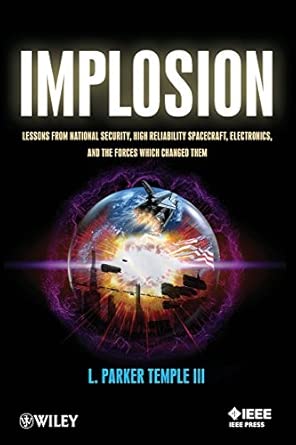
Solid-state electronics enabled the amazing transformation of life on Earth in countless ways during the second half of the twentieth century. This technology has become so ubiquitous that people worldwide take it for granted and, more often than not, never contemplate what the world would be like without it. In Implosion, historian Parker Temple captures in remarkable detail the evolutionary complexity of one aspect of that technological transformation―the requirement for and the acquisition of highly reliable solid-state electronics for mission assurance in U.S. national security and national defense space programs. From the incorporation of strict military specifications and standards for proliferating solid-state devices during the 1950-1960s to the inability of those specifications and standards to keep pace with the evolution of electronics in the 1980s―1990s, Dr. Temple weaves an elaborate narrative. He explains how military standards advanced the quality of solid-state electronic devices generally, even as demands for more capabilities engendered greater complexity, until concern about rising costs in the waning years of the twentieth century politicized change and resulted in the entropic unraveling of an optimized production system.
Engineering instructors, students, industrial leaders, government procurement officers, administrative policy makers, and legislators all might benefit from contemplating Dr. Temple’s critical analysis of how the optimized production system for highly reliable electronics came about, what sustained it over time, why it fell apart, and whether a satisfactory replacement might again ensure delivery of highly reliable electronic devices. History holds many lessons for those who are willing to pay attention, and Implosion reminds the attentive few that technological complexity can harbor the seeds of its own collapse. As Dr. Temple correctly acknowledges, it took decades to evolve an optimized production system that once ensured highly reliable solid-state electronic devices for U.S. rocket and space programs; it likely will take decades before a fully acceptable replacement system emerges. Well informed, historically astute participants, playing many different roles, can help ‘stay the course’ that leads to that new production system.
―Rick W. Sturdevant, Ph.D., Deputy Director of History, HQ Air Force Space Command
From the Inside Flap
Implosion is a focused study of the history and uses of high-reliability, solid-state electronics, military standards, and space systems that support our national security and defense. This book is unique in combining the interdependent evolution of and interrelationships among military standards, solid-state electronics, and very high-reliability space systems.
Starting with a brief description of the physics that enabled the development of the first transistor, Implosion covers the need for standardizing military electronics, which began during World War II and continues today. The book shows how these twin topics affected, and largely enabled, the highest reliability and most technologically capable robotic systems ever conceived.
This riveting history helps readers:
- Realize the complex interdependence of solid-state electronics and practical implementations in the national security and defense space programs
- Understand the evolution of military standards for piece parts, quality, and reliability as they affected these programs
- Gain insight into the attempted reforms of federal systems acquisition of security- and defense-related space systems in the latter half of the twentieth century
- Appreciate the complexity of science and technology public policy decisions in the context of political, organizational, and economic realities
Written in clear, jargon-free language, but with plenty of technical detail, Implosion is a must-read for aerospace and aviation engineers, manufacturers, and enthusiasts; technology students and historians; and anyone interested in the history of technology, military technology, and the space program.
From the Back Cover
Implosion is a focused study of the history and uses of high-reliability, solid-state electronics, military standards, and space systems that support our national security and defense. This book is unique in combining the interdependent evolution of and interrelationships among military standards, solid-state electronics, and very high-reliability space systems.
Starting with a brief description of the physics that enabled the development of the first transistor, Implosion covers the need for standardizing military electronics, which began during World War II and continues today. The book shows how these twin topics affected, and largely enabled, the highest reliability and most technologically capable robotic systems ever conceived.
This riveting history helps readers:
- Realize the complex interdependence of solid-state electronics and practical implementations in the national security and defense space programs
- Understand the evolution of military standards for piece parts, quality, and reliability as they affected these programs
- Gain insight into the attempted reforms of federal systems acquisition of security- and defense-related space systems in the latter half of the twentieth century
- Appreciate the complexity of science and technology public policy decisions in the context of political, organizational, and economic realities
Written in clear, jargon-free language, but with plenty of technical detail, Implosion is a must-read for aerospace and aviation engineers, manufacturers, and enthusiasts; technology students and historians; and anyone interested in the history of technology, military technology, and the space program.
About the Author
L. PARKER TEMPLE III, PhD, is a Senior Policy Analyst with more than forty years’ experience in program management and execution, software and systems engineering, policy and systems analysis in national defense, and national security air and space programs. The recipient of numerous awards, Dr. Temple has worked with the National Reconnaissance Office; NASA; the Intelligence Community; the Departments of Transportation, State, and Commerce; the Office of the Secretary of Defense; and the armed services.
 Wow! eBook