Wow! eBook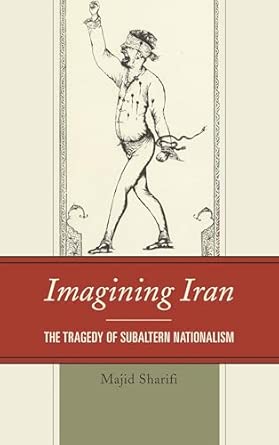
Imagining Iran: The Tragedy of Subaltern Nationalism
Author(s): Majid Sharifi (Author)
- Publisher: Lexington Books (UK)
- Publication Date: 22 Aug. 2013
- Language: English
- Print length: 374 pages
- ISBN-10: 0739179446
- ISBN-13: 9780739179444
Book Description
This book makes three specific contributions. The first contribution is pedagogical. By focusing on the dynamics of regime changes, it provides a heuristic model for identifying challenges that all Iranian regimes have faced. Moreover, the book is a comprehensive review of the disruptive, oppressive, and bloody nature of the rise and fall of different regimes. The second contribution is theoretical. Rather than examining the behavior of various Iranian regimes in isolation from their international context, the book examines how each regime got to understand itself in relations to its imperial others. By examining the governmental rationality of each regime, the book offers a better theoretical framework for understanding political development not only in Iran, but also in all other Middle Eastern and South Asian states. Finally, the third contribution of this book is its critical approach to the main body of the literature on Iran, modernity, development, democracy, and constitutionalism.
Editorial Reviews
Review
Majid Sharifi thoroughly researches politics in Iran for the past one-hundred years. He depicts the five regime changes accurately and then reviews the fundamental dynamics of the rise and fall of each regime and why it is that they have all failed to nationalize their narrative of Iranianness. Any reader of Imagining Iran will walk away with a well-informed sense of political history of Iran, especially in relation to what the state has accomplished and not accomplished in the past vis-à-vis the Iranian population.
This expansive book seeks to explain why different Iranian regimes that came to power after the 1905-06 constitutional revolution have unsuccessfully sought to define ‘Iranianness.’ Sharifi explains the political dynamics of the rise and fall of each regime in terms of the inability of each type of government, whether secularist or Islamic, to make its narrative of ‘Iranianness’ inclusive enough to make the state into the embodiment of the country’s heterogeneous people. He further demonstrates that the failure to politically and socially engage the elites and masses around the state’s official identity have had several consequences. They included securitization of Iran’s sociopolitical space, various regimes’ increasing reliance on coercive and regulatory mechanisms to stay in power, and the emergence of counterhegemonic forces against the state’s official identity and ideology of ‘Iranianness.’ Moreover, the author develops a theoretical framework for connecting the development of Iranian nationalism with those of the other states in the Middle East and South Asia that have experienced colonial and/or imperial domination. This well-researched, theoretically rigorous, and cogently argued book is highly recommended. Summing Up: Highly recommended. Upper-division undergraduate, graduate, and research collections.