Wow! eBook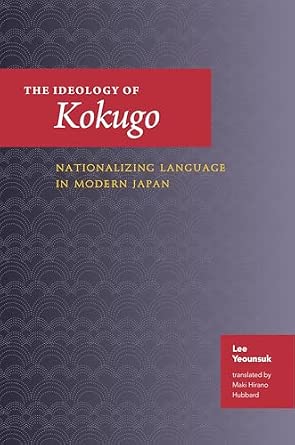
The Ideology of Kokugo: Nationalizing Language in Modern Japan
Author(s): Yeounsuk Lee (Author)
- Publisher: University of Hawaii Press
- Publication Date: 30 Nov. 2021
- Language: English
- Print length: 286 pages
- ISBN-10: 0824892801
- ISBN-13: 9780824892807
Book Description
Re-examining debates and controversies over genbun itchi (unification of written and spoken languages) and other language reform movements, Lee discusses the contributions of Ueda Kazutoshi (1867–1937) and Hoshina Koichi (1872–1955) in the creation of kokugo and moves us one step closer to understanding how the ideology of kokugo cast a spell over linguistic identity in modern Japan. She examines the notion of the unshakable homogeneity of the Japanese language―a belief born of the political climate of early-twentieth-century Japan and its colonization of other East Asian countries―urging us to pay attention to the linguistic consciousness that underlies “scientific” scholarship and language policies. Her critical discussion of the construction of kokugo uncovers a strain of cultural nationalism that has been long nurtured in Japan’s education system and academic traditions. The ideology of kokugo, argues Lee, must be recognized both as an academic apparatus and a political concept.
The Ideology of Kokugo was the first work to explore Japan’s linguistic consciousness at the dawn of its modernization. It will therefore be of interest to not only linguists, but also historians, anthropologists, political scientists, and scholars in the fields of education and cultural studies.Editorial Reviews
Review
Following its publication in Japan in 1996, Lee Yeounsuk’s
Kokugo to iu shisō quickly became a must-read for anyone with an interest in the relationship between language, national identity, and imperialism in the context of modern East Asia, and its enduring relevance makes it an excellent choice for translation into English. . . . Hubbard’s translation is written in admirably felicitous academic prose, she offers a solid rendering of both Lee’s argument and the copious citations that support it, and her introduction to the work is concise and informative.–Indra Levy, Stanford University “Journal of Japanese Studies, 38:2 (2012)”Lee unearths aspects of history which Japanese scholars have been reluctant to explore but maintains a fair approach to this sensitive subject, and presents a face of
kokugo that we have not seen before. . . . There can be no doubt as to the significance of Lee’s contribution and it is easy to understand why she received the prestigious Suntory Foundation Prize in Literary and Art Criticism for her work in 1997.–Emiko Okayama, University of Sydney “Japanese Studies, 30:3 (December 2010)”