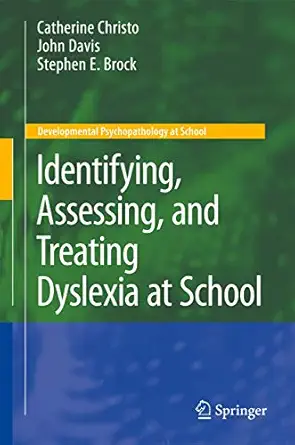
Identifying, Assessing, and Treating Dyslexia at School Softcover reprint of hardcover 1st ed. 2009 Edition

Identifying, Assessing, and Treating Dyslexia at School Softcover reprint of hardcover 1st ed. 2009 Edition book cover

Identifying, Assessing, and Treating Dyslexia at School Softcover reprint of hardcover 1st ed. 2009 Edition

Author(s): Catherine Christo (Author), John M. Davis (Author), Stephen E. Brock (Author)

  • Publisher: Springer
  • Publication Date: November 1, 2010
  • Edition: Softcover reprint of hardcover 1st ed. 2009
  • Language: English
  • Print length: 164 pages
  • ISBN-10: 1441946969
  • ISBN-13: 9781441946966

Book Description

As many as one in four children experiences problems with reading. Dyslexia, the most common learning disability leads to well-documented negative effects on school and, ultimately, adult success. Therefore, it is critical that school professionals provide early and effective assessment and intervention.

Identifying, Assessing, and Treating Dyslexia at School Softcover reprint of hardcover 1st ed. 2009 Edition equips practitioners with in-depth understanding of the disorder and a wealth of practical information for meeting student needs. This volume:

    • Reviews up-to-date findings on dyslexia – causes, prevalence, and related conditions.

    • Provides research-based tools for identifying and addressing dyslexia.

    • Offers a detailed framework for case finding and screening, diagnostic and psychoeducational assessment as well as age- and grade-appropriate intervention.

    • Explains the roles and responsibilities of school psychologists when it comes to identifying students with dyslexia.

    • Focuses solely on dyslexia, unlike most other books on learning disabilities.

    As the duties of school psychologists and related education professionals become more complex, recognizing and providing services for students with learning disorders has become progressively more demanding. Identifying, Assessing, and Treating Dyslexia at School Softcover reprint of hardcover 1st ed. 2009 Edition offers practitioners an accessible and easy-to-read reference that they will use for years to come.

    Editorial Reviews

    From the Back Cover

    As many as one in four children experiences problems with reading. Dyslexia, the most common learning disability leads to well-documented negative effects on school and, ultimately, adult success. Therefore, it is critical that school professionals provide early and effective assessment and intervention.

    Identifying, Assessing, and Treating Dyslexia at School Softcover reprint of hardcover 1st ed. 2009 Edition equips practitioners with in-depth understanding of the disorder and a wealth of practical information for meeting student needs. This volume:

      • Reviews up-to-date findings on dyslexia – causes, prevalence, and related conditions.

      • Provides research-based tools for identifying and addressing dyslexia.

      • Offers a detailed framework for case finding and screening, diagnostic and psychoeducational assessment as well as age- and grade-appropriate intervention.

      • Explains the roles and responsibilities of school psychologists when it comes to identifying students with dyslexia.

      • Focuses solely on dyslexia, unlike most other books on learning disabilities.

      As the duties of school psychologists and related education professionals become more complex, recognizing and providing services for students with learning disorders has become progressively more demanding. Identifying, Assessing, and Treating Dyslexia at School Softcover reprint of hardcover 1st ed. 2009 Edition offers practitioners an accessible and easy-to-read reference that they will use for years to come.

      About the Author

      Catherine Christo, Ph.D., NCSP, is professor of school psychology at California State University Sacramento and coordinator of the School Psychology Graduate Program. She previously worked as a school psychologist in Davis Joint Unified School District and Yolo County Office of Education. Dr. Christo teaches courses in cognitive assessment, preventive academic interventions, and assessment of learning disorders. She is a past board member of the California Association of School Psychologists, and maintains a private practice as a Licensed Educational Psychologist. Dr. Christo is a frequent presenter at professional meetings primarily on topics related to reading disability, assessment, curriculum based measurement and response to intervention models.
      John M. Davis, Ph.D., is currently a professor at California State University East Bay where he teaches and supervises in the Clinical Child and School Psychology Program. He received his Ph.D. from the U.C. Berkeley School Psychology program and did clinical postdoctoral studies to become a licensed psychologist. He has a special interest in learning and developmental disorders and has been the director of a school and clinic for students with learning disabilities for 13 years that provided diagnostic and intervention services. His current clinical work is primarily with children and adults with learning disorders. His writing and research interests include articles and book chapters in the areas of mental health consultation, suicide/crisis intervention, and learning disorders.
      Stephen E. Brock, Ph.D., NCSP, is an associate professor at California State University Sacramento. Previously, he worked for 18 years as a school psychologist with the Lodi Unified School District (the last six of which included assignments as Lead Psychologist). His professional preparation includes a Ph.D. at the University of California, Davis, where he researched AD/HD, and was one of the first researchers to identify the reading comprehension deficits often found among students with AD/HD. Dr. Brock currently serves on the editorial boards of both state and national school psychology association newsletters and is an Associate Editor of The California School Psychologist (a peer peer-reviewed journal with the second largest distribution of school psychology journals in the United States). He is Past-President of the California Association of School Psychologists and a member of the National Association of School Psychologists Delegate Assembly and its Executive Counsel. Dr. Brock has authored more than 140 publications (including four books) and has made more than 65 referred or invited state/national conference presentations. In addition to AD/HD, his academic work has included study of school crisis response, suicide prevention, autism, behavioral interventions, violence prevention, threat assessment, child development, and reading comprehension.

      View on Amazon

      电子书代发PDF格式价格30我要求助
      未经允许不得转载:Wow! eBook » Identifying, Assessing, and Treating Dyslexia at School Softcover reprint of hardcover 1st ed. 2009 Edition

      Identifying, Assessing, and Treating PTSD at School Softcover reprint of hardcover 1st ed. 2009 Edition

      Identifying, Assessing, and Treating PTSD at School Softcover reprint of hardcover 1st ed. 2009 Edition book cover

      Identifying, Assessing, and Treating PTSD at School Softcover reprint of hardcover 1st ed. 2009 Edition

      Author(s): Amanda B. Nickerson (Author), Melissa A. Reeves (Author), Stephen E. Brock (Author), Shane R. Jimerson (Author)

      • Publisher: Springer
      • Publication Date: November 19, 2010
      • Edition: Softcover reprint of hardcover 1st ed. 2009
      • Language: English
      • Print length: 179 pages
      • ISBN-10: 144194642X
      • ISBN-13: 9781441946423

      Book Description

      By age 16, significant – one might even say “alarming” – numbers of students are demonstrating signs of posttraumatic stress disorder (PTSD). Students with PTSD are more likely to develop a range of problems, from delinquent behavior to eating disorders to substance abuse to dropping out. For the school-based professional, the ability to recognize these symptoms and warning signs is essential.

      Emphasizing prevention as well as intervention, Identifying, Assessing, and Treating PTSD at School Softcover reprint of hardcover 1st ed. 2009 Edition clearly defines PTSD, explains its adverse affects on children’s academic and social-emotional skills, and offers expert guidance on how to recognize student needs and provide appropriate services. This volume, designed as a practical, easy-to-use reference for school psychologists and other educational professionals: (1) Makes the case for why school psychologists and their colleagues need to be more prepared, willing, and able to identify and serve students with PTSD. (2) Identifies the causes, prevalence, and associated conditions of PTSD. (3) Provides a review of screening, referral, and diagnostic assessment processes. (4) Reviews appropriate treatments for students with PTSD.

      Today’s youth live in an increasingly uncertain world, and school psychologists, counselors, social workers, and general and special education personnel will find Identifying, Assessing, and Treating PTSD at School Softcover reprint of hardcover 1st ed. 2009 Edition an invaluable resource in their practices.

      Editorial Reviews

      From the Back Cover

      By age 16, significant – one might even say “alarming” – numbers of students are demonstrating signs of posttraumatic stress disorder (PTSD). Students with PTSD are more likely to develop a range of problems, from delinquent behavior to eating disorders to substance abuse to dropping out. For the school-based professional, the ability to recognize these symptoms and warning signs is essential.

      Emphasizing prevention as well as intervention, Identifying, Assessing, and Treating PTSD at School Softcover reprint of hardcover 1st ed. 2009 Edition clearly defines PTSD, explains its adverse affects on children’s academic and social-emotional skills, and offers expert guidance on how to recognize student needs and provide appropriate services. This volume, designed as a practical, easy-to-use reference for school psychologists and other educational professionals:

        • Makes the case for why school psychologists and their colleagues need to be more prepared, willing, and able to identify and serve students with PTSD.

        • Identifies the causes, prevalence, and associated conditions of PTSD.

        • Provides a review of screening, referral, and diagnostic assessment processes.

        • Reviews appropriate treatments for students with PTSD.

        Today’s youth live in an increasingly uncertain world, and school psychologists, counselors, social workers, and general and special education personnel will find Identifying, Assessing, and Treating PTSD at School Softcover reprint of hardcover 1st ed. 2009 Edition an invaluable resource in their practices.

        About the Author

        Amanda B. Nickerson, Ph.D., is an assistant professor at the University at Albany – State University of New York. A nationally certified school psychologist and a licensed psychologist, she has conducted more than 50 professional presentations on the topics of preventing and intervening with aggression and bullying, school crisis prevention and intervention, assessing and treating children with emotional and behavioral disorders, and parent and peer relationships. She has published more than 20 journal articles and book chapters and is co-author of the Educators’ Handbook on Effective Testing. In addition, she serves on the editorial boards of Psychology in the Schools and The School Psychologist. She is also a recipient of the 2006 National Association of School Psychologists Presidential Award for her work with the crisis prevention and intervention workgroup.
        Melissa A. Reeves, Ph.D., NCSP is a school psychologist, licensed special education teacher, and adjunct faculty member with a specialty in working with behaviorally and emotionally challenged youth. She has worked in public school and treatment settings for more than 15 years with children ages preschool through high school. She has conducted more than 40 presentations and has consulted with various school districts in the areas of crisis prevention and intervention, psychological safety, risk and suicide assessments, the impact of trauma, establishing safe schools, response to intervention models addressing both academics and behavior, and establishing effective programs for students with behavioral and emotional needs. As an adjunct faculty member she has taught courses in psychosocial aspects of exceptional children, social-emotional assessment, crisis prevention and intervention, and academic and behavioral interventions. She was a founding member of the Colorado Society of School Psychologists State-Wide Crisis Response Team where she responded to various local crises, including student andfaculty deaths and Columbine. She is a recipient of the 2006 National Association of School Psychologists Presidential Award for her work with the crisis prevention and intervention workgroup.
        Stephen E. Brock, Ph.D., is a professor at California State University Sacramento. Previously, he worked for 18 years as a school psychologist with the Lodi Unified School District (the last six of which included assignments as Lead Psychologist and member of an autism specialty team). His professional preparation includes a Ph.D. at the University of California, Davis, where he researched AD/HD, school crisis intervention, and suicide prevention. Dr. Brock currently serves on the editorial boards of both state and national school psychology association newsletters and is an Associate Editor of The California School Psychologist (a peer-reviewed journal with the second largest distribution of a school psychology journal in the United States). He is Past President of the California Association of School Psychologists and a member of the National Association of School Psychologists Delegate Assembly and its National Emergency Assistance Team. Dr. Brock has authored more than 140 publications (including three books) and has made over 65 refereed or invited state/national conference presentations. His other areas of academic interest and research include autism, behavioral interventions, violence prevention, threat assessment, child development, and reading comprehension.
        Shane R. Jimerson, PhD is an Associate Professor of Counseling, Clinical, and School Psychology Program and Associate Dean for Research at the University of California, Santa Barbara in the United States. Among over 150 professional publications, he is a co-author of a five-book grief support group curriculum series (The Mourning Child Grief Support Group Curriculum (Taylor and Francis), co-author of Assessing, Identifying, and Treating Autism at School (Springer) and a co-editor of Best Practices in School Crisis Prevention and Intervention (National Association of School Psychologists), the lead editor of The Handbook of School Violence and School Safety (Lawrence Earlbaum, Inc), the lead editor of The Handbook of International School Psychology (Sage) and the lead editor of The Handbook of Response to Intervention: The Science and Practice of Assessment and Intervention (Springer). He serves as the Editor of The California School Psychologist journal, Associate Editor of School Psychology Review, and is on the editorial boards of the Journal of School Psychology and School Psychology Quarterly. Dr. Jimerson has chaired and served on numerous boards and advisory committees at the state, national, and international levels, including co-chair of the international school violence and crisis response network and the research committee of the International School Psychology Association. His scholarly publications and presentations have provided further insights regarding; developmental pathways, the efficacy of early prevention and intervention programs, school psychology internationally, and school crisis prevention and intervention. The quality and contributions of his scholarship are reflected in the numerous awards and recognition that he has received. Dr. Jimerson received the Best Research Article of the year award from the Society for the Study of School Psychology, in 1998 and then again in 2000. He also received the 2001 Outstanding Article of the Year Award from the National Association of School Psychologists’, School Psychology Review. Dr. Jimerson’s scholarly efforts were also recognized by the American Educational Research Association with the 2002 Early Career Award in Human Development. He and his UCSB research team received the 2003 Outstanding Research Award from the California Association of School Psychologists. Also during 2003, Dr. Jimerson received the Lightner Witmer Early Career Contributions Award from Division 16 (School Psychology) of theAmerican Psychological Association. In 2006, Dr. Jimerson was recognized with the distinction of Fellow from Division 16 (School Psychology) of the American Psychological Association. His scholarship continues to highlight the importance of early experiences on subsequent development and emphasize the importance of research informing professional practice to promote the social and cognitive competence of children.

        View on Amazon

        电子书代发PDF格式价格30我要求助
        未经允许不得转载:Wow! eBook » Identifying, Assessing, and Treating PTSD at School Softcover reprint of hardcover 1st ed. 2009 Edition