Wow! eBook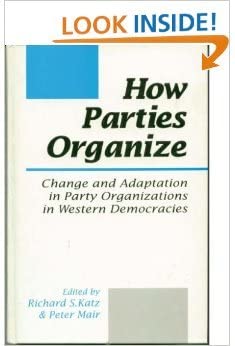
How Parties Organize: Change and Adaptation in Party Organizations in Western Democracies
Author(s): Richard S. Katz (Editor), Peter Mair
- Publisher: SAGE Publications Ltd
- Publication Date: 29 Nov. 1994
- Edition: 1st
- Language: English
- Print length: 384 pages
- ISBN-10: 0803979606
- ISBN-13: 9780803979604
Book Description
The contributors are recognized authorities on the party systems of their countries, and have all been involved in gathering data on party membership, party finance and the internal structure of power. They add to the analysis of these original data an expert knowledge of the wider political patterns in their countries, and thus provide insight into the development of parties and party systems from the perspective of party organizations themselves. How Parties Organize offers the most systematic and comparable analysis of party organization in contemporary Europe and the United States.
Editorial Reviews
Review
`A ground-breaking research study, composed of twelve country studies plus an introductory chapter and an overview on the development of transnational party federations in Western Europe. What is provided in the individual chapters, each written by a leading authority, is not another set of “offical data” on party organizations in the country examined but a thorough insight into the highly complex relationship between different sections of a party, parties and citizens as well as parties and the state…. the volume maintains a remarkably high degree of coheremc which is, not least, the merit of Peter Mair′s excellent introduction′ – Political Studies
`Most people in the know will already be aware of this book, the latest publication to emerge from the mammoth Katz/Mair research programme on political parties. In a very real sense, therefore, any review is as much a commentary on the research programme as a whole as on any one of its publications. There can be no doubt that the Katz/Mair project is a very important undertaking, at the heart of European political science. The reasons for this have in part to do with the intellectual quality of the output, and in part to do with the professional logistics of organizing such an undertaking…. Following the opening chapter is a series of country-specific analyses that put some empirical flesh on these theoretical bones. The authors of each are members of the research project, acknowledged experts in their field, and provide very sound analyses. The fact that the authors have been working to a common brief for some time now means that the chapters fit together much better than those in most edited volumes…. The net result is a very useful collection of chapters that anyone writing on party politics will value. The very scale of the Katz/Mair project adds to its importance… this ambitious programme, by virtue of the fact that it has co-ordinated so many people′s activities over such a long time, is likely to be the only show in town for some time to come. Others may write about party organization, of course, but taking on, or replicating, the Katz/Mair research team would be a very daunting prospect indeed. In effect, this group is putting together primary data on party organizations that will be the raw material for work in this field for quite a few years to come. This is yet another reason why How Parties Organize simply cannot be ignored′ – Irish Political Studies
About the Author
Peter Mair is Professor of Political Science and Comparative Politics at the University of Leiden, and is co-editor of the European Journal of Political Research.
Richard S Katz and Peter Mair are also co-editors of Party Organizations: A Data Handbook (Sage, 1992).
Contributors
Katz & Mair: How Parties Organize
Luciano Bardi Universita di Bologna
Lars Bille University of Copenhagen
Kris Deschouwer Vrije Universiteit Brussel
David Farrell University of Manchester
Ruud Koole University of Leiden
Leonardo Morlino Universita di Firenze
Wolfgang C Muller Universitat Wien
Jon Pierre Goteborgs Universitet
Thomas Poguntke Universitat Mannheim
Jan Sundberg University of Helsinki
Lars Svasand University of Bergen
Paul Webb Brunel University
Anders Widfeldt Goteborgs Universitet