 Wow! eBook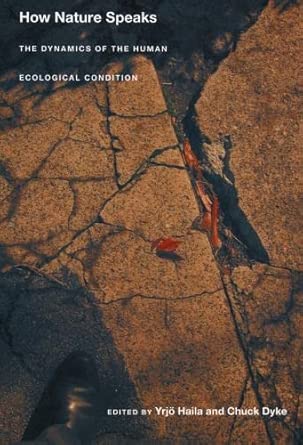
How Nature Speaks: The Dynamics of the Human Ecological Condition
Author(s): Yrjo Haila (Editor), Chuck Dyke
- Publisher: Duke University Press Books
- Publication Date: 17 Mar. 2006
- Language: English
- Print length: 344 pages
- ISBN-10: 0822337258
- ISBN-13: 9780822337256
Book Description
Exploring ways of conceiving the complexity and multiplicity of humans’ many interactive relationships with the environment, the contributors provide in-depth case studies of the interweaving of culture and nature in socio-historical processes. The case studies focus on the origin of environmental movements, the politicization of environmental issues in city politics, the development of a local energy production system, and the convergence of forest management practices toward a dominant scheme. They are supported by explorations of big-picture issues: recurring themes in studies of social and environmental dynamics, the difficulties of deliberative democracy, and the potential gains for socio-ecological research offered by developmental systems theory and Pierre Bourdieu’s theory of intentionality.
How Nature Speaks includes a helpful primer, “On Thinking Dynamically about the Human Ecological Condition,” which explains the basic principles of complexity and nonlinear thinking.
Contributors. Chuck Dyke, Yrjö Haila, Ari Jokinen, Ville Lähde, Markus Laine, Iordanis Marcoulatos, John O’Neill, Susan Oyama, Taru Peltola, Lasse Peltonen, John Shotter, Peter Taylor
Editorial Reviews
Review
“The strength of the collection lies in the contributors’ creative and exploratory applications of scientific models in complexity and non-linear thinking to social movements and political debate.” — Cheryl Lousley ―
The Goose“This is not just another book on ecology! It is a book that makes the reader contemplate the most appropriate way to think about ecology.” — Hefin Jones ―
BiologistReview
From the Back Cover
About the Author
Yrjö Haila is Professor of Environmental Policy at the University of Tampere in Finland. Among his books are Humanity and Nature (with Richard Levins) and several books in Finnish.
Chuck Dyke is Professor of Philosophy at Temple University. He is the author of The Evolutionary Dynamics of Complex Systems and Through the Genetic Maze.
Excerpt. © Reprinted by permission. All rights reserved.
How Nature Speaks
The Dynamics of the Human Ecological Condition
DUKE UNIVERSITY PRESS
Copyright © 2006 DUKE UNIVERSITY PRESS
All right reserved.
ISBN: 978-0-8223-3725-6
Contents
PREFACE……………………………………………………………………………………………………………………..viiYRJ HAILA AND CHUCK DYKE Introduction: What to Say about Nature’s “Speech”………………………………………………………..1SUSAN OYAMA Speaking of Nature………………………………………………………………………………………………..49CHUCK DYKE Natural Speech: A Hoary Story……………………………………………………………………………………….66VILLE LHDE Gardens, Climate Changes, and Cultures: An Exploration into the Historical Nature of Environmental Problems…………………78JOHN SHOTTER Participative Thinking: “Seeing the Face” and “Hearing the Voice” of Nature…………………………………………….106IORDANIS MARCOULATOS Rethinking Intentionality: A Bourdieuian Perspective………………………………………………………….127LASSE PELTONEN Fluids on the Move: An Analogical Account of Environmental Mobilization………………………………………………150MARKUS LAINE Fight Over the Face of Tampere: A Sneaking Transformation of a Local Political Field…………………………………….177ARI JOKINEN Stand/ardization and Entrainment in Forest Management…………………………………………………………………198TARU PELTOLA Calculating the Futures: Stability and Change in a Local Energy Production System……………………………………….218PETER TAYLOR Exploring Themes about Social Agency through Interpretation of Diagrams of Nature and Society…………………………….235JOHN O’NEILL Who Speaks for Nature?……………………………………………………………………………………………261CHUCK DYKE Appendix: Primer: On Thinking Dynamically about the Human Ecological Condition…………………………………………….279REFERENCES…………………………………………………………………………………………………………………..303NOTES ON THE CONTRIBUTORS……………………………………………………………………………………………………..323INDEX……………………………………………………………………………………………………………………….325
Chapter One
Speaking of Nature
Susan Oyama
SPEAKING ABOUT SOMETHING is also, to some extent, saying how we think it speaks. To say that humans have unconscious drives, for example, is also to say how we believe people reveal themselves to us-in a sense, how they speak or don’t speak. To begin this discussion, therefore, I am going to engage in a little rhetorical exploitation, using Chuck Dyke’s essay (this volume) about “natural speech” to make a point about this theme of speaking. Although I am basically in sympathy with his declaration that Nature doesn’t speak, I suggest that his denial implies a model of the human subject that we can question. I suspect that Dyke does question it, and that he will forgive this use of his spirited contribution: our agreements are significant, our differences minor. My suggestion is that if, in a systems-informed spirit, we understand our own natures and behavior to emerge in interaction rather than being “expressed” from within; if we are understood not as cleanly bounded, fixed realities but as always changing, always situated in worlds that are stable in some respects, variable in others; if our speaking is not the conveyance of fixed packets of meaning or “information” from one brain to another but just one mode by which we relate to each other, it may turn out that Nature “speaks” in ways not so very different from the ways we ourselves do. Insofar as this is the case, our speech about the “speech” of other people and about the rest of the worlds of which we are part must be rich, nuanced, tentative, and flexible, and we must always be ready to acknowledge the part we play in the generation of the speakings we observe. Nature doesn’t speak as an autonomous being with a determinate nature, communicating her fixed truths to us, but then neither do we speak to each other this way; once we recast our view of our own natures and our relations with one another, there is much less difference between our speakings among ourselves and the kind of interactive interrogating and attending used in studying the rest of the world.
I begin with a mini-autobiography. The concept of the developmental system was part of an attempt to resolve the difficulties that attend certain more conventional understandings of life processes and interrelationships, so knowing what difficulties I encountered should make it easier to understand my particular takes on systems-talk and nature-talk. It should make clear, for instance, why it has been important to me to rework a variety of inside-outside boundaries; to include the environment in the developmental system rather than making it a location, or a mere container or source of materials and constraints, or even an independent but cooperating “partner”; to realign the definitions of nature and nurture, thus broadening our views of development, evolution, and inheritance. Some of the key ideas in that realignment, often called developmental systems theory (DST), are sketched. Then I mention some challenges faced by those working with this conceptual scheme. If we are trying to develop an alternative view of life processes, how can we use the language of systems, construction, and interaction in a way that is both shareable and true to the vision we are constructing? Finally, I return to our theme with a speculative coda on agency. Along the way, I hope to show how intimately, and interestingly, the question How does nature speak? is connected to the ways we speak of nature, as well as the ways we speak of, and to, each other.
(MY) LIFE BEFORE DEVELOPMENTAL SYSTEMS
What I do is probably best described as philosophy of biology, but my undergraduate training was in psychology. Psychology is a field completely informed by nature-nurture dichotomies and shot through with allied oppositions like individual-social and mind-body. My graduate studies in psycholinguistics were housed in an interdisciplinary department of “social relations,” which included developmental, social, cognitive, and clinical (but not comparative, experimental, or physiological) psychology; cultural (but not physical) anthropology; and sociology. There is a whole intellectual and social history in that list. On the then existing academic landscape, these were all largely “social” and, to that extent, not “biological.” Then as now, the schisms between biology and culture, between nature and nurture, ordered the content of individual disciplines, shaping their very identities as disciplines (and those of their practitioners), and therefore the relations among them. This in turn kept the rifts from being effectively bridged, despite the best efforts of concerned scholars. Meanwhile, successive generations continue to be raised on the intricate geographies, forbidden territories, and blind canyons of these divided conceptual terrains.
A classic nature-nurture question, in fact, was the occasion for my dissertation on a sensitive period for second language acquisition: a restricted period when young humans can learn a language with native proficiency. The notion of a preprogrammed timetable regulating exposure to outside forces evoked both embryology’s critical period for tissue determination and ethology’s imprinting (think of ethologist Konrad Lorenz’s ducklings, faithfully following him because he was the first moving object they spied on hatching). Then as now, such time limitations on development were treated as evidence for a “biological base,” indispensable in the era of Chomskian linguistic nativism. As I read in psycholinguistics proper, however, and eventually in various areas of biology, comparative psychology, and philosophy of biology, I became less and less sure of what a biological base could be, or much the same thing, what the alternative was. And if biological bases were unclear, then so were similar terms, such as innate, maturational, genetic, inherited, programmed, and so on, as well as their opposites acquired, environmental, and revealingly, developed. So the basic concepts were surprisingly obscure, and the situation was scarcely helped by the fact that terms were usually not defined but were apparently assumed to be transparent and universally accepted. When a definition was offered, it was typically taken from a closed circle of synonyms, so that if you asked what it meant for something to be maturational, you were told that it was programmed (or biological, or innate), and if you then wanted to know what programmed meant, you were told that it was innate, maturational, or in the genes. I need hardly add that innateness was apt to be defined as programmed or biological, and so forth, to everybody’s increasing irritation. Ambiguous terms were used in a variety of ways without qualification, and as a result, evidence was sometimes mustered with a cavalier attitude that would not be tolerated under other circumstances. Occasionally such definitional circles were unexpectedly revealing: hearing that innate means physical, for instance (as I did once, from a behavior geneticist who ought to have known better), makes one wonder, Physical as opposed to what? More often, these (inadvertent) games just annoyed both parties; they revealed that the “common knowledge” was alarmingly murky, and that it was not fun either to ask or to be asked to clarify it.
Common Ground
One thing that made this situation possible was that despite the lack of agreement about particular meanings and usages, many broader assumptions were largely shared. Perhaps most basic of these was what I have called developmental dualism, the belief in two sources of developmental causation, one internal and the other external. Whether these were conceptualized as the genes and everything else in the universe, biology and culture, physiology and learning, or some other inside-outside pair, the internal causes tended to be treated as somehow primary. The genes, for example, are usually thought to control development with a centralized autonomy that imbues their products with a peculiar kind of necessity. Nature speaks through the genes. Or, in the sometimes grandiose rhetoric of the Human Genome Project, in which science succeeded in sequencing “the” human genome, genes are the language in which God wrote the Book of Life. In comparison, external influences on development tend to be treated as secondary: contingent, capricious, diffuse.
A parallel dualism exists in evolutionary theory, but with the causal polarity reversed. Here, Nature’s voice is external; she speaks by setting environmental problems for organisms to solve, punishing them when they fail. In the evolutionary story, that is, Nature’s voice is the voice of natural selection, typically considered to be life’s primary formative agent over the span of millennia. Selection, in this view, confers the genes’ extraordinary powers on them. Now the secondary influences are internal, supplied by development itself, in the form of “developmental constraints on selection” (Oyama 2000a, chap. 5).
Consider Nature, speaking. Logos, as Dyke notes elsewhere in this volume, no longer belongs only to God, or at least, not to the traditional God of organized religion. Setting aside some complications he mentions, we could say that in today’s world (at least that part that doesn’t reject evolution as heresy), natural selection has a monopoly on that precious commodity. Historically God’s competitor for authorship of life, natural selection is no idle chatterer; for many people it is the true giver of the Word, the all-knowing, all-seeing shaper of the living world. As Yrj Haila and Peter Taylor (2001, 95) observe, “If the essence of natural selection is selection of genes, and organisms are ‘really’ optimization vehicles for their genes, then changes in gene frequencies from generation to generation give a faithful reflection of the environment of the organisms as it ‘really is.'” Since the advent of gene-level selection, in fact, as these authors imply, the ultimate goal of all life has become narrowly circumscribed. In Richard Dawkins’s (1982) gene’s-eye view, what counts is not the reproduction of the mere organismic “vehicle” but only the propagation of the gene itself, for the sake of whose replication the vehicle exists in the first place. Both executor and beneficiary of the evolutionary legacy, the gene aims, in this account, to make other genes in its own image. All else is instrumental to that goal. In many ways, then, DNA becomes the carrier of fate. (Try substituting “It is written” every time you see “It’s genetic”-it works shockingly well.)
The gene, then, is hailed as Nature’s Chosen (Selected!) Molecule, the agent into which the evolutionary Word is breathed, the worker of the ubiquitous secular miracles of life, including much of development, mind, and behavior. The dominance of the language of language in genetics, in fact, is striking and fits all too neatly with our discussion of Logos: geneticists’ technical vocabulary (not, they insist, metaphoric) is rife with codes, translations, transcriptions, editing, sense and non-sense, along with comparisons of bases to letters, of genomes to libraries. From cognitive and computer science, meanwhile, engaged in constant conceptual and terminological cross-fertilization with molecular biology, come information, transmission, representations, programs, and algorithms.
Genes as Gods
In this context, the gene is the God of Nature made Word in the heart of every cell. “The ghost in the ghost in the machine” in my The Ontogeny of Information (Oyama 2000b) was my attempt to capture something of this gene-god-word-soul connection (see Nelkin and Lindee 1995). The ghost in the machine is the explanatorily redundant entity placed inside a person to account for feelings, wants, actions-the homunculus that has so long bedeviled philosophers’ efforts to make sense of the mind. In like manner, I argued, we imagine a genetic program in the nucleus, as though the actual material cell, with all its complexity and its complex surroundings, were inadequate to do the cell’s work. At the level of whole animals, the gene is also thought to explain behavior, perception, developmental propensities, and more, that cannot be accounted for by the organism’s own intelligence. It is treated, in short, as an alternative intelligence or agency. Thus, the old opposition of the innate to the acquired is recast as a distinction between innate information carried in the DNA and information gained through the senses, so that an “instinctive” act is authored by an organism’s genes, not by the organism itself. To observe such an act is to hear (its) Nature speak.
No wonder critiques of biological dichotomies are so unstable, even when they are on target. The conceptual background sketched here ensures that the dualisms will be continuously recreated, even in the very discourses meant to eliminate them. Hence my description of nature and nurture as phenotypic products and the developmental processes that produce them, rather than as alternative causal agencies. The companion move is made by shifting temporal scales and defining evolution as change in the constitution and distribution of developmental systems. Instead of being fixed at conception, natures are multiple and changing over the life span. Instead of being the internal cause of development, natures are changing products of development. (As such, they are resources for, and so causes of, their own future development.) A nature is simply a phenotype-an organism-in-transition through the life cycle-whereas nurture is all the developmental processes that contribute to a life.
OVERVIEW OF DEVELOPMENTAL SYSTEMS THEORY
In my work on the concept of the developmental system I have attempted to deal with a whole complex of interlocked problems, including the causal dualisms alluded to earlier. A systems approach to life processes can be characterized negatively, to highlight the difficulties to which it is a response. Put this way, it is nongenocentric, nonpreformationist, nonreductionist, nonessentialist, and nondualistic. More positively, it is a constructivist interactionist approach to development and evolution. But every word in that description can, and will, be contested.
A general outline may help. The developmental system consists of the organism and all the developmentally relevant aspects of its environment, micro- as well as macroscopic, biotic as well as inanimate. The system-the organism and its developmental environment-emerges through the interaction (hence constructivist interaction) of many different kinds of resources or interactants, some within the skin, many not. These interactants define, constrain, and influence each other as interactants, for any factor’s role in the system depends on its relations with the others. There is no single, centralized control of the processes of development. Rather, it is precisely the interactions of these changing components that give rise to (constitute) the changing system. The environment here is not just a place or a supplier of materials; it is an integral part of a constructive system. For me, the developmental system, existing as it does on a variety of scales of time and magnitude, gives a synthetic alternative to both developmental and evolutionary dualisms. It reframes traditional research, opening new avenues of inquiry. Although I have tended to resist reducing this approach to a list of principles, the following “key ideas and methodological strategies,” adapted from my book, Evolution’s Eye (Oyama 2000a, 2-7), give a relatively concise introduction to the perspective:
1. The philosopher’s tool, parity of reasoning, is frequently employed in DST. We discern the logic supporting some argument and then apply it to other events or entities with which it has not been used before. We can in this way see if various devices for maintaining a privileged place for genes in biological accounts can consistently be restricted to them alone. If genes are given causal priority even when other factors meet the same criteria, assumptions are being passed off as conclusions.
(Continues…)
Excerpted from How Nature Speaks Copyright © 2006 by DUKE UNIVERSITY PRESS. Excerpted by permission.
All rights reserved. No part of this excerpt may be reproduced or reprinted without permission in writing from the publisher.
Excerpts are provided by Dial-A-Book Inc. solely for the personal use of visitors to this web site.


