 Wow! eBook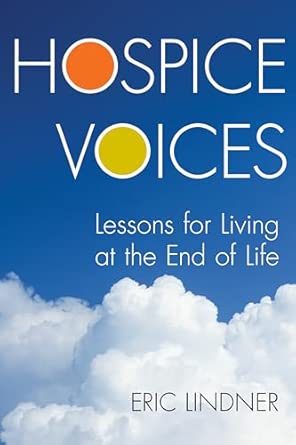
Hospice Voices: Lessons for Living at the End of Life
Author(s): Eric Lindner (Author)
- Publisher: Rowman & Littlefield Publishers
- Publication Date: 1 Oct. 2013
- Edition: 1st
- Language: English
- Print length: 232 pages
- ISBN-10: 1442220597
- ISBN-13: 9781442220591
Book Description
Editorial Reviews
Review
Author Eric Lindner’s debut is somewhat like an Irish wake. There are tears, but also joy and surprising levity. His writing honors and gives voice to those intensely personal moments that patients and their loved ones endure and find reasons to celebrate. . . .Lindner urges us to be still, present and listen with all our sensory antennae to the winks and whispers, hugs and mumbles, sighs and chuckles of those on the cusp of the Hereafter. The unspoken, the look, the long deep breath, the tear in the corner of the eye, and the tight grip of the hand these are the unspoken things that speak volumes. As a ‘companion caregiver,’ he ushers us into the lives of seven special patients, illuminating what’s relevant to and for the dying and the living. As far as the dying are concerned, Lindner observes, one of the most relevant things ‘is preserving a shred of privacy and dignity, which can be tough when you’re incontinent, your wig’s on backward, or you can’t find your false teeth.’ . . . Lindner is an honest teacher, not one to shy away from highlighting his own foibles. Yet he demonstrates how all of us, even the most ‘unskilled,’ can help alleviate pain and suffering — while learning great lessons in the process. He brings to us patients with whom we can all sympathize and identify. Lindner’s stories echo Khalil Gibran, who said, ‘Pain breaks the shell that encloses understanding.’ –Huffington Post
I started Hospice Voices and read it straight through. I was deeply moved by the extraordinary people I met in the book. –Will Schwalbe, author of the New York Times bestseller, The End of Your Life Book Club
Author Eric Lindner’s debut is somewhat like an Irish wake. There are tears, but also joy and surprising levity. His writing honors and gives voice to those intensely personal moments that patients and their loved ones endure and find reasons to celebrate. . . .Lindner urges us to be still, present and listen with all our sensory antennae to the winks and whispers, hugs and mumbles, sighs and chuckles of those on the cusp of the Hereafter. The unspoken, the look, the long deep breath, the tear in the corner of the eye, and the tight grip of the hand these are the unspoken things that speak volumes. As a ‘companion caregiver,’ he ushers us into the lives of seven special patients, illuminating what’s relevant to and for the dying and the living. As far as the dying are concerned, Lindner observes, one of the most relevant things ‘is preserving a shred of privacy and dignity, which can be tough when you’re incontinent, your wig’s on backward, or you can’t find your false teeth.’ . . . Lindner is an honest teacher, not one to shy away from highlighting his own foibles. Yet he demonstrates how all of us, even the most ‘unskilled,’ can help alleviate pain and suffering — while learning great lessons in the process. He brings to us patients with whom we can all sympathize and identify. Lindner’s stories echo Khalil Gibran, who said, ‘Pain breaks the shell that encloses understanding.’ –Huffington Post
I started Hospice Voices and read it straight through. I was deeply moved by the extraordinary people I met in the book. –Will Schwalbe, author of the New York Times bestseller, The End of Your Life Book Club
Author Eric Lindner’s debut is somewhat like an Irish wake. There are tears, but also joy and surprising levity. His writing honors and gives voice to those intensely personal moments that patients and their loved ones endure and find reasons to celebrate. . . .Lindner urges us to be still, present and listen with all our sensory antennae to the winks and whispers, hugs and mumbles, sighs and chuckles of those on the cusp of the Hereafter. The unspoken, the look, the long deep breath, the tear in the corner of the eye, and the tight grip of the hand these are the unspoken things that speak volumes. As a ‘companion caregiver,’ he ushers us into the lives of seven special patients, illuminating what’s relevant to and for the dying and the living. As far as the dying are concerned, Lindner observes, one of the most relevant things ‘is preserving a shred of privacy and dignity, which can be tough when you’re incontinent, your wig’s on backward, or you can’t find your false teeth.’ . . . Lindner is an honest teacher, not one to shy away from highlighting his own foibles. Yet he demonstrates how all of us, even the most ‘unskilled,’ can help alleviate pain and suffering — while learning great lessons in the process. He brings to us patients with whom we can all sympathize and identify. Lindner’s stories echo Khalil Gibran, who said, ‘Pain breaks the shell that encloses understanding.’ –Huffington Post
I started Hospice Voices and read it straight through. I was deeply moved by the extraordinary people I met in the book. –Will Schwalbe, author of the New York Times bestseller, The End of Your Life Book Club
About the Author
Excerpt. © Reprinted by permission. All rights reserved.
HOSPICE VOICES
Lessons for Living at the End of Life
By Eric Lindner
ROWMAN & LITTLEFIELD PUBLISHERS, INC.
Copyright © 2013 Rowman & Littlefield Publishers, Inc.
All rights reserved.
ISBN: 978-1-4422-2059-1
Contents
Preface…………………………………………………………..xiAn Aptly Named Caregiver……………………………………………1Find the Key That Unlocks Empathy……………………………………11Adversity Crumbles When Laughed At…………………………………..33Ownership Isn’t All That It’s Cracked Up to Be………………………..61Talk Less, Communicate More…………………………………………79We’re Only as Sick as Our Secrets……………………………………105Have Guns, Will Travel……………………………………………..141Live Discharge…………………………………………………….171Dos and Don’ts…………………………………………………….203Acknowledgments……………………………………………………209About the Author…………………………………………………..211
CHAPTER 1
AN APTLY NAMED CAREGIVER
Joy LeBaron seems really nice but distracted. “I’d love to have anothervolunteer … Eric—did you say your name was?” The executivedirector of Hospice Support of Fauquier County (Virginia), Inc., is aslight woman. She looks about five to ten years younger than me, so inher early to mid-forties. She also looks unpretentious: her ensembleof slacks, blouse, and cable-knit sweater is loose fitting; her short hair,simply cut, is a wavy, bang-heavy lattice of several shades of blonde.Though she clearly appreciates my walking in off the street in February2009, its not being on her to-do list is mildly disruptive; if, thatis, it’s possible to disrupt the disruption that governs Joy’s feng shui.Her small office is crammed with collapsed walkers and wheelchairs,stands of green oxygen tanks, a cluttered conference table, an overflowingbookcase. It smells musty. The coffee at the base of the potlooks carbonized. The phone rings a lot, kicking over to voicemail.”I’ve currently got twenty patients. I could add another twenty by theend of the day—if I had more volunteers. I can’t give my patients anywherenear the hours they want.”
According to the National Hospice and Palliative Care Organization(NHPCO), her overburdened not-for-profit is one of 5,300 inthe United States—quite a rate of growth, considering America’s firsthospice didn’t open until 1974, in New Haven, Connecticut (in associationwith Yale University). Circa 2013, more than half the world’shospices are located in the United States.
Joy’s an expert in “palliative care,” of which hospice is the best-knownparadigm. Such care is all about comforting, not curing. Of those whodie every year in the United States, nearly one in two are served by hospice.Moreover, as patients—and their loved ones—generally rate theirexperiences very favorably, and the per diem hospice cost is but a tinyfraction of the per diem hospital cost, hospice is a very bright componentin the oft-maligned U.S. healthcare system. One reason hospice isso efficient has to do with the role played by volunteers, nearly 500,000of whom serve 1,650,000 terminally ill patients, annually. At many hospices,the volunteers outnumber the paid professionals.
“Okay, then. So I’ve come to the right place. Throw me into thehopper.”
Suddenly I’m not there, as Joy’s hand shoots to her mouth, and shespins around. “Hhh! Where’d I put that? …” But then she remembersme. “Sorry …”
“I’m sorry. I should have called first.”
“No, no. I’m glad you stopped in. It’s just that … you need orientation,and training.”
“Fair enough. When’s your next session?”
“See, that’s just it. We’re so small, we’ve not got anything lined upright now. We’re strapped for funds. The financial crisis dried up ourdonor base. But,” she adds, “I’ll e-mail Rosalie Palermo at HaymarketHospice. They’re much bigger. Unlike us, they get funds from Medicareas well as from Virginia, Maryland, and the District of Columbia. Rosaliehas new volunteer sessions all the time. She has to.”
“Where are they based?”
Her head cants, she smiles. “Haymarket.”
“Gosh, what a dumb question. ‘Course.”
“They’ve got maybe a thousand volunteers! Plus a paid professionalstaff of seven hundred or so.”
“That does sound big.”
“Once you’re trained in Haymarket, you’d be on my roster, too. Weoften share patients.”
MARCH–MAY 2009
Joy follows through on her promise, and I exchange e-mails with Rosalie.Haymarket Hospice does hold regular orientation and trainingsessions; however, I’m often out of town.
Still, I fill out some forms and coax some friends into submitting referenceletters. (Asked to attest that I’m no psychopath, several hesitate.)Meanwhile, Rosalie puts me in touch with existing caregivers, bothvolunteers and paid professionals. “We find it often helps,” she says, “tohear why others are doing it and how reality does—and/or doesn’t—differfrom what they felt might be the case coming in.” I reach out to herreferrals, and learn a lot.
JUNE 2
6:23 p.m. My first orientation session is well under way in a convertedantebellum Virginia office building of fieldstone, brick, milk-paintedplaster, and lovely heart-of-pine, where, 148 Junes prior, a then-unknownlemon-sucking fanatical Presbyterian preacher named ThomasJackson was en route to rescue Confederate general P. G. T. Beauregardat First Bull Run—earning his nickname in the process: Stonewall.I can’t figure out how to buzz myself in using the after-hours intercomcontraption. After several frustrating minutes, Rosalie rescues me.
Trapped within the vestibule, I hear the elevator ding. She flies outand charges over, the rush of air billowing her purple blouse. “I hopethis isn’t a test,” I say. “It is,” says she. “But I grade on a curve!” “SorryI’m late,” I add. “No worries!” she responds. We swap smiles and shakehands, which rattles and clanks her chunky silver necklace, hoop earrings,and bracelets. Black bell-bottomed pants and pink ballet-flatshoes complete a sort of happy hippy ensemble.
We head down into the cool basement, where I join three otherprospective volunteers around a big, gleaming table. We wave, sayhi to each other. Clockwise from my right, there’s a thin, fidgety,frail-looking man whom I’d guess to be in his early thirties, in baggygrass-stained jodhpurs, an older, smiling señora in a floral blouse, anda dapper gentleman in natty herringbone, who I’m told once ran withDean Martin and other members of The Rat Pack. The coffee smellsgood, and the cookies look tempting. The softly playing New Age musicis soothing, but, as the bright overhead lights aren’t, I tug my caplow over my brow, shielding my sensitive eyes.
While we recruits sign in, settle in, sip, and nosh, Rosalie remainsstanding at the end of the table. “There may be one or two more stragglers,but I think this is probably it.”
Rosalie’s smile dominates her personality. Though expansive andexpressive, it can’t contain—or communicate—the full extent of herebullience, even when abetted by her halogen hazel eyes. In toto, it’sthe pardoning countenance of a Been There, Done That woman, of amother of two boys, one girl, and the ex-wife of a man who skippedtown just after she’d delivered his son. Her naturally curly auburn hairis now crazily spirally so, as a result of chemo. In a Boston accent shesays, “Please raise your hand if, during the past year, you’ve either experiencedthe loss of a loved one or you’re currently caring for someonewho’s terminally ill.”
All hands go up except mine, sending a few glances my way. LikeRosalie, whose mother received hospice care until her death in 2002,everyone else in the room, via brief summaries, explains how they’vebeen positively touched by hospice and, thus, wants to “give forward.”
But my motivations are atypical, and my path to this conference roomis anything but linear. It follows decades of discursive dabbling, from afew weeks in a hospital burn unit to nine years on the board of a biguniversity. All told, as a volunteer I’ve done some good and screwedsome things up. At fifty, with my second of two kids having just shippedoff to college, and my business on cruise control, the restlessness that’salways bubbled beneath the surface of my life is no longer masked bythe film of details attendant to earning a living and raising a family. Butbeing restive isn’t my only motivation. Most of my patients would beseniors, and I’ve always been attracted to “wise elders.” My wife closesthe sale. When I ask Ellen what she thinks of my spending ten hours aweek providing companion care for a revolving door of terminal illness,she replies, “It’s something not many people can do, but I do think youhave what it takes and should give it a try.”
The “why volunteer?” responses of my fellow trainees don’t tell memuch, but they’re suggestive. Everyone seems a bit diffident and/ortired, like it’s been a long day, illness, or both. Rosalie’s referrals hadshed more particulars on what I might be getting myself into.
My favorite motivational story is that of Gil Booker, Joy’s assistant.Having been diagnosed with kidney cancer at age forty-three, Gil wastwo days away from surgery when his doctor suddenly called it off.
“Off??” Gil exclaims. “Why?”
The oncologist explained how, notwithstanding all the consistentand encouraging images of a shrinking kidney mass, out of nowhere,the latest scan showed robust bone cancer. “It’s metastasized surprisinglyfast.” Pointing to bright spots in the skull, ribs, and elsewhere onthe image, the oncologist explained that surgery—any type of remediation—wasnow, unfortunately, hopeless. Consequently, the doctorstrongly advised Gil to forego the planned removal of the kidney massand, instead, get his will in order, draft up a Bucket List, and wring outas much enjoyment as he can, “until it becomes too much.” (Bone canceris excruciatingly painful.)
Naturally, Gil was in shock. Naturally, once home, he and his wifehugged a lot, cried a lot. Less naturally, Gil ignored his oncologist andinsisted on going ahead with the scheduled surgery. The result? In additionto successfully removing the kidney tumor, several bone biopsiesreveal that there was in fact no bone cancer. “We can’t explain it!” theoncologist exclaimed. “We don’t know what those bright lights on theimaging were!” Gil’s been a hospice volunteer ever since, for twenty-fiveyears.
I’m thinking of Gil as Rosalie passes around a sign-in sheet, along withtroves of information, a small pile for each prospect. It’s hardly lightreading, what with book, pamphlet, monograph, and one-page handouttitles like “Good Mourning,” “Infection Control,” “Hazardous Materials–ManagementProgram,” “101 Things to Do with a Person Who HasAlzheimer’s Disease,” and, in the event of suspected patient abuse,”Confidential Occurrence Report.”
“I know this is a lot of information,” says Rosalie. “But please read itall, when you get a chance. The most important information is the list ofDos and Don’ts in that purple-bound book there, titled Student Manual.
“Dos,” she explains, “like being dependable. Being genuine.” Dolisten. Do keep good boundaries, both physical and philosophical, suchas religion. Do encourage a life review. Do be comfortable with quiet;”silence is okay.” Do remember to care for yourself, and to communicatewith the volunteer manager/hospice team, both in regular written reportsand, if necessary, by telephone call, if something’s in need of moreurgent attention. Do remember that little things mean a lot; “what yougive is immeasurable.” Finally, as tragic and sickening as this sounds, byall means, do report signs of abuse.
“Meanwhile, on the flip side, don’t visit your patient if you’re ill.”Don’t play doctor or nurse, either by offering advice or dispensing anysort of medication. Don’t judge; “especially don’t try to referee a familysquabble!” Don’t break confidentiality. Don’t give unsolicited advice;here again, religion often comes into play. Don’t take on more patientsthan you can manage. Don’t take it personally—whatever. “Don’t expectyour patient to conform to your standards/expectations.” Don’t interruptwhen the patient is sharing. “And, last but not least, don’t assumeyou know what their needs/feelings are.”
“That’s all?” says a prospect, voicing the reaction of us all.
Rosalie nods, and smiles. “I know. It’s a lot. But, first, as to the reporting,we don’t expect much. Just the basics, anything noteworthy. Nobodylikes paperwork. More generally, it boils down to one thing, really: beingcompassionate. Compassion trumps everything. As those of you who’vesuffered through a loss—or who are now suffering—know, I’d wager. Iam very sorry for what you’ve gone through, or are going through now. Ihope I might, maybe, offer you some tools to ease your suffering.
“Thank you, all of you, for your willingness to volunteer. There’s suchan enormous need out there.”
According to NHPCO, each year nearly five hundred thousand volunteersrack up a total of twenty million hours. This translates into lessthan an hour a week; most patients are looking for three to five hours,if not more. Haymarket Hospice boasts “nearly 1,500 patient contactseach and every day.” However, thin volunteer ranks mean many such”patient contacts” are no more than five-minute phone calls. “I’m notcomplaining!” Rosalie is quick to note. “I understand, totally! We allhave such busy lives … our own bundle of existing commitments, obligations,and other priorities. But, still …”
The volunteer shortage is tragic in two ways. First, about two-thirdsof America’s terminally ill die in hospitals or nursing homes, as opposedto in their own home (or the home of a loved one), where nearly nine inten would prefer to die. Second, the last emotion hundreds of thousandsof Americans experience is—loneliness. “Being lonely at the end of lifeis so sad, so tragic. I’ve heard it—loneliness—called the most desperateof all English words. And it’s far worse in most other countries.
“But let’s not dwell on a downer, right? Once we’re through with ournine hours of orientation and training, and you’re out in the field, I’mconfident that, like almost all volunteers report, you’re going to experiencesomething truly special, a real win-win. In addition to helpingothers, and despite the unavoidable sadness, you’ll be helping yourself,too, by discovering a sublime sense of fulfillment. I know it! I’ve everyconfidence you’ll feel as I do: helping people at this stage of their livesfeel less alone is a real privilege.
“Now … a bit about me. I’ve been around the block!”
I’ll say. By the sound of it, she’s just about seen it all: miraculous recoveries,abrupt deaths; selfless doting by strangers, shocking abandonmentby supposed loved ones; warm collegiality among hospice workers,stymying by higher-ups in a cold corporate bureaucracy. “I need to warnyou,” Rosalie cautions, “we’ve got nearly seven hundred paid staff anda thousand volunteers interacting with terminally ill patients more thana thousand times each day …” She shakes her head. “At times, just theHIPAA requirements—”
She pauses, in response to several puzzled stares. “Sorry. HIPAAstands for the Health Insurance Portability and Accountability Act. It’sa mouthful, I know. You’ll be able to read all about it, in your packet.”
“Oh,” says the man in the grass-stained jodhpurs.
“What I was getting at is that, sometimes, wanting to be compassionateconflicts with needing to be legally compliant. Now, sometimes, Ithink the view from the front lines—from you guys—makes a lot moresense than what the armchair quarterbacks have to say, back in there.”She wags her head toward the warren of offices beyond the recentlytuck-pointed stone walls.
“But I don’t want to blow things out of proportion, either. There area lot of good people in executive management. And, like at most places,they often got there by working themselves up through the ranks. Manyhave far more experience than me. I’ve only been doing this for abouta year, drawn by how much help it was to my mom, and me, during herlast weeks, and months, in oh-two.
“I bring something else to the table, too. I’m a cancer survivor. Ithought I’d bought the farm.” Rosalie looks around, prompting severalknowing nods.
“But, we’ll all buy the farm, some day. As everyone from Buddha toBen Franklin has remarked, we all have a terminal condition. It’s calledbeing human!
“We pretty much all begin the same, as a former midwife now onstaff will tell you. It’s more our endings that vary, like the seven hundredthousand Americans who die each year of heart disease versusthe seventy thousand Alzheimer’s claims. Hmm …” An index fingertaps her lower lip. “Ten hearts for every one mind. Fodder for a poet,if you ask me.
“So … terminal illness, which seems such a concrete, finite, hard-edgedterm, is actually somewhat slippery. Though it depends on semantics,it really boils down to two things: First, that our time-relatedframe of reference shifts, from the flipping of calendar pages to theticking of a stopwatch. Second, that our cause of death appears reasonablypredictable. However, as you get some experience under yourbelts, you’ll begin to see the wiggle room in both of these terms, too—reasonableand predictable. For instance, Medicare will only reimburseHaymarket Hospice if two conditions exist. First, the patient must havegiven up trying to seek a cure. Second, a doctor must say that the patientis not expected to last longer than six months.
“But I’ll share with you two little hospice secrets. Treasures, really.First, we in hospice like to say that, between the curing of and caring forpatients, there’s plenty of room for healing—of human beings. Second,for every six patients that America’s five thousand–plus hospices took inlast year, one was discharged—alive!
(Continues…)Excerpted from HOSPICE VOICES by Eric Lindner. Copyright © 2013 Rowman & Littlefield Publishers, Inc.. Excerpted by permission of ROWMAN & LITTLEFIELD PUBLISHERS, INC..
All rights reserved. No part of this excerpt may be reproduced or reprinted without permission in writing from the publisher.
Excerpts are provided by Dial-A-Book Inc. solely for the personal use of visitors to this web site.



