Wow! eBook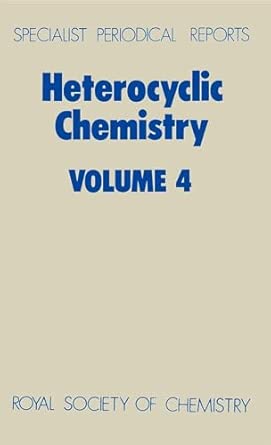
Heterocyclic Chemistry: Volume 4 Edition. ed. Edition
Author(s): H Suschitzky
- Publisher: Royal Society of Chemistry
- Publication Date: 1 Jan. 1985
- Edition: Edition. ed.
- Language: English
- Print length: 486 pages
- ISBN-10: 0851868339
- ISBN-13: 9780851868332
Book Description
Reflecting the growing volume of published work in this field, researchers will find this book an invaluable source of information on current methods and applications.
Editorial Reviews
Excerpt. © Reprinted by permission. All rights reserved.
Heterocyclic Chemistry Volume 4
A Review of the Literature Abstracted Between July 1981 and June 1982
By H. Suschitzky, O. Meth-Cohn
The Royal Society of Chemistry
Copyright © 1985 The Royal Society of Chemistry
All rights reserved.
ISBN: 978-0-85186-833-2
Contents
Chapter 1 Three-Membered Ring Systems By T. J. Mason, 1,
Chapter 2 Four-Membered Ring Systems By T. V. Lee, 57,
Chapter 3 Five-Membered Ring Systems By G. V. Boyd, S. Gronowitz, O. Guilloton, and H. Quiniou, 71,
Chapter 4 Six-Membered Ring Systems By S. D. Carter, G. W. H. Cheeseman, and G. P. Ellis, 285,
Chapter 5 Seven-Membered Ring Systems By J. T. Sharp, 389,
Chapter 6 Eight-Membered and Larger Ring Systems By J. M. E. Quirke, 419,
Chapter 7 Bridged Systems By J. R. Malpass, 441,
CHAPTER 1
Three-Membered Ring Systems
BY T. J. MASON
1 Reviews
General. – Thermally induced ring-enlargement of vinyl three-membered heterocycles has been reviewed.
Rings containing Oxygen. – The catalytic epoxidations of alkenes with hydroperoxides have been surveyed, as have transition-metal-catalysed stereo-controlled epoxidations. A major review of oxiran chemistry (956 references) has been published as a chapter in Saul Patai’s series on the Chemistry of Functional Groups (1980).
Theoretical aspects of the thermal and general chemical reactions of oxirans have been treated by the application of quantum-mechanical methods to the study of the reactions of the triplet states of isomers.
Rings containing Nitrogen. – The reactions of aziridines with alkylidenephosphoranes and with phosphorus(III) nucleophiles and the reactions of 3-amino-2H-azirines with NH-acidic compounds have been reviewed.
Rings containing Sulphur. – The subject of a lecture given in 1980 and published in 1981 was some aspects of the chemistry of episulphoxides.
2 Oxirans
Preparation. – Oxidation of Alkenes to Oxirans, using Oxygen or Oxygen-containing Gases. Research into the improvement of the silver catalysts that are used in the commercial oxidation of ethene has resulted in continued interest in the doping of the catalyst with alkali-metal salts, particularly caesium. Spent catalyst may be rejuvenated by treatment with NH3, MeOH, and CsNO3.
Silver powder with a high surface area has been used to determine the reactivity of adsorbed oxygen for the epoxidation of perdeuterioethene. The results suggest that the alkene oxide is formed only if both surface and subsurface adsorbed oxygen are present. Two types of adsorbed oxygen were invoked to explain the results obtained when studying the solid-electrolyte aided oxidation of ethene on polycrystalline silver. Solid electrolyte potentiometry (SEP) was used to monitor the chemical potential of the adsorbed oxygen, the activity of which was not affected by the presence of CO2. This latter appeared to inhibit only the epoxidation reaction. The same group have also reported that both the selectivity for and the yield of ethylene oxide on polycrystalline silver may be increased by electrochemical pumping of oxygen (O2-). The reaction was studied in the solid electrolyte cell C2H4, C2H4O, CO2, O2, Ag|ZrO2 (Y2O3)|Ag, air, at temperatures around 400°C and at atmospheric pressure. The cell behaved as a normal epoxidation catalyst under open-circuit conditions. A study has been made of the bond energies between adsorbed oxygen and various supported silver catalysts and of their relation ship to the activity of such catalysts for epoxidation of ethene. A linear free energy relationship between the mean heat of formation of a monolayer of surface AgO and the catalytic activity was found. Kinetic performance parameters have been calculated for a number of supported-silver epoxidation catalysts.
Direct oxygenation of alkenes other than ethene and propene is normally achieved in the liquid phase and in the presence of a catalyst or under u.v. irradiation. Thus aryl-oxirans (1; n = 1 or 4) were obtained in 37–71% yields by autoxidation of the corresponding 1-phenyl-cycloalkenes in the presence of cobalt naphthenate at 50°C.
Unbranched terminal alkenes yield epoxides during autoxidation in the presence of the soluble catalysts CoQ3, PrQ3, TiOQ2, and VOQ2 (Q = pentane-2,4-dionato). The autoxidation of aromatic vinyl ethers proceeds at room temperature even in the dark, but irradiation with u.v. light and the use of a radical generator facilitates the reactions which yield epoxides and carbonyl compounds in significant quantities.
Photo-epoxidation of alkenes in the presence of benzoins and oxygen has been shown to proceed via the benzoylperoxy radical (2), which is effectively trapped by alkene and subsequently yields predominantly trans-epoxides. The same intermediate radical (and, as a result, similar reactivities) has been observed during photo-epoxidation using benzoylformic acid (PhCOCOOH), but the reactivities of the alkenes were different from those obtained using peroxy-acids. A correction has been published to some previous studies on the efficiency of benzil-sensitized photo-epoxidation of trinorbornene. The new results indicate a lower yield of ≤ 2 moles of epoxide per mole of diketone that is consumed and thus suggest that a chain mechanism is not involved for such reactions.
A new reaction system has been reported in which molecular oxygen oxidizes alkenes to epoxides both thermally and photochemically, in the presence of SO2, under ambient conditions. Irradiation of a mixture of propene and SO2 in acetonitrile at 0°C caused absorption of O2, to yield propene oxide as the sole volatile product. A similar reaction occurred at 25°C in the dark, in the presence of potassium nitrite.
Direct ozonolysis of the parent vinyl sulphide gives (3) (40%), suggesting that oxiran intermediates might be involved more generally in the ozonolysis of vinyl derivatives. Ozonolysis of cis– and of trans-1,2-difluoroethene also yields epoxides with predominantly retained stereochemistry.
Oxidation of Alkenes to Oxirans by Peroxy-acids. An improved procedure for epoxidation using aromatic peroxy-acids has been reported. After a normal epoxidation with 3-chloroperoxybenzoic acid (mCPBA) in CH2 Cl2, activated KF is added to the crude mixture, and this results in the precipitation of both mCPBA and the aromatic acid by-product, leaving an acid-free reaction mixture for normal work-up. As an alternative, the insoluble mCPBA–KF complex itself may be used for the epoxidation of alkenes overnight at room temperature. After filtration and treatment of the CH2Cl2 solution with more KF (to ensure removal of any residual peroxy-acid), normal work-up leads to yields in excess of 95% for cyclohexene and styrene oxides.
The site-selectivity of oxidations by mCPBA is demonstrated in the con- version of (4; R = Me or Ph) into the corresponding ene epoxide (5). The product is sensitive to acid, so that the conversion is accomplished in a basic two-phase medium. Normal epoxidation of (6) with mCPBA leads to (7). The stereochemistries for such reactions are shown in the predominant formation of the β-epoxide (8) (81%) from the parent alkene, with 12% of the α-product. Similar epoxidation of the cannabinol (9) leads to a less stereo-specific isomer distribution of 27.3% and 18.2%. Remarkable stereoselectivity has been shown in the epoxidation of the 14,15-unsaturated oestratrienes (10). Whereas oxidation of 17β-esters and 17β-ethers gave 14α,15α-epoxides (≤ 59%), the 17β-urethane derivatives displayed a syn-directive effect to yield 14β,15β-epoxides (≤ 87%).
The rates of epoxidation of cyclododecene with a series of aliphatic peroxy-acids have been correlated, using the Taft equation. The reaction constant (ρ*) was + 2.0 and the steric constant (δ) was found to be essentially zero. A two-parameter correlation has been found for the effect of basicity and polarity of the solvent on the rate of epoxidation of propene with peracetic acid. Rate constants and activation parameters for the epoxidation of a number of cycloalkenes, including (11; R = H or COOMe), (12; R = H, Ph, or 2-furyl), {13), (14), and cyclo-octa-1,5-diene, have been measured. An isokinetic relationship was demonstrated, with the isokinetic temperature of 3°C. There was only a weak dependence of the rate on the structure of the alkenxe.
Alkenes have been epoxidized in high yield, using peroxyformic acid (prepared in situ from formic acid and 85% H2O2); thus a 90% yield of mono- epoxide has been prepared from trimethylcyclodecatriene.
Oxidation of Alkenes to Oxirans, using Peroxides. The peroxide ( 15; R = OOH) is a useful oxidant for a number of alkenes, giving epoxides in good to moderate yields and generating (15; R = OH). The reactivity of this peroxide is two orders of magnitude lower than that of peroxyacetic acid but at least one order of magnitude greater than that of a-peroxy-esters and -nitriles. Its selectivity relative to the structure of the alkene is similar to that for peroxyacetic acid.
A few years ago, hexafluoroacetone was shown to be an effective catalyst for the epoxidation of alkenes by H2O2. The reagent is highly toxic, however, and not commercially available, and so an alternative has been sought. An efficient alternative catalyst has been found to be hexafluoropropan-2-ol, but more recently it has been reported that tetrachloroacetone is a useful commercially available alternative. The reactive species is thought to be (16; R = OOH), the by-product of epoxidation being the hydrate (16; R = OH), which is thermally unstable and from which tetrachloroacetone may be regenerated. The yields are generally good and the selectivity is high, as illustrated by the formation of (17) (60%) from the epoxidation of 4-vinylcyclohexene with only 4% total yield of other possible mono- and di-epoxide products.
Two groups have studied the epoxidation of αβ-unsaturated ketones with alkaline H2O2 in methanol; a second-order process. Electron-releasing groups attached to the β-carbon atom in the alkene reduced the rate whereas electron-attracting groups had the reverse effect. In the case of (18; R = H or alkyl), the rate constants in 80% aqueous methanol decreased in the order H > Me > Pr > pentyl. Spectral studies suggested that the origin of this order of reactivity concerned hindrance to delocalization of charge in the intermediate.
Base-catalysed epoxidation of norandrostenone (19), using H2O2 in methanol, produced exclusively the β-epoxide in the A ring. It was suggested that the conformations of the A ring were such that the hydroperoxide group attached at the 5α- or 5β-positions could attain an axial confirmation. cis-Cyclo-octene oxide (20) has been prepared in 60% yield by epoxidation of cis-cyclo-octene by 30% H2O2 in MeCN at 25–35°C. A high yield of epoxide may be obtained by two-phase epoxidation of alkenes, using dichloroethane–water with Na2WO4 catalyst and a tetraalkylammonium salt as the phase-transfer agent.
One of the most commonly used types of catalyst for epoxidations using alkyl hydroperoxides is complexes of molybdenum. The yields can be almost quantitative, as observed when using the π-cyclopentadienyl complex Cp2 MoX2 (X = Cl or Br) with t-butyl hydroperoxide, which gives 98.4% of diepoxide from the dimer of cyclopentadiene. For the epoxidation of propene by t-butyl hydroperoxide and molybdenum salts of organic acids, the catalytic activity was little affected by the ligand on the metal. A similar insensitivity to ligand (and also to valency) was noted in the epoxidation of cholesteryl acetate with MoO2(acac)2, Mo(CO)6, and MoCl5. When cyclohexene was treated wtith t-butyl hydroperoxide and molybdenum porphyrins, cyclohexene oxide was obtained with up to 85% selectivity at total peroxide conversion (17–24 hr). A similar catalyst gave 97% of cis– and 99% of trans-hex-2-ene oxides from the cis– and trans-alkenes respectively.
A number of different catalysts have been used in the epoxidation of monoterpenes with t-butyl hydroperoxide and the conditions optimized. While oxidation of a-pinene in the presence of V(acac)3 gave cis-epoxide (4.4%), campholenic aldehyde was also obtained in the presence of Mo(CO)6.
The n.m.r. line-broadening method was applied to the determination of the kinetic parameters of the exchange reactions of cumene hydroperoxide, cumyl alcohol, and cyclohexene in the co-ordination sphere of the complex H2[Mo2O4(C2O4)2(H2O)2·4H2O·(CH3)CO. The results revealed that the first stage of both the decomposition of the hydroperoxide and the epoxidation reaction is the formation of an intermediate compound between a molybdenum(V) complex and the hydroperoxide.
Synthesis of Oxirans by Halohydrin Cyclizations and Related Reactions. One of the oldest commercial methods for the production of ethene oxide is the chlorohydrin route, involving chlorohydration of ethene followed by dehydrochlorination. An improved procedure for the second stage of this process has been reported in which a basic ion-exchange resin is used to remove the HCl that is generated during cyclization. The generation of styrene oxide (21; R = Ph) (85%) from PhCH2ClCH2Cl with 99% purity has been achieved by simple hydrolysis followed by elimination of HCl from the intermediate chlorohydrin, using aqueous NaOH. Other methods for cyclization include the use of sodium methoxide in methanol to generate (21 ; R = C10H7OCH2) from (22), reduction of (23) with sodium borohydride to yield the cis-epoxide (24), or the heating of β-halogeno-esters with ammonium or phosphonium salts; e.g., (25) and Bu4P+Br-, when heated at 180°C for 2 hours, gave (21; R = Me) (95%).
The phosphonate epoxide (28) has been prepared in 58% yield from the trimethylsilyl ether (26) via fluoride-ion-induced cyclization of the intermediate (27) (Scheme 1). The stereochemistry of bromohydrin (31), which yields the oxiran (33) after sequential reduction and treatment with a base, has been proved by the use of a novel oxidative bromocarbonation (Scheme 2). Enol (29) of known stereochemistry is converted into the cyclic bromo-carbonate (32) (79%) upon treatment of the lithium alkoxide of (29) with dry CO2 followed by Br2. Since (32), on treatment with base, gives (33), and the stereochemistry of (32) follows from that of (29), the structure of (31) is established.
Synthesis of Oxirans via Attack of a Carbanion on the Carbonyl Group of Aldehydes and Ketones. The dibromo-ketones [34; R = 4-MeC6H4, 4-MeOC6H4, 4-ClC6 H4, or 3,4-(MeO)2C6H3] cyclized on dissolving in MeONa–MeOH, refluxing, and standing for 10 hours at room temperature to give the compounds (35) (86–95%) by the Darzens mechanism. A rather useful, mild, and stereoselective synthesis of α,β-epoxyphenyl ketones (36; R1 = Me, R2 = PhCH2CH2, Ph, octyl, or 4-ClC6H4; R1 = Et, R2 = Ph or PhCH2CH2)(52–81%) involves the reaction of aldehydes R2CHO with α,α-dibromo-ketones PhCOCBr2R1 in the presence of SnF2.
The use of KCN in the synthesis of oxirans from α-bromo-ketones under phase-transfer conditions has been investigated. Treatment of (37) in CH2Cl2 with 40% aqueous KCN and aqueous Et3(PhCH2)N+Cl- at 20°C for 4 hours gave (38) (85%) as a 50 : 50 mixture of the cis– and the trans-isomers. Under homogeneous conditions, using DMF as a solvent , the same mixture was obtained in 61% yield, but the reaction can be made stereoselective for the cis-isomer in the presence of solid adsorbants. Owing to the insolubility of KCN, no reaction occurs between (37) and KCN in CH2Cl2, but when the same substrate is treated with aqueous KCN that is adsorbed on silica gel (CH2Cl2, at 20°C, for 4 hours), the oxiran (38) (95%) is produced, comprising 88% of the cis-isomer. A similar result is obtained by using benzene as solvent and alumina as adsorbant. Both silica gel and alumina are thought to facilitate the reaction by virtue of adsorbing the reacting species onto a surface upon which OH groups are plentiful. The combination of adsorption and hydrogen-bonding with OH groups on the surface is thought to explain the stereospecificity. Significantly, both activated carbon and Celite do not pro- mote the epoxidation, neither material being able to participate via surface hydrogen-bonding.
(Continues…)Excerpted from Heterocyclic Chemistry Volume 4 by H. Suschitzky, O. Meth-Cohn. Copyright © 1985 The Royal Society of Chemistry. Excerpted by permission of The Royal Society of Chemistry.
All rights reserved. No part of this excerpt may be reproduced or reprinted without permission in writing from the publisher.
Excerpts are provided by Dial-A-Book Inc. solely for the personal use of visitors to this web site.