Wow! eBook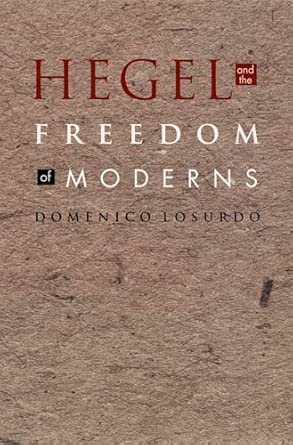
Hegel and the Freedom of Moderns
Author(s): Domenico Losurdo (Author), Jon Morris (Translator), Marella Morris (Translator)
- Publisher: Duke University Press Books
- Publication Date: 18 Aug. 2004
- Language: English
- Print length: 400 pages
- ISBN-10: 0822332531
- ISBN-13: 9780822332534
Book Description
Hegel and the Freedom of Moderns persuasively argues that the tug of war between “conservative” and “liberal” interpretations of Hegel has obscured and distorted the most important aspects of his political thought. Losurdo unravels this misleading dualism and provides an illuminating discussion of the relation between Hegel’s political philosophy and the thinking of Karl Marx and Friedrich Engels. He also discusses Hegel’s ideas in relation to the pertinent writings of other major figures of modern political philosophy such as Jean-Jacques Rousseau, John Locke, Edmund Burke, John Stuart Mill, Jeremy Bentham, Karl Popper, Norberto Bobbio, and Friedrich Hayek.
Editorial Reviews
Review
“Domenico Losurdo is one of the great contemporary authorities on Hegel; his work needs to be known in the English-speaking world.”—Fredric Jameson, Duke University
From the Back Cover
About the Author
Domenico Losurdo is Professor of Philosophy at the University of Urbino and President of the International Hegel-Marx Society for Dialectical Thought. He is the author of numerous books in Italian.
Excerpt. © Reprinted by permission. All rights reserved.
Hegel and the Freedom of Moderns
By Domenico Losurdo
Duke University Press
Copyright © 2004 Domenico Losurdo
All right reserved.
ISBN: 9780822332534
Chapter One
Searching for the “Authentic” Hegel
1. Censorship and Self-Censorship
In 1766, Immanuel Kant confessed in a letter: “Indeed I believe, with the firmest conviction and the utmost satisfaction, many things that I will never have the courage to say, but I will never say anything I do not believe.” At the time, Kant’s native Prussia was ruled by Friedrich II, an interlocutor and at times even a friend of the major representatives of the French Enlightenment, a king who flaunted his tolerance, at least with regard to religion and that which did not pose a threat to the governmental machine. Almost thirty years later, in 1794, the times are much more dramatic: Friedrich II has died, the restlessness caused by the French Revolution even on this side of the Rhine has made Prussian censorship particularly severe, and the authorities have become intolerant even on religious matters. On this occasion, Kant writes another letter to express his feelings and thoughts: yes, authorities can forbid him from “fully revealing his principles,” but that is-he declares-“what I have been doing thus far (and I do not regret it in the least).”
We do not have such explicit letters from Hegel. Yet, we do have several meaningful testimonies, elements, and facts. It is after the publication of the “complete edition of his works, especially his lectures” that Hegel has “an enormous impact:” this remark, by a young Friedrich Engels, is not unique. Two years earlier, commenting on the publication of the Lectures on the Philosophy of Religion, Johann K. F. Rosenkranz foresees that they will end up reinforcing the “hatred against Hegel’s philosophy.” While Hegel was still alive, his contemporaries noticed that in the Lectures he used a particularly bold and spirited language, and for this reason they went to great lengths to obtain them, even after they had been collected and printed in a volume. Sometimes they would go so far as to contact Hegel himself, who was very accessible and open about it, and who did not disclaim in any way the paternity of the lectures which his students transcribed and circulated even outside academia and sometimes even outside Germany. Reading one of those transcriptions, we stumble upon a revealing passage: “From France, the Enlightenment moved to Germany, where it gave birth to a new world of ideas. Its principles were interpreted more deeply. Yet, these new notions were not so often distinguished publicly from dogma; rather, sacrifices and distortions were made in order to maintain at least the appearance of the recognition of religion, something which is done, after all, even nowadays” (Ph. G., 916-17).
Which author or authors is Hegel referring to in this last statement? Or is it to be interpreted as a confession? One thing is certain: the techniques he describes are those of dissimulation and self-censorship, and the use of these techniques, as Hegel emphasizes, has been ongoing and has lasted through to the present. The above-cited passage is not the only one in which Hegel reveals his full awareness that the objective situation demands a careful and cautious style; even Johann Georg Hamann, he points out, was forced to “hide his satire from the royal authorities” (W, XI, 334).
And yet, resistance to facing this issue is still strong. One of Hegel’s most authoritative scholars, Claudio Cesa, does not seem willing to attribute much importance to the problems of censorship and self-censorship: “German intellectuals and academics could express themselves quite freely, within reason, of course.” In reality, even one of Hegel’s “moderate” disciples mentions, referring to the end of the 1920s and the beginning of the 1930s, his own “first struggle against censorship.” In a letter to his publisher, written in 1840 (and thus in circumstances that were undoubtedly less threatening than those in Prussia after the Karlsbad resolutions), Heinrich Heine writes: “As I said to you before, in writing this book I kept in mind your problems with censorship, and I have carried out a very conscientious self-censorship.” But why go so far, after all?
Let us compare ? 127 in the achroamatic text to that in the printed text of Philosophy of Right. In the former we read: “A man who is starving to death has the absolute right to violate the property of another; he is violating the property of another only in a limited fashion. The right of extreme need (Notrecht) does not imply violating the right of another as such: the interest is directed exclusively to a little piece of bread; one does not treat another as a person without rights” (V.Rph., IV, 341). In the printed text the figure of the starving man essentially disappears, and there remains only an allusion to the fact that the right of necessity can come “in collision with the rightful property of another,” while theft becomes “an injury only to a singular and limited aspect of freedom” (in the printed text Hegel chooses not to mention at all the “absolute right” that the starving man has to this theft). The effort at self-censorship is evident.
More examples could be produced. Here, however, it might be more useful to clarify the methods of censorship by means of a contrast between the text of the essay Reformbill, published in the Preu?ische Staatszeitung, and the text of Hegel’s manuscript. Thanks to the Hoffmeister edition we are able to examine the variations that have taken place: at least in appearance, the discourse centers exclusively upon England; and yet, unlike the original manuscript, the printed text is characterized by a constant effort to tone down the harshness of the criticism. Thus, the “greed” (Habsucht) of the dominant British classes and clergy in their oppression of the Irish people becomes mere “selfishness” (Eigennutz; B.Schr., 478). This term is not only milder, but more importantly, it has abandoned its political significance in favor of a tone that would be better suited to a moral lecture. The “aridity” of the principles that preside over England’s political and social order becomes mere “shallowness” (wenig Tiefe; B.Schr., 484), and the reference to its “most bizarre, most awkward” aspects (B.Schr., 463) disappears. In the same context, “absurdity” becomes “anomaly,” while the “depravity” (Verdorbenheit) that characterizes elections and that involves both the active and passive organs of corruption becomes once again “selfishness” (B.Schr., 466). If Hegel denounces the “presumptuousness” that British people have about their freedom, the State Gazette is decidedly more anglophile (something which is worth reflecting upon and which will be discussed later) and opts for the term “pride” (Stolz) (B.Schr., 482). We can even cite a more titillating example: the manuscript denounces the plague of Church tithes in England, titles which serve to finance the parasitical, dissolute life of a clergy that remains irremovable despite the gravity of the scandals it is often involved in. Even a priest who used to stroll “around the streets and on the bridges of his city with two whores from a public brothel, one on each arm” manages to keep his position and his prebend. The State Gazette merely mentions the fact that the priest was accompanied by “an utterly inappropriate party.” Analogously, the “details” pitilessly exposed by Hegel about the odd “relations” of this priest “with his own wife and with one of her lovers, who lived in his house” become the details of the “domestic relations of the man” in question (B.Schr., 475).
It is unlikely that these changes were suggested by mere prudishness. At any rate, in other cases the political preoccupation is more evident: the State Gazette completely eliminates the “coarse ignorance of fox hunters and agrarian nobility” denounced in the manuscript (B.Schr., 482). It is true that, apparently, the target of the accusation is only England, but the attack could well be applied to other countries, all the more so since the term used to indicate agrarian nobility, Landjunker, was actually more reminiscent of Prussia than of England. And here is yet another statement that the State Gazette completely dismisses: “The prejudice according to which a person is automatically endowed with the necessary intelligence to fulfill a position to which he had been appointed to by birth or through wealth is more rooted and unshakable in England than in any other place” (B.Schr., 482). England is cited here as the most sensational-though not as the only-example of the prejudice and arrogance of the nobility, vices from which Prussia itself was not exempt, as Hegel and the State censors knew very well.
At this point, however, there emerges a more general problem, which had already been raised by one of Hegel’s disciples: the essay Reformbill-Arnold Ruge writes in 1841-“is very truthful and instructive with regard to England,” but what is not very clear (partly because Hegel writes in the State Gazette, and behaves like a “diplomat”) is whether “British feudal wretchedness” is contrasted to Germany’s or the “continent’s” (and therefore to “the products of the French Revolution”). Indeed, the essay Reformbill is permeated by a calculated ambiguity. What is certain is that, when the “positive” that dominates England is contrasted to the “general principles” which “generated the codes and political institutions of the continent” (B.Schr., 469), one allusion, if not the first allusion, is clearly to France, though the latter remains unmentioned, concealed within the generic category of “continent” (B.Schr., 469). Hegel strongly condemns the ideology centered upon the celebration of the positive and that which is historically handed down, the celebration of what rests upon the “wisdom of ancestors” (Weisheit der Vorfahren; B.Schr., 466-67). The essay Reformbill formulates this condemnation with exclusive reference to England, but Hegel could hardly ignore the fact that such ideology was also present and deeply rooted in Germany and Prussia, as is demonstrated by his harsh criticism of Gustav Hugo and Friedrich Karl von Savigny.
About fifteen years later, Friedrich Wilhelm IV himself will contrast the French model, with its “patched-up and negotiated constitutions,” to the British model, whose constitution “is the result not of a piece of paper, but of centuries of work, and an inherited wisdom that has no match” (infra, ch. XIII, 2). The Weisheit der Vorfahren denounced in the essay Reformbill becomes here the Erbweisheit (inherited wisdom) celebrated by the King of Prussia. It is true that fifteen years elapse between the two texts. Yet, during the years in which he was still a crown prince shielded from arbitrariness and from the violence of external legislative interventions, Friedrich Wilhelm IV learned to support the idea of historical continuity from Savigny, who on other occasions had been a target of Hegel’s attacks, though Hegel himself, in the Preu?ische Staatszeitung, is careful not to refer to Prussia’s current historical school of thought or to its ideology and ideologists.
It is well known that the publication of the second part of Hegel’s article Reformbill was vetoed by an authoritative intervention that came from on high. Even if one accepts the official motivation that attributes the veto to considerations of opportunity on the level of international politics, there still remains the fact that Hegel was not allowed to express himself freely. And even less freedom of expression was allowed to Eduard Gans, who complained about the fact that the obituary written for his dead teacher and published in the Preu?ische Staatszeitung had been so thoroughly “whitewashed with censorship” that it had become unrecognizable (H.B, 502).
One could add, only partially in jest, that if Hegel had ever admitted that Prussian intellectuals were given “considerable freedom” of expression, it would have been regarded as definitive proof of his enslavement to the Restoration. This goes to show how uncertain understanding of Prussia is at the time: its characteristics are redefined over and over and with little coherence, depending upon whether the goal is to condemn or to defend Hegel. What emerges is the need for a more precise and articulated view of the historical period and milieu. At any rate, the presence of censorship is a fact, as Claudio Cesa acknowledges elsewhere: “In 1847, Bruno Bauer wrote a three-volume work about the “struggles among parties” in Germany between 1842 and 1846. In the chapter dedicated to the Rheinische Zeitung he amuses himself by showing how, throughout 1842, when the newspaper had been directed first by Moses Hess and then by Karl Marx, no chance was missed to express faith in the good intention of the Prussian government. Bauer was revealing only half of the truth: we know, and he could not ignore the fact that the editors of the newspaper were fighting an exhausting battle against both censorship and the threat of suppression; expressions of faith in the government had the function of counterbalancing unpleasant news, or critical judgments, and the same can be said about most of the political articles written at the time, at least those that were printed within the boundaries of the German confederation.”
Therefore, the problem of eluding the watchful eye of the censor was real and present even before 1842, a more urgent situation, when the repressive system was already starting to come undone at the seams. In addition, if one were to take Cesa’s statements literally, “the expressions of faith in the government” would constitute a case not so much of self-censorship (the author does not deny his own convictions; rather, he limits himself to formulating them in an obscure and convoluted manner; if anything, he decides against a full expression of his thoughts), but of authentic double-dealing (the author makes statements that do not correspond in the least to his thoughts, but function only to confuse the censors, and in this way smuggle out content that is not so loyal to the powers that be). Needless to say, this double-dealing would force us to face even more difficult problems, since it would not be enough to decode an obscure or cryptic text, but would require one to separate, on the basis of extremely problematic criteria, the authentic from the spurious.
Paradoxically, despite the overt intention to drastically reduce or even eliminate Hegel’s “secret” or “different” dimension, Cesa ends up proposing a methodology that is essentially similar to that of Karl-Heinz Ilting. If the latter ultimately considers the printed text of Philosophy of Right as inauthentic and spurious, the former considers as ultimately inauthentic many articles in the Rheinische Zeitung. Marx, on the contrary, seems to draw a completely different balance of this journalistic experience. “It is a shame-he writes in a letter to Ruge-that one has to put on a servile attitude, even though it is for the sake of freedom, fighting with pins rather than with clubs.” Practicing self-censorship is certainly a painful task: one is forced to “adapt, bend, twist oneself, chisel one’s own words.” Some of these terms are reminiscent of those used by Hegel to indicate the methods of the German Enlightenment, which strove to conceal disagreements with regard to the dominant religion. Particularly instructive are Marx’s and Heine’s confessions-descriptions, which suggest a precise interpretation. The point is to decode a text which is inevitably cryptic, not to choose between spurious and authentic material. The category to be used is that of “self-censorship” (explicitly indicated by Heine), not that of double-dealing.
Continues…
Excerpted from Hegel and the Freedom of Modernsby Domenico Losurdo Copyright © 2004 by Domenico Losurdo. Excerpted by permission.
All rights reserved. No part of this excerpt may be reproduced or reprinted without permission in writing from the publisher.
Excerpts are provided by Dial-A-Book Inc. solely for the personal use of visitors to this web site.