Wow! eBook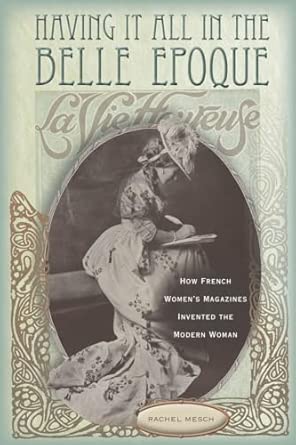
Having It All in the Belle Epoque: How French Women's Magazines Invented the Modern Woman
Author(s): Rachel Mesch (Author)
- Publisher: Stanford University Press
- Publication Date: 3 July 2013
- Edition: 1st
- Language: English
- Print length: 256 pages
- ISBN-10: 0804784248
- ISBN-13: 9780804784245
Book Description
At once deeply historical and surprisingly timely, Having it All in the Belle Epoque shows how the debates that continue to captivate high-achieving women in America and Europe can be traced back to the early 1900s in France. The first two photographic magazines aimed at women, Femina and La Vie Heureuse created a female role model who could balance age-old convention with new equalities. Often referred to simply as the “modern woman,” this captivating figure embodied the hopes and dreams as well as the most pressing internal conflicts of large numbers of French women during what was a period of profound change. Full of never-before-studied images of the modern French woman in action, Having it All shows how these early magazines exploited new photographic technologies, artistic currents, and literary trends to create a powerful model of French femininity, one that has exerted a lasting influence on French expression.
This book introduces and explores the concept of Belle Epoque literary feminism, a product of the elite milieu from which the magazines emerged. Defined by its refusal of political engagement, this feminism was nevertheless preoccupied with expanding women’s roles, as it worked to construct a collective fantasy of female achievement. Through an astute blend of historical research, literary criticism, and visual analysis, Mesch’s study of women’s magazines and the popular writers associated with them offers an original window onto a bygone era that can serve as a framework for ongoing debates about feminism, femininity, and work-life tensions.
Editorial Reviews
Review
“Mesch’s study furthers understanding of Belle Époque women’s literary culture by highlighting its role and reception in the print culture of the time . . . Mesch offers engaging intricate readings of the magazines’ celebration of feminine, elegant, achieving women before she moves beyond their pages to consider both the magazines’ relationship to the actual authors they promoted and their reception by the larger public . . . Mesch’s concept of Belle Époque literary feminism opens a new perspective onto the matrix of Belle Époque women’s magazines, popular women’s fiction, and their female readers . . .
Having It All is a well-researched, richly textured, and readable study built upon detailed, elegant readings of Belle Époque visual print culture. At the same time, it elucidates important and dynamic relations of journalism and female literary culture in the Belle Époque. Deftly bringing into play the multiple perspectives of literary, visual, and cultural studies, Mesch’s romance with Femina and La Vie Heureuse constitutes a welcome contribution to French studies that will engage students and scholars of print media, women’s history, gender studies, and French literary culture.”―Cheryl A. Morgan, H-France Review of Books“Just how expertly Mesch navigates the ‘contradictory ideological terrain’ of Belle Époque literary feminism, where a self-declared feminist can call her partner ‘master’ if doing so might reconcile love, marriage, feminism, and femininity without requiring a choice between them cannot be over-emphasized . . . [S]he argues convincingly for the significance of the magazines’ ‘dreaming’ and the momentous ideological shift it represents . . . Beautifully written and lavishly illustrated,
Having It All is also remarkably timely: as the magazines beckoning from grocery check-out stands demonstrate, we still worship celebrities, just as we continue to debate whether women can be both ‘feminine’ and ‘feminist’ and to strive for a work-life balance.”―Hope Christiansen, The French Review“Rachel Mesch’s fascinating, lavishly illustrated study opens a window into the surprising world of the Belle Époque French women’s magazines that, in the dozen or so years preceding the Great War, tackled questions still at the heart of debates over women’s place in society today: how to reconcile femininity and feminism, life and work, conventional expectations and new opportunities . . .
Having It All takes us on a remarkable journey into lost time, worthwhile both in itself and for the insights it offers into issues that continue to preoccupy us today.”―Michael Garval, Nineteenth-Century French Studies“Asking the question ‘Did women have a Belle Epoque?’
Having It All in the Belle Epoque is a study that explores some of the early twentieth-century history of concerns and debates that remain extremely relevant to women’s lives into the twenty-first century. Readers will find in this book a rich archive that illuminates the history of women readers and writers before World War I while offering a longer-term perspective on the ways we think about the complexities of femininity and feminism (and their relationships to one another) up to the present day.”―Roxanne Panchasi, New Books in French Studies“Few academic books have given rise to blogs (
Plus ça change) and articles published by Slate.com (“Having It All. In France. 100 Years ago.”). These online publications are a testament both to Rachel Mesch’s lively, jargon-free prose and the surprising lessons in her wonderful new study that are applicable even to our lives today . . . Mesch’s engaging, entertaining study is a lovely addition to Belle Époque, feminist, and media studies. Her scholarship demonstrates her talents as a close reader of texts and images and a great synthesizer of cultural events.”―Gayle A. Levy, Contemporary French Civilization“Offering a refreshing new vision of late-19th-century feminism, Mesch presents a compelling reinterpretation of two fin-de-siècle women’s magazines . . . Mesch’s book helps one view these women’s magazines in the context of their time and understand the feminist message they embodied for their readers . . . Highly recommended.”―S. E. Cline,
CHOICE“[W]ith its rich array of reproduced pages to illustrate points, and nice attention to the magazines’ visual as well as verbal discourse, this is a highly readable, enjoyable book that adds an important dimension to the study of how the vibrant feminist contestation of those years was mediated for and experienced by the majority of women.”―Diana Holmes,
French Studies“Through brilliantly constructed close readings of word and image in these magazines, Mesch brings to light a much more complicated picture of debates by and on women at the turn of the nineteenth century . . . Many of the journalists used by, and writers depicted in, these magazines had literary ambitions. Indeed, one of the great virtues in having this material addressed by a scholar with a proper interest in cultural history, as well as securely anchored origins in the world of nineteenth-century French literary studies, is that she is able to identify novels of the period which addressed the issue of women’s magazines . . . Not only does Mesch identify such key texts in the relationship between journalism and fiction, but she also brings to bear in the cultural history the kind of close textual analysis for which literary interpretation is the best preparation.”―Nicholas White,
Times Literary Supplement“In the search for work-life balance, readers will marvel at suggestions that date back 100 years.”―
Publishers Weekly“This book’s unique angle of analysis, wealth of quotations from primary sources, and many illustrations make it both a viable teaching tool and a scholarly resource.”―Miglena Sternadori,
Journal of Magazine and New Media Research“Mesch illuminates both the context that produced the paradox of ‘having it all’ and the difficulties that arose as a result. Her book opens a window onto a distant and relatively unknown past, all the while shedding light on debates that are still very much alive today.”―Susan Hiner, Vassar College
“For too long, we have tended to view the Belle Epoque through the prism of the feminism of our own day―how it measures up or falls short of current standards. By linking women’s magazines of the time to novels, visual imagery, and cultural practices, Mesch breaks out of this straitjacket, offering the most insightful and thorough examination of that space to date.”―Lenard R. Berlanstein, University of Virginia
“
Having It All in the Bell Epoque provides a fine historical survey debating the history of high-achieving women and how the roots of these achievers can be traced back to early 1900s France. Two key photographic magazines for women created a female role model who embodied new freedoms and approaches for women, captivating large numbers of French women and setting the stage for a century of women’s rights changes. This focus on these publications provides new images of this modern French figure, analyzes artistic and literary trends contributing to the rise of this culture, and blends history with literary and artistic insights throughout, making for a solid and specific pick for any women’s studies collection.”―Midwest Book Review“
Having It All in the Belle Epoque is a splendidly rewarding and highly informative read. The book builds convincingly on Mary Louise Roberts’s work on the New Woman, and Mesch’s nuanced formulation of the femme moderne figure adds an interesting dimension to other important interdisciplinary scholarship on gender at the turn of the century…The prose is engaging and eloquent, and the volume’s many high-quality illustrations facilitate Mesch’s stellar readings of text and image together.”―Heidi Brevik-Zender,SymposiumFrom the Author
Rachel Mesch is Associate Professor of French at Yeshiva University. She is the author of The Hysteric’s Revenge: French Women Writers at the Fin de Siècle (2006).
About the Author
Excerpt. © Reprinted by permission. All rights reserved.
HAVING IT ALL IN THE BELLE EPOQUE
How French Women’s Magazines Invented the Modern Woman
By Rachel Mesch
Stanford University Press
Copyright © 2013 Board of Trustees of the Leland Stanford Junior University
All rights reserved.
ISBN: 978-0-8047-8424-5
Contents
Acknowledgments……………………………………………………ixIntroduction: Femina, La Vie Heureuse and the Invention of the Femme
Moderne…………………………………………………………..1PART I READERS AND WRITERS…………………………………………Chapter 1 Chères lectrices: Cinderella Powder, Poet Queens and the Woman
Reader……………………………………………………………33Chapter 2 Beyond the Bluestocking: Images of Work-Life Balance in the
Belle Epoque………………………………………………………55Chapter 3 The “Oriental” Authoress: Myriam Harry and Lucie
Delarue-Mardrus……………………………………………………85Chapter 4 The Writer Writes Back……………………………………107PART II TEXTS AND CONTEXTS…………………………………………Chapter 5 A New Man for the New Woman? Belle Epoque Literary Feminism and
the French Marriage Plot……………………………………………123Chapter 6 Jean Lorrain’s Women’s Magazine: Emma Bovary Meets Celebrity
Culture…………………………………………………………..144Chapter 7 A Belle Epoque Media Storm: Marcelle Tinayre and the Legion of
Honor…………………………………………………………….155Conclusion: Imagining the Académicienne………………………………173Notes…………………………………………………………….197Selected Bibliography………………………………………………225Index…………………………………………………………….233
CHAPTER 1
CHÈRES LECTRICESCinderella Powder, Poet Queens and the Woman Reader
IN the back pages of Femina‘s first issues, full-page advertisementsdescribed the wonders of the beauty-enhancing Cinderella powderand soap (Fig. 1.1). Drawing on the fairy tale heroine, one advertisementclaimed that Cinderella’s dramatic transformation was not unfamiliarto many women: “All creatures of beauty and seduction have a doublelife.” Furthermore, the ad insisted that Cinderella was very much alivein Belle Epoque France—as witnessed by several recent performancesand publications—and was poised to pass on her secrets to “all women,her sisters, so that they could be, like her, sure to please.”
This advertisement performs, I would suggest, the work of Feminaand La Vie Heureuse themselves: they both served as a kind of Cinderellapowder, introducing women to new worlds that fascinated becauseof their exclusiveness and inaccessibility, while at the same time allowingwomen to identify with the realm of the elite and to view their ownexistences as refracted through its beautifying, edifying lens. Cinderellapowder promised to transport women to a realm of fantasy in thecontext of their daily lives. At the same time, as the advertisement suggested,Cinderella was no longer an exclusive sort of figure. All readerswere capable of—and entitled to—her upscale existence; it was simplya matter of learning her secrets. Cinderella thus symbolized at once anaristocratic elegance inscribed in a longstanding and revered courtlytradition, and the democratization of that elegance, available now to all,regardless of birth.
Both La Vie Heureuse and Femina were in this sense perfect vehiclesfor the democratization of luxury that Emile Zola had identified decadesbefore in his novel about the department store, whose drama grew directlyout of women’s newly available purchasing power. The magazineswere filled with articles on real-life royals, alongside advertisements forfashion and furs; study these women’s lavish interiors and then run tothe furniture shop advertised a few pages later and buy that same lamp.This was, at least, the initial way in which those whose privileged destinieswere meant only to cast a little warm light on a mundane existencevery quickly became models to emulate. Yet while the Cinderellaadvertisement focused on beauty and seduction, both magazines weresoon coupling their affirmation of conventional feminine norms with aninsistence on women’s capacity for other kinds of stunning transformations,as they featured them in an array of compelling new roles. Indeed,both publications energetically invited readers to not just admire thesenew models of female achievement but to imitate them; the democratizationof luxury so clearly celebrated in these magazines at the outsetbecame, over time, tightly linked to what I am calling a democratizationof female intellect, as the magazines insistently encouraged their readersto become thinkers and writers themselves. This chapter explores theprocess through which Femina and La Vie Heureuse constructed a newkind of reflective woman reader, who was seen not just as a consumer ofgoods, but of culture and literature. Part of Belle Epoque literary feminism’smost important work—and its appeal—was to make its devotedlectrices into veritable collaboratrices, an outcome that, by both magazines’own admission, was both welcome and unexpected.
Becoming a Princess
The first issue of La Vie Heureuse explicitly formulated a proposed relationshipbetween its readers and the select, elite women who would befeatured in its pages. In the mission statement included in their inauguralissue, the editors wrote:
There are female destinies so brilliant that the world seems to look at them withadmiration. Their luminous reputations, their large estates and their radiantyouth make these marvelous Women dazzle. But isn’t it good for other hardworkingwomen to occasionally catch a glimpse, as if in a dream, of the lives of queensand princesses, of Women who are the most refined expression of the elite of allspecies? In this heaven filled with fortune and splendor shouldn’t the less fortunateget to see the care, worries and obligations that compensate for the privilegeswith which these ones had the fortune to be born?
This justification for readers’ anticipated fascination with famous womenconforms to certain traditional theories of fame through which celebritieswere viewed as models of an ideal existence that offered a respitefrom the banality of the fan’s own necessarily more mundane reality.Inscribed explicitly in an aristocratic model, the elite women to be featuredin the magazine were deemed worthy of attention simply becauseof their birth. The ideal of happiness embodied by these special “Women”would appear in La Vie Heureuse, “in its true state,” promised the editors,as they offered readers comfort from—while inevitably remindingthem of—their lesser lot. Those lucky enough to catch a glimpse ofthese bright lights could thus “return more satisfied to the modest calmof their own condition.”
And yet, even with this insistence on traditional class structures, theeditors clearly suggested a shift towards a more democratic paradigm:while these exceptional women were born into their superior role, realizingtheir grace required work. By opening a window onto the “care,worries and obligations” required of them, the magazine also ensured alessening of the gulf between humble readers and destinées brillantes—between”women” and “Women,” as it were. In appealing to an aristocraticmodel, La Vie Heureuse addressed a conservative readership eagerto hinge modern femininity to familiar French ideals. Yet the fact ofputting these women, their homes, children and intimate thoughts ondisplay through a captivating layout of images and text was actually akey step in making these famous women more accessible, collapsing thedistance between admired and admirer.
In fact, the women of La Vie Heureuse were compelling at once becauseof their exceptionalness, and because of the ordinariness and familiarityof their domestic preoccupations. The magazine’s repeated depictionof female royals tending to their children provides a perfect example ofthis dynamic. The June 15, 1910 frontispiece featured a startling photographof the queen of England giving her young son a piggyback ride(Fig. 1.2). Similarly, a September 1907 story, “Young Royal Mothers,”showed several queens and princesses holding their children. On theone hand, the text of this particular story details the somewhat exoticrituals that follow a royal birth, like the firing of one hundred canons.On the other hand, what the accompanying iconography demonstratesin a series of images of mothers cradling children, and what the articleultimately concludes, is that royal motherhood is no different from thatof the rest of society: “Outside of political realms, queens are nothingmore than young women watching tenderly over their precious, frail offspring[…] under their sparkling crowns, they laugh with their babieslike the most modest of their subjects.” La Vie Heureuse‘s success thusoffers perfect evidence for Lenard Berlanstein’s and Vanessa Schwartz’sclaims that celebrity “united rather than divided the upper classes andthe masses” by the late nineteenth century in France, and that spectatorship—inthis case, through an endless array of photographs—”had thepower to convert potentially antagonistic classes into a culturally unifiedcrowd.” Readers of this story, mothers everywhere, were asked to seethe royals they admired as fundamentally no different from themselves.
Rather than “return more satisfied to the modest calm of their owncondition,” then, everything about La Vie Heureuse seemed to encouragewomen to see a better version of themselves in the ever-expandingsmorgasbord of models of modern femininity. Bit by bit, it seems, thestars whose privileged destinies were meant only to cast a little warmlight on a mundane existence easily became paragons of achievement,if not models to emulate. The very women celebrated within the pagesof both magazines immediately invited this slippage. La Vie Heureuseseemed at first to suggest that the women it would feature had gainedtheir distinction by birth. The first issue contained an article, just a fewpages after the mission statement cited above, on the acclaimed poetCountess Anna de Noailles, seemingly confirming this fact. And yet, herpresence in the magazine was assured as much by her literary prowessas by her aristocratic lineage, which turned out to be the main focus ofthe article, in which her poetry was quoted and extensively commentedupon. In fact, within the first months of the magazine’s existence, thedistinction between women born into glory and those who had earned itby talent quickly dissolved: distinguished women writers and artists wereregularly depicted as celebrities in the magazine, alongside queens andprincesses. In feature after feature, these women’s children were pictured,their home decor and sartorial choices examined and glorified. Theyhad become veritable celebrities, a status defined in part by the blurringof the line between their public accomplishments and private lives.
“Chères lectrices”
Like La Vie Heureuse’s, Femina‘s aristocratic valences were mitigated byits repeated efforts to draw the reader closer, collapsing social boundariesbetween reader and editor, between the aristocratic world that itglorified and the lives of the readers it sought to enhance. This is apparentfrom its very first issue of February 1901, even as it featured theEmpress of Russia on its cover, Queen Wilhelmine in its first article,replete with images of her in royal garb and pictures of her estate, andlavish photographs of Prince Roland Bonaparte’s home (Fig. 1.3). To bea woman was, Femina explicitly argued, in itself a very special privilege,a kind of nobility really, and that is why the magazine would devoteitself to offering “an exact idea of everything that takes place inher charming kingdom.”
Femina cultivated its readers as a community, referring to them consistentlyand throughout each issue directly as “chères lectrices” (dearreaders, in the feminine), if not “charmantes lectrices” (charming readers).The directness of this second person address encouraged readersto see themselves as fully part of, indeed implicated in, a conversation,rather than simply observers. It transformed the editorial voice intothe semblance of an actual person on the other end. The repetitionof the refrain also suggested a single person where there were many,bridging the gulf between reader and writer(s). In the regular columnshe began in 1908, writer Lucie Delarue-Mardrus encouraged readersto think of her as an “attentive and trustworthy friend,” and thatwas indeed the overall persona of Femina‘s editorial voice. In addition,the repeated invocation of the magazine’s plurality of female readersserved as a reminder to each individual that she was not alone, butrather part of a shared community of women that was separate, distinctand special. In her history of mass culture in fin-de-siècle France,Vanessa Schwartz argues that at the end of the nineteenth century”the apprehension of urban experience and modern life through visualre-presentation was a means of forming a new kind of crowd” and thatthese “re-presentations” had the effect of effacing class and gender”in their conceit that diverse consumers should, could and would havesimilar access to them.” The women’s press offered a similar experiencein its effacement of class lines, while maintaining a deliberatelygendered point of view that only further contributed to the illusion ofexclusiveness, in the special kingdom of women.
The recurring second-person address also had the effect of fleshingout the alternative universe of the magazine. Not only were readersinvited to see celebrated actresses and writers as alternate imagesof themselves, but they could also see better versions of themselvesthrough their consurs, their fellow lectrices, who shared many qualitieswith their favorite celebrities. In April 1908, the novelist Marcel Prévost,a frequent contributor to Femina, accepted Pierre Lafitte’s invitation tooffer a monthly chronique in which he would “converse with the Feminareader.” (This was, incidentally, described as Femina‘s effort to associateitself more with literature and art.) Doing precisely what he promised,Prévost began his first chat with a meditation on the term “lectrice deFemina” in which he offered those readers myriad tantalizing images ofmodern femininity from which to self-identify:
[I thought of] the French society woman or wealthy foreigner who thumbsthrough the magazine while stretched out on a 10,000 Franc chaise longue, amidher priceless trinkets … the elegant Parisian woman, well-off, cultured, for whomthe magazine is both a document and a distraction … the clever bourgeoise, whowith her precise budget takes just what she needs for managing a lovely home,having some guests, dressing to the nines … the cheerful worker who looks fora dream-worthy supplement to her life of labor in the stories and images. And Ithought of you also, the exquisite women of the provinces in this century whenthere are practically no more provinces, you, those inexhaustible reserves of thegrace, wit and art of Paris: I saw you, oh pretty lady of the place du Martroi, ofthe cours Gambetta, of the rue des Ursulines, decked out, nimble, sporty, runningto your bookstore or the train station library, the day Femina comes out!
Prévost’s comments point to a wider and more diverse audience thanthe exclusively upper bourgeois readership that the magazine’s high-endadvertisements seem to suggest. Lenard Berlanstein has arguedthat Femina‘s readership was mostly upper bourgeois, based upon thehigh-end advertisements and those who responded to surveys. ColetteCosnier also notes that the absence of pointers on household tasks (asin Le Petit Echo de la Mode or La Mode Pratique) presumes a reader whowould not engage in such tasks. However, there is also evidence of otherkinds of readers, including women in the work force. In December 1902,for example, novelist Gabrielle Réval wrote a piece on female stenographersthat was explicitly solicited by readers—presumably stenographersthemselves—after an article appeared about female phone operators.While the magazine certainly modeled a highbrow milieu, this did notmean that all readers actually lived in one. Beyond signaling who someof the actual readers might have been, Prévost’s remarks underline theimportance of the imaginary universe that Femina so actively created.Reading this piece assured the chère lectrice that she was in good company.Whether she was from Paris or the quickly receding provinces—or anexotic foreign land—mattered not. Of the highest echelons of societyor laboring away but still finding time to admire, every woman had areason to feel good about reading the magazine. Taking in Prévost’swords, the less than well-off, hardworking provincial could fancy herselfa high-class Parisian, and that Parisian could, in turn, feel goodabout serving as a model for the hard-working provincial. And thus,the simulacrum was complete: the woman reader was free to imagineherself among this cohort of peers, reading about a world of exceptionalwomen, equally constructed; the magazine offered subtle tools to enablewomen to emulate these role models, and, as we shall see in a moment,invitations to participate in the magazine itself. Hence the celebratedglory and achievement highlighted in its pages ultimately served to enhancethe reader’s own sense of self-worth and possibility.
(Continues…)Excerpted from HAVING IT ALL IN THE BELLE EPOQUE by Rachel Mesch. Copyright © 2013 Board of Trustees of the Leland Stanford Junior University. Excerpted by permission of Stanford University Press.
All rights reserved. No part of this excerpt may be reproduced or reprinted without permission in writing from the publisher.
Excerpts are provided by Dial-A-Book Inc. solely for the personal use of visitors to this web site.