Wow! eBook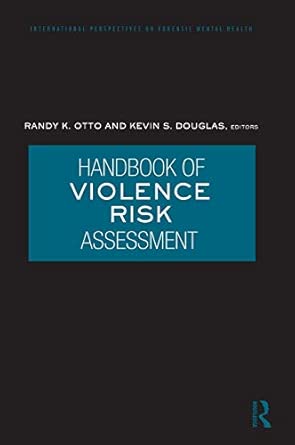
Handbook of Violence Risk Assessment
Author(s): Randy K. Otto (Editor), Kevin S. Douglas
- Publisher: Routledge
- Publication Date: 28 Oct. 2009
- Edition: 1st
- Language: English
- Print length: 326 pages
- ISBN-10: 0415962145
- ISBN-13: 9780415962148
Book Description
This comprehensive Handbook of original chapters serves as a resource for clinicians and researchers alike. Two introductory chapters cover general issues in violence risk assessment, while the remainder of the book offers a comprehensive discussion of specific risk assessment measures.
Forensic psychology practitioners, mental health professionals who deal with the criminal justice system, and legal professionals working with violent offenders will find the Handbook of Violence Risk Assessment to be the primary reference for the field.
Editorial Reviews
Review
“This is an important topic that is not covered comprehensively elsewhere. I would buy the book both for myself and for my school’s library.” – Rebecca Jackson, Director of Forensic Psychology Program, Pacific Graduate School of Psychology, USA
“This Handbook is the ultimate ‘tool box’ for all clinicians, researchers and trainees involved in violence risk assessment. Each instrument’s review is authoritative, balanced, and comprehensive, yet concise. It is likely to be this topic’s best sourcebook for the next decade.” -Thomas Grisso, PhD, Director of the Law-Psychiatry Program at the University of Massachusetts Medical School; author of Evaluating Competencies―Forensic Assessments and Instruments
“An eminently useful compendium of information about the major violence risk assessment tools. Just the sort of book that every mental health professional should have readily at hand.” –Paul S. Appelbaum, MD, Dollard Professor of Psychiatry, Medicine, and Law, Columbia University
“In the Handbook of Violence Risk Assessment, developers of all major measures now available present thorough reviews of the assessment methods they helped create. If you want an accurate, comprehensive, up-to-date explanation of risk assessment instruments and how they work, get this book.” –Douglas Mossman, MD, University of Cincinnati College of Law and Medicine
“Otto and Douglas have done an excellent job of bringing together chapters by the leaders in this expanding field. A well-edited and authoritative overview of risk assessment, certainly of great use to psychologists and of great interest to social scientists and members of the legal community.” – Richard Ortega, PhD., in PsycCRITIQUES, October 2010
“Handbook of Violence Risk Assessment is a no-nonsense, down-to-business compendium of the most widely researched and applied violence risk assessment tools in current usage.This is not light reading, but what saves the book from being a bone-dry expository slog is the presence of illuminating case studies for each topic that puts practical flesh on the theoretical skeletons by showing how these instruments can be used in the everyday real world of clinical-forensic practice. The editors do a fair job of…focus[ing] on the task of providing clinical-forensic practitioners with what they need to know to make their choice of violence risk assessment instrument for their particular populations and settings.” –Laurence Miller, PhD, International Journal of Emergency Mental Health
“[This book] provides a comprehensive background to methods of assessing the risk of violence in potentially criminal populations. As there is currently no shortage of risk assessment instruments for professionals to choose from, this handbook of particularly useful in that it first provides an overview of the current research on risk assessment in a general context, and then concentrates on reviewing the most commonly used violence risk assessment tools. This text is therefore likely to be useful for students and trainees studying risk assessment in forensic populations in most countries and is likely to be an invaluable resource to any clinical, legal or correctional staff seeking background information on established risk assessment tools.” – Jessica Szabo, King’s College London, Institute of Psychiatry, in Journal of Mental Health
‘I would purchase this as a “desk reference” for those referrals involving Risk Assessment… The topic is a very complex and important one and I believe Dr. Otto is correct in his claim that prior texts are usually organized around a single instrument or approach, rather than an overview of several assessment methods.’ – Robert P. Archer, PhD, Frank Harrell Redwood Distinquished Professor, Department of Psychiatry and Behavioral Sciences, Eastern Virginia Medical School
‘Yes, this is an important topic that is not covered comprehensively elsewhere. I would buy the book both for myself and for my school’s library.’ – Rebecca Jackson, Director of Forensic Psychology Program, Pacific Graduate School of Psychology, USA
About the Author
Randy K. Otto, PhD, ABPP, is an associate professor in the Department of Mental Health Law & Policy at the University of South Florida in Tampa and an adjunct faculty member at Stetson University College of Law in St. Petersburg. He has served as President of the American Psychology-Law Society and the American Board of Forensic Psychology, and currently chairs the committee revising the Specialty Guidelines for Forensic Psychologists. He is a fellow of the American Psychological Association and, in 2008, he received an award for distinguished career contributions to forensic psychology from the American Academy of Forensic Psychology.
Kevin S. Douglas, Ph.D., LL.B., is on the psychology faculty at Simon Fraser University. He is a co-author of the HCR-20 (along with Christopher Webster, Stephen Hart, and Derek Eaves), one of the most widely used violence risk assessment tools. He is the 2006 recipient of the Saleem Shah Award for Early Career Achievement sponsored by the American Academy of Forensic Psychology and the American Psychology-Law Society.