 Wow! eBook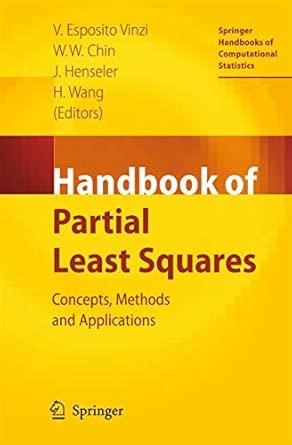
Handbook of Partial Least Squares: Concepts, Methods and Applications 2010th Edition
Author(s): Vincenzo Esposito Vinzi (Editor), Wynne W. Chin (Editor), Jörg Henseler (Editor), Huiwen Wang (Editor)
- Publisher: Springer
- Publication Date: 1 Oct. 2008
- Edition: 2010th
- Language: English
- Print length: 812 pages
- ISBN-10: 9783540328254
- ISBN-13: 3540328254
Book Description
Editorial Reviews
Review
From the reviews:
“I found the book to be a good resource for those without prior knowledge of PLS looking forward to an introduction as well as a comprehensive reference for every researcher and every practitioner interested in the most recent advances in PLS methodology. All of them should have this title as an essential part of their library. … Great Stuff! … will be the definitive reference work in the field for a good time to come. … it is wonderfully readable and referable.” (Current Engineering Practice, August, 2011)
“The book is divided into three parts, dealing, respectively, with contemporary methodological developments, applications in marketing and related areas, and tutorials on particular aspects of PLS analysis. It provides a comprehensive overview of recent advances in the area, and describes cutting-edge methodological developments showing how PLS can be applied in tackling a wide variety of problem types. … for people who do have some prior experience with PLS, this book is a goldmine of novel methodological and practical applications.” (David J. Hand, International Statistical Review, Vol. 80 (3), 2012)
From the Back Cover
The "Handbook of Partial Least Squares (PLS) and Marketing: Concepts, Methods and Applications" is the second volume in the series of the Handbooks of Computational Statistics. This Handbook represents a comprehensive overview of PLS methods with specific reference to their use in Marketing and with a discussion of the directions of current research and perspectives. The Handbook covers the broad area of PLS Methods from Regression to Structural Equation Modeling, from methods to applications, from software to interpretation of results. The Handbook features papers on the use and the analysis of latent variables and indicators by means of the PLS Path Modeling approach from the design of the causal network to the model assessment and improvement. Moreover, within the PLS framework, the Handbook addresses, among others, special and advanced topics such as the analysis of multi-block, multi-group and multi-structured data, the use of categorical indicators, the study of interaction effects, the integration of classification issues, the validation aspects and the comparison between the component-based PLS approach and the covariance-based Structural Equation Modeling. Most chapters comprise a thorough discussion of applications to problems from Marketing and related areas. Furthermore, a few tutorials focus on some key aspects of PLS analysis with a didactic approach. This Handbook serves as both an introduction for those without prior knowledge of PLS as well as a comprehensive reference for researchers and practitioners interested in the most recent advances in PLS methodology.


