The quality of a food is determined from two perspectives: scientific status and consumer preference. Scientific factors include: composition, spoilage, functional ingredients (affecting health), contamination, and general safety. Consumer preferences are linked directly to the human senses and include sight, touch, smell, taste, and mouth feel. The quality of a food is therefore the composite picture of many factors.
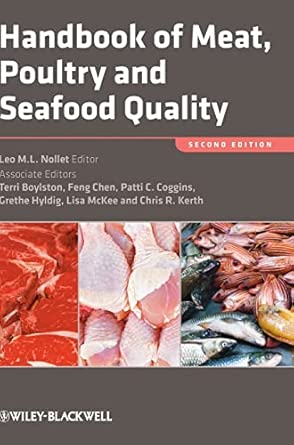
This extensively revised second edition of Handbook of Meat, Poultry, and Seafood Quality focuses especially on the different quality factors affecting muscle foods (beef, pork, poultry, and seafood). The book consists of five sections. Section 1: Quality Aspects of Products of Animal Origin, deals with the general sensory aspects of muscle foods such as color, texture, and flavor, and how to determine these parameters in muscle foods. Sections 2 to 5 explore in depth the quality parameters of beef, pork, poultry, and seafood. Parameters covered in these chapters include shelf life, microbiological and sensory properties, and packaging, all as they apply to fresh and to frozen muscle foods.
Handbook of Meat, Poultry, and Seafood Quality is the result of the combined efforts of more than 30 professionals from industry, government, and academia worldwide. They represent more than 11 countries with diverse expertise and background in the quality of muscle goods. The book is designed to serve as an essential reference on the quality of muscle foods for all professionals in government, industry, and academia.
From the Back Cover
The quality of a food is determined from two perspectives: scientific status and consumer preference. Scientific factors include: composition, spoilage, functional ingredients (affecting health), contamination, and general safety. Consumer preferences are linked directly to the human senses and include sight, touch, smell, taste, and mouth feel. The quality of a food is therefore the composite picture of many factors.
This extensively revised second edition of Handbook of Meat, Poultry, and Seafood Quality focuses especially on the different quality factors affecting muscle foods (beef, pork, poultry, and seafood). The book consists of five sections. Section 1: Quality Aspects of Products of Animal Origin, deals with the general sensory aspects of muscle foods such as color, texture, and flavor, and how to determine these parameters in muscle foods. Sections 2 to 5 explore in depth the quality parameters of beef, pork, poultry, and seafood. Parameters covered in these chapters include shelf life, microbiological and sensory properties, and packaging, all as they apply to fresh and to frozen muscle foods.
Handbook of Meat, Poultry, and Seafood Quality is the result of the combined efforts of more than 30 professionals from industry, government, and academia worldwide. They represent more than 11 countries with diverse expertise and background in the quality of muscle goods. The book is designed to serve as an essential reference on the quality of muscle foods for all professionals in government, industry, and academia.
About the Author
The Editor
Dr. Leo M. L. Nollet, Professor of Biotechnology, Department of Engineering Science, Ghent, Belgium
Associate Editors
Dr. Terri Boylston, Department of Food Science and Human Nutrition, Iowa State University, Ames, Iowa, USA
Dr. Feng Chen, Department of Food, Nutrition, and Packaging Sciences, Clemson University, Clemson, South Carolina, USA
Dr. Patti C. Coggins, Food Science, Nutrition, and Health Promotion, Mississippi State University, Starkville, Mississippi, USA
Dr. Grethe Hyldig, Division of Industrial Food Research, National Food Institute, Technical University of Denmark, Kongens Lyngby, Denmark
Professor Lisa McKee, Human Nutrition and Food Science, College of Agricultural, Consumer and Environmental Sciences, New Mexico State University, Las Cruces, New Mexico, USA
Dr. Chris R. Kerth, Department of Animal Science, College of Agriculture and Life Sciences, Texas A&M University, College Station, Texas, USA
 Wow! eBook