 Wow! eBook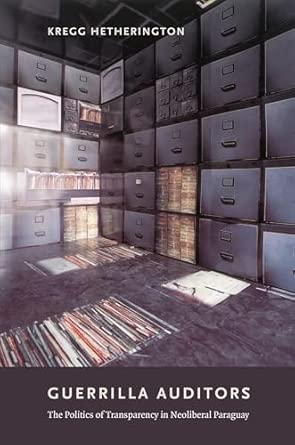
Guerrilla Auditors: The Politics of Transparency in Neoliberal Paraguay
Author(s): Kregg Hetherington (Author)
- Publisher: Duke University Press Books
- Publication Date: 14 Sept. 2011
- Language: English
- Print length: 312 pages
- ISBN-10: 082235019X
- ISBN-13: 9780822350194
Book Description
Editorial Reviews
Review
“Understanding that property and the neoliberal project of transparency rest on ‘paperwork,’ Kregg Hetherington brilliantly deconstructs the politics of creating documents. His astute, closely observed, and entertaining study is radical scholarship at its deepest and most searching. A powerful point of departure for the next generation of critiques of development.”—
James C. Scott, author of Seeing Like a State: How Certain Schemes to Improve the Human Condition Have Failed“Hetherington argues that Paraguayan neoliberalism is premised on an exclusionary distinction between modern citizens and backward peasants, but his analysis could benefit from a deeper consideration of the class divisions that are reshaping Paraguayan society…. [T]he book is a well-written, insightful study of an underresearched Latin American country, and it should be read by social scientists, development practitioners, and area studies specialists.” — Lesley Gill ―
American Historical Review“
Guerilla Auditors is a superb deep ethnography of development that excavates how land politics and the technologies of “good governance” collude to produce campesinos as firmly outside of proper democratic society in post-Stroessner Paraguay…. Hetherington’s latest is necessary reading for students and scholars of development, Paraguay and Latin American populism alike.” — Jennifer Tucker ― AmeriQuests“
Guerrilla Auditors is a fine refutation of certain stances in global NGO and academic arguments (what he terms the “new democrats”). . . . Guerrilla Auditors provides us with a rich account of another, important theme: the constitutive cultural power of bureaucratization, such as the highly valued possession of original documents on physical paper, and not copies, in the world of ostensibly non-bureaucrats, peasants within a state society.” — Josiah Heyman ― Anthropological Quarterly“Kregg Hetherington’s highly original account of the rise of information and transparency in the governance of Paraguay points to a new kind of struggle and one that political scientists wedded to old categories and classes would do well to consider…. This book should become essential reading on modern politics courses, highlighting the new forms of contestation that are shaping Latin America’s globalised future.” — EC ―
Latin American Review of Books“Kregg Hetherington’s elegant ethnography makes important interventions into the anthropological scholarship on documents, the political anthropology of the state, and literatures on land reform and neoliberalism in Latin America. He brings together a deeply contextualized examination of land reform in post-Stroessner Paraguay with a theoretically and ethnographically rich study of the emerging politics of transparency among both urban elites and rural
campesinos…. Hetherington writes beautifully…. Guerrilla Auditors thus not only makes important contributions to the ethnographic study of power, law, bureaucracy, and politics but offers much for readers interested in an engaged anthropology.” — Heath Cabot ― PoLAR“Hetherington’s book is a gem, and there are simply too many threads one could pick up and follow to broader and interesting implications.” — Manuel Balan ―
Latin American Research Review“
Guerilla Auditors is a much-needed contribution to the study of Paraguayan politics. Hetherington has chosen a very important topic in an understudied country. The history of Paraguay’s democratic transition is both opaque and highly politicized, and Hetherington passes through it with skill and nuance, drawing freely from the ethnography of campesino settlements and state archives and the history of land tenure and national politics.” — Warren M. Thompson ― Social Forces“
Guerrilla Auditors is a pathbreaking ethnography of peasant struggle in Paraguay. … The book develops new ways of thinking about an older issue in Latin America: the rural peasantry and the struggle for livelihoods, rights, and survival. … This work is a must-read for students of Latin American politics, social movements, and the state.” — Bret Gustafson ― The AmericasAbout the Author
Kregg Hetherington is Assistant Professor in the Department of Sociology and Social Anthropology at Dalhousie University in Halifax, Nova Scotia.
Excerpt. © Reprinted by permission. All rights reserved.
GUERRILLA AUDITORS
The Politics of Transparency in Neoliberal ParaguayBy KREGG HETHERINGTON
DUKE UNIVERSITY PRESS
Copyright © 2011 Duke University Press
All right reserved.
ISBN: 978-0-8223-5019-4
Contents
Acknowledgments……………………………..ixNote on Names……………………………….xiiiIntroduction………………………………..11 The Transition to Democracy…………………252 Ill-Gotten Land……………………………663 Precarious Lots……………………………974 Duplicitous Documents………………………1435 Populist Transparency………………………184Epilogue……………………………………223Notes………………………………………233Bibliography………………………………..263Index………………………………………283
Chapter One
THE TRANSITION TO DEMOCRACY
When I first visited Paraguay in 1998 and for ten years thereafter, the word democracy was everywhere and always laden with complicated negative feelings. At the very least, Paraguay was still in a “transition to democracy” which had no clear end in sight. Since 1989, when the Colorado Party, which had then been in power for forty-two years, announced that democracy was coming, Paraguayans had been participating in open, internationally approved national elections. But the Colorados had remained in power, and a degree of cynicism had overtaken most opinions of the transition. Depending on where and whom I asked, the reasons for these feelings varied. In Asunción, where most of my conversations were with middle-class professionals, a longing for democracy and state reform was still palpable under the deep despair about the transition, hatred of the Colorados, and fears of a return to outright dictatorship. In the countryside, or campo, where I spoke mainly with politically active campesinos, hatred of the Colorados, often couched in a language of anti-authoritarianism, was underwritten with ambivalence about what democracy might actually bring. A common refrain in the campo was “with Stroessner you couldn’t say what you wanted to say, but you could eat what you wanted to eat.” The politics, aspirations, and worldviews of these two groups were shaped by the different frustrations of prolonged transition, and they came to be related to each other, often antagonistically. For while campesinos continued to believe that they epitomized el pueblo Paraguayo, “the Paraguayan people,” in Asunción a quite different vision of the country was brewing.
The most powerful actor in Paraguayan politics throughout the transition period remained the Colorado Party, a deep-rooted clientelist network that tied Paraguay’s richest families with its poorest and gave the former almost complete control of the military, the judiciary, and the bureaucracy. But if campesinos had carved out their politics in relation to the Colorados throughout the Cold War, they now found they had to negotiate political space with those who increasingly dominated media, business, development organizations, and the school system, and whose primary hope for campesinos was their disappearance. The transition sweeping Paraguay was not about the destruction of traditional campesino culture (although certainly the romantic vision of peasant ways of life reemerged in the debate over these transformations), but rather about the unraveling of a once powerful if fractious historic bloc, organized around a land reform that linked the Colorado Party to campesino economic aspirations. With that unraveling came profound economic and political realignments and a complete overhaul of both the political and the agricultural landscape.
The transition to democracy, whatever else it might have been, was a powerful narrative that organized new democratic politics. The transition produced a publicly legitimated sense of past, present, and future, which in turn created exclusions in time. If the Stroessner government prior to 1989 made a great show of saying that campesinos were the future of the nation, after the coup new democrats increasingly portrayed campesinos as part of the nation’s past, and doomed to disappearance. This view of campesino anachronism did not necessarily emerge from overt malevolence toward the rural poor. In the years just after the coup, new democratic politicians, intellectuals, journalists, and social leaders made huge efforts to bring the campesinado into the transition project and to make the narrative of new democratic ascendancy agree with the narrative of rural people’s liberation from tyranny. But these projects didn’t work out, and over time it became clear that the campesinado simply didn’t fit the transitional narrative. Campesinos were eventually held responsible for the continuities associated with a tyrannical past, cultural and bureaucratic elements embarrassingly out of joint with the primary symbols of the coming democracy: transparency, civil society, and the free market. In the worst cases, campesinos were perceived as the frightful masses whose political irrationality might just bring the dictatorship back. At other times they were seen simply to be in the way, a drag on inevitable progress.
CAMPESINOS AND NEW DEMOCRATS
COLD WAR CAMPESINOS
Even in the most dispassionate of analyses, the word campesino connotes for Paraguayans a series of cultural, linguistic, and historical associations spanning the gamut between romantic ideals and deeply racist stereotypes. It includes ideas about traditional cultural norms that prevailed among mestizo smallholders in the rural departments closest to Asunción (Caazapá, Guairá, Paraguarí) in the nineteenth century and early twentieth, and the strong populist politics that predominated during Stroessner’s reign in the departments that were settled by those same families during the land reform (San Pedro, Caaguazú, Alto Paraná). It also signals a kind of overt identity politics which explicitly retains the stigmatized label to promote a particular view of how the nation should be organized. For those who call themselves campesinos in the twenty-first century, the word is a militant stance against national abandonment and a fierce reiteration of Cold War populism against a political trend away from rural redistribution projects.
The first thing to understand about the stakes of this politics, though, is the degree to which it goes unrecognized as a true politics by most commentaries. For the idea of the campesinado as a passive rabble contains its own theory of what makes campesinos rise up. That theory, formed by liberal fears about the mob’s irrationality and potential for violence, goes under the umbrella term populism, a style of politics that implies the suspension of rational policymaking in order to pander to the popular masses. In Paraguay, populism is called many things, but most often it goes by the name caudillismo, a politics characterized by the leadership of strong men with personal connections to el pueblo Paraguayo, the traditional masses. In the hands of new democrats, caudillismo is a derogatory label for the behavior of acolytes who blindly follow the superficial personalities of caudillos (strongmen) instead of the principles of rational deliberation. A comment heard pervasively in analysis of campesino mobilizations is that the majority of people who show up to demonstrations, roadblocks, and land invasions are merely the dupes of cunning, self-interested leaders who know how to attract followers with Guaraní speeches and empty, misleading, or violent rhetoric.
The story of Paraguayan caudillismo goes back at least to the country’s independence from Spain, in 1811, after which it was ruled by a succession of the most ruthless dictators in the region. During the transition to democracy, the association of the campesinado with populist leadership evokes the more recent history of land reform that, from 1963 onward, was a central building block of Stroessner’s rule. The Colorado Party took power in 1947, during a short but vicious civil war against their traditional rivals, the Liberal Party. General Stroessner, controlling the military wing of the party, assumed the presidency in 1954. He was not personally sympathetic to land reform, which was an idea strongly associated with the Liberals, but other factions in his party were eager to take up the project. Moreover, a regional conversation about land reform throughout Latin America had shifted the debate. Center-left economists from cepal (the Economic Commission on Latin America) were arguing that the region’s latifundios, vast tracts of land run as private fiefdoms, were “unproductive” and “inefficient” and therefore a drag on the rural economy, and that their redistribution to the rural poor would boost food production and spur national industrialization. The party was fundamentally split on the idea. But by 1960 land reform had been adopted as dogma even by the U.S.-led Alliance for Progress, and Stroessner quickly appointed a proponent of the antilatifundio position to take charge of a colonization project (see Pastore 1972). Juan Manuel Frutos, representing the agrarista wing of the Colorado Party instituted the colonization project that would transform eastern Paraguay and turn the state-granted ten-hectare plot into the defining feature of campesino political life. Frutos enacted the Estatuto Agrario (Paraguay 1963), which established the legal parameters for colonization, and built an institution called the Institute for Rural Welfare (IBR) to carry it out.
For forty years the IBR created colonias throughout the forested eastern half of the country, pioneer settlements intended to grow into thriving peasant communities of titled smallholders. The project, also called the “March to the East,” echoed the Brazilian “March to the West,” with all its military undertones. (Both were also explicitly modeled on the U.S. frontier of the nineteenth century.) It was seen as a nation-building project which would simultaneously improve the lives of the campesino population and protect the territory from being annexed to Brazil’s much larger frontier drive. Between 1963 and 1985, Frutos claimed that the reform had created 661 such colonies, enclosing 130 thousand lotes (plots) on 8.8 million hectares of land (see Frutos 1985, 95). He also claimed that the government had handed out over 400,000 land titles. Whatever one makes of these numbers, there’s no question that the development of the frontier was, alongside the construction of the massive hydroelectric dam at Itaiú, one of the regime’s most dramatic economic feats (Roett and Sacks 1991). Families living on very small plots in the central departments of the country headed out to the frontier to take their allotted ten hectares of land, creating new towns, economies, and political organizations. By the time of the coup, in 1989, hundreds of thousands of Paraguayans lived in colonies created by the reform.
The civil war between Liberals and Colorados in the 1940s had severely weakened the Liberal Party in the countryside, and land reform intensified the imbalance, creating an apparatus for rewarding Colorado Party members and for spying on everyone else (see Turner 1993). The Colorado Party became the party of most campesinos, with only a small percentage of Liberal families holding to the opposition party. Stroessner developed a style of fierce anticommunism which served him particularly well during the Cold War. It won him military support from the United States, and in the 1970s, when coups transformed all of Paraguay’s neighbors into military dictatorships, it won him allies throughout the region. Despite this it is hard to find much in the Colorado Party’s policies to classify it definitively as either Left or Right. What it was was a massive clientelist apparatus that built itself institutionally into the colonial landscape of the frontier.
Even while the party swelled with campesinos, there quickly developed a radical rural politics opposed to the Colorados which further shaped the concept of “campesino.” At the outset this was primarily organized around Christian base organizations, collectively called the Ligas Agrarias Cristianas, which claimed land and protested government repression in the 1960s and 1970s (see Fernández 2003; Telesca 2004). Although initially established within the Catholic Church, these followers of liberation theology were increasingly secular, and most of the movement’s leaders eventually left the church altogether. The Ligas were violently dismembered in 1976, during a regional crackdown on dissidents. But the influence of liberation theology remained, in the underground Marxist organizations that sprang up in their wake, in the NGOS concerned with human rights and sustainable development, and in the very language of campesino politics as a vindication of “campesino reality” and the “campesino base.” As the Stroessner government began to fall apart and was finally overthrown, state commitment to agrarian reform became even more uncertain, and campesino organizations took on the mantle of agrarian reform in protest against the government. These organizations were plagued by infighting, ideological disagreements, and structural frictions, but they all fundamentally stood for a statist model of rural protectionism built on cash-crop production by patriarchal family units in smallholder colonies. In short, the bulk of the campesino movement was never about a wholesale rejection of Stroessner’s agenda. Its primary goal was to make the Colorados deliver on their own agrarian promises.
None of this is to downplay the contentiousness of this relationship, or the history of terror, or the violence that Stroessner often meted out to campesino communities that fell out of line. The fearsomeness of Stroessner’s military brigades and later police are well documented, and I have heard many stories in the countryside of routine brutality against dissidents and petty thieves, not to mention the daily pall of fear that most people felt about speaking out against the regime. Yet, however violent the dispute between the state and campesino organizations became at different moments during Stroessner’s reign, both were committed to a similar strategy for national development. It is on that basis that I suggest one of Stroessner’s successes was the creation of a powerful historic bloc based on a singular philosophy of land use, development, and ultimately of the nation-state itself. It is an uncomfortable history for many campesinos, and it certainly doesn’t serve them in the present conjuncture, but that strong tie still comes out in conversations even with some of the most vociferously anti-Colorado leaders. One such leader, who was known in the area for making powerful speeches in which he attacked any and all of his opponents for being Stronistas, surprised me during an interview when I asked him to describe the moment of the coup. He and I had been talking about the late 1980s—a time during which he and other landless youths would meet secretly in the local church to avoid Colorado spies—when I asked him how he had felt on hearing that Stroessner had been overthrown. Without pause he answered that it had been one of the scariest moments in his life. “It was so uncertain,” he said. “El General was the one who protected us.”
Sure enough, the land-reform project began to disintegrate soon after the coup. But in the early twenty-first century that project continues to be the benchmark by which campesinos talk about their economic, political, and cultural aspirations. Simply to call oneself campesino, particularly in the areas affected by the reform, is a sign of the desire and right to live in these colonias. It was this desire that drove the massive pioneering effort that continues today, with young men leaving their parents’ homesteads in their late teens to look for their own plot of forest. The premises of the land reform were always highly paternalistic. Campesino rights to land were never simply recognized. Instead, beneficiaries of the reform had to prove their worth as rational economic subjects capable of properly applying their labor to the land, a process through which they would be phased into full ownership and full personhood. But however hierarchical the land reform may have been, it interpolated a massive class of rural people who were eager to live out this process of self-realization.
This narrative about land and self-realization emerged consistently as I spoke to campesinos around Vaquería. Most self-identified campesino men whom I met in Paraguay could either recite a life-story which matched the basic premises of the narrative or expected that at some point they would be able to claim land on the frontier and create a homestead. Even for the many young people (particularly young women) who envisioned a different future opening through educational reform, homesteading remained their fall-back plan. The Estatuto Agrario and the IBR therefore continued to be vital institutions for campesinos. Love it or hate it, all recognized the IBR as the state institution that made these aspirations possible. For several months after the coup, campesinos flooded into IBR headquarters in Asunción, creating a documentary logjam of demands and actually blocking the halls, so that bureaucrats felt they were under siege. While new democrats took over the universities and the media and parts of the courthouse, campesinos headed to that arm of the state that they cherished most. Regional offices of the IBR were taken by force repeatedly during the transition. And even as they become much more familiar with the courthouse, the public registry, and the ministry of agriculture, campesino leaders in the twenty-first century talk about the IBR as the place they gained access to the state, their training ground in dealing with bureaucracy.
(Continues…)
Excerpted from GUERRILLA AUDITORSby KREGG HETHERINGTON Copyright © 2011 by Duke University Press. Excerpted by permission of DUKE UNIVERSITY PRESS. All rights reserved. No part of this excerpt may be reproduced or reprinted without permission in writing from the publisher.
Excerpts are provided by Dial-A-Book Inc. solely for the personal use of visitors to this web site.


