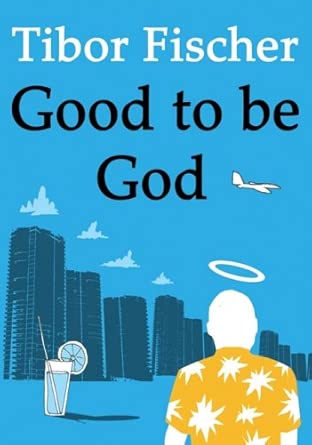
Using the credit card and identity of a handcuffs salesman, professional failure Tyndale Corbett arrives in Miami for a law enforcement conference to discover the joys of luxury hotels and above all the delight of being someone else, someone successful. Feeling his previous lack of success might be due to insufficient ambition, Tyndale decides on a new money-making scheme. He will up the ante substantially, exponentially and pretend to be someone really important and successful: God.His mission to convince the citizenry of Miami that he is, despite appearances, the Supreme Being results in him taking over the Church of the Heavily Armed Christ. His duties there involve him in forming a private army, hiring call girls, trafficking coke, issuing death threats, beating off church-jackers and sorting out (as almightily as possible) various problems his parishioners are having with pets. All the while he is working on his grand project, the clincher miracle, dying and coming back to life…
Editorial Reviews
Review
one of the funniest writers in the business –The Daily Telegraph
This is Fischer at his sharpest – a wildly original feelbad philosophical hayride –The Times
Tibor Fischer’s new novel resembles an Evelyn Waugh plot filmed by David Lynch…Fischer’s fecund imagination keeps the satire constantly engaging. –The Daily Mail
About the Author
Tibor Fischer was born in Stockport in 1959 of Hungarian parents. Brought up in South London, where he now lives, he was educated at Cambridge and worked as a journalist. He was shortlisted for the Booker Prize for his first novel, Under the Frog, which also won the Betty Trask Award, and he was nominated as one of Granta’s Best of Young British Novelists. Subsequent novels include The Thought Gang, The Collector Collector, Don’t Read this Book if You’re Stupid and Voyage to the End of the Room.
You know when you’re in trouble. You know you’re in trouble when you phone and no one phones back. You know you’re in trouble when you get back home, the door’s been kicked in, the only thing stolen is the lock (it’s the only thing worth stealing) and your burglar has left a note urging you to “pull yourself together”. This isn’t funny when it happens to you. I tried to live my life decently. For a long time. I really did, but it didn’t work…
“Well,” says Nelson. I haven’t seen him for a few years. He’s waiting for me in the Chinese restaurant, patiently turning over the menu. With your schoolfriends, you tend to think of them as they were, and it was unnatural to find Nelson there, not just on time, but early. Nelson was the schoolfriend my parents liked. He mastered manipulation young, and my parents were reassured by the state of the nation when Nelson, his hair immaculately combed, would greet them with excessive courtesy. This opposed to the inevitable grunts of my other associates. My mother was often more pleased to see Nelson than I was. Only once did my mother have suspicions. One evening, as I walked out to join Nelson in his car, she mused, “He does look too young to be driving.” That was probably because Nelson was indeed two years too young to have a driving licence, but since the car was stolen that didn’t matter much.
Nelson, Bizzy and I would roll through South London. You’ll never be able to enjoy driving as much as when you’re fifteen and in a stolen car. We’d stop off and have an expensive meal (prawn cocktail, steak, black forest gateau) on one of Nelson’s stolen credit cards. We did this quite often, and we only had trouble one night, but not from suspicious waiters or the police. Nelson – normally a conscientious driver – accidentally cut up a vanload of heavies, twice our age, size and number. We were chased around for an hour, and it was the only time I saw Nelson scared.
 Wow! eBook