"Unique for its strong focus on important policy questions in international trade and development economics. It provides comprehensive analysis of issues that generally do not appear in an introductory international economics text, including trade policy equivalence, intellectual property rights, and international trade and its impacts on labor markets and the environment."
―Keith E. Maskus, University of Colorado at Boulder
"This is an excellent and comprehensive treatment of the theory of international trade, trade policies, and institutional issues."
Robert M. Stern, Goldman School, University of California Berkeley
"Strong and subtle symmetry is a very attractive strength of this insightful treatment of modern policy interventions in globalized markets. Its structure is assiduously integrative, almost poetic in its analytics. Its applied questions encourage readers into the adventure of seasoned policy evaluation. It is a mature mentor -- more-than-primer -- for both activists and analysts, who need to go beyond the elementary anatomy of policy prescription for a global economy."
―J. David Richardson, Syracuse University and Peterson Institute for International Economics
“Pamela Smith fills a long-standing gap for students and policymakers wanting to understand contemporary trade issues like services, labor, and intellectual property rights, while remaining grounded in rigorous economics.”
―Michael J. Ferrantino
From the Inside Flap
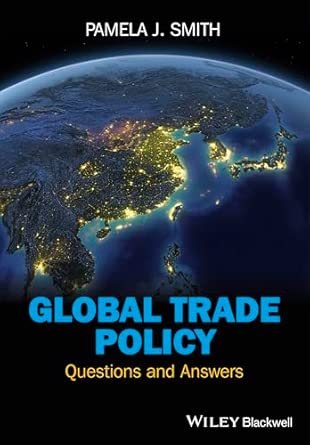
In Global Trade Policy, economist Pamela J. Smith explores the key questions raised about global trade and policy today —and the answers that emerge from economic research. During the past two decades, the character of global trade and policy has changed in unprecedented ways. Attention has turned from traditional trade policies —such as tariffs, quantitative restrictions, and export subsidies —to trade related policies including intellectual property rights, labor policies, environmental policies, and growth and development policies. The institutional arrangements for these policies continue to evolve with substantial international debate. Offering accessible coverage for students of economics, business, public policy, and applied economics, this book provides an economic framework for understanding the current policy debates in global trade. Readers are first given background knowledge of trade theory to help guide discussions of trade policy, including traditional theories of inter industry trade, as well as newer theories of intra industry and intra firm trade. They then examine the national and global effects of widely used policies designed to directly affect trade, the indirect impacts of newer trade related policies, and the institutional arrangements for these policies. The distinctive question based format provides an accessible structure for students to grasp the key issues in this field, and the inclusion of reading lists and applied exercises enable them to explore open ended and realistic questions of policy debate.
From the Back Cover
In Global Trade Policy, economist Pamela J. Smith explores the key questions raised about global trade and policy today ―and the answers that emerge from economic research. During the past two decades, the character of global trade and policy has changed in unprecedented ways. Attention has turned from traditional trade policies ―such as tariffs, quantitative restrictions, and export subsidies ―to trade related policies including intellectual property rights, labor policies, environmental policies, and growth and development policies. The institutional arrangements for these policies continue to evolve with substantial international debate. Offering accessible coverage for students of economics, business, public policy, and applied economics, this book provides an economic framework for understanding the current policy debates in global trade. Readers are first given background knowledge of trade theory to help guide discussions of trade policy, including traditional theories of inter industry trade, as well as newer theories of intra industry and intra firm trade. They then examine the national and global effects of widely used policies designed to directly affect trade, the indirect impacts of newer trade related policies, and the institutional arrangements for these policies. The distinctive question based format provides an accessible structure for students to grasp the key issues in this field, and the inclusion of reading lists and applied exercises enable them to explore open ended and realistic questions of policy debate.
About the Author
Pamela J. Smith is Associate Professor of applied economics at the University of Minnesota and teaches international trade and policy at the graduate and undergraduate levels
 Wow! eBook