 Wow! eBook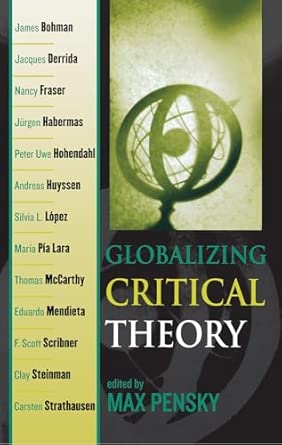
Globalizing Critical Theory
Author(s): Max Pensky (Editor), James Bohman (Contributor), Jacques Derrida (Contributor), Nancy Fraser (Contributor), Jürgen Habermas (Contributor), Peter Uwe Hohendahl (Contributor), Andreas Huyssen (Contributor), María Pía Lara (Contributor), Silvia L. López (Contributor), Thomas McCarthy (Contributor), Eduardo Mendieta (Contributor), F Scott Scribner (Contributor), Clay Steinman (Contributor), Carsten Strathausen (Contributor)
- Publisher: Rowman & Littlefield Publishers
- Publication Date: 3 Feb. 2005
- Language: English
- Print length: 264 pages
- ISBN-10: 0742534499
- ISBN-13: 9780742534490
Book Description
Editorial Reviews
Review
In this volume Max Pensky has assembled the best in the field to address the phenomenon of globalization. Beginning with Habermas’s now famous text on the global anti-war movement, Globalizing Critical Theory provides a sweeping vision of globalization in its various forms. For those interested in a critical examination of the global aspects of war, the public sphere, race and memory―as well as science, technology and aesthetics―this is required reading. — David Rasmussen, Ph.D., Boston College
The 11 essays on the “global public sphere” and other related topics are timely…Summing up: Recommended. Upper-division undergraduates and above. ―
CHOICEThis is a welcome and innovative book. ―
Perspectives on PoliticsIt represents an engaged and critical discussion of some various aspects of the much-discussed phenomenon of globalization, without exhausting the resourcefulness of the perspectives afforded by Critical Theory. ―
Philosophy in Review, October 2006The Critical Social Theory of the Frankfurt School was formulated to grasp the transition from nineteenth-century laissez-faire capitalism to early 20th century ‘state-capitalism’ or ‘organized capitalism.’ Today we are experiencing another epochal shift from Fordism to post-Fordism, from national economies to neo-liberal globalization. The powerful essays in this volume seek to come to terms with this new shift in its political and socio-cultural ramifications. A critical theory of globalization involves globalizing and transforming critical theory itself. — Seyla Benhabib


