Wow! eBook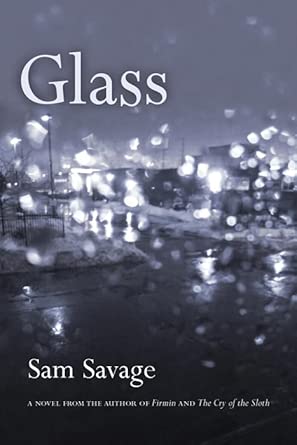
Glass
Author(s): Sam Savage (Author)
- Publisher: Coffee House Press
- Publication Date: 29 Sept. 2011
- Language: English
- Print length: 210 pages
- ISBN-10: 1566892732
- ISBN-13: 9781566892735
Book Description
Editorial Reviews
Review
"[A]n intriguing story . . . Savage's skill is in creating complex first-person characters using nothing but their own voice. . . . Edna's voice, too, is unique and hypnotic, although it is full of evasions and omissions. She tells a difficult story: It is cold and critical, a fading picture in place of memory. Typically, memoir gives us the emotional high points, but Savage's Edna inverts that: She writes loneliness and tedium, the bits and pieces that are hard to look at, or that typically wind up on the cutting room floor."--Carolyn Kellogg, The Los Angeles Times
"[A] dazzling, graceful novel . . . Glass gives us both a life story told well and tantalizingly in unspooled snippets, and a thoughtful rumination on the nature of late-life reflection itself. . . . Note is usually made of Savage's age upon the publication of his first novel in 2006: He was 65. But the layers of wisdom, the rapier honesty and the sheer intellectual rigor he displays in novels like Glass argue that seasoning may well trump youthful audacity in writing, perhaps the most cerebral of the arts."--Minneapolis Star Tribune
"Readers who don't know that author Sam Savage (Firmin, The Cry of the Sloth) holds a PhD in philosophy from Yale until after they've read Glass will be unsurprised. The book, while a skilled piece of storytelling, reads like a philosophical exploration as much as anything else. . . . Glass is a fantastic experiment in perspective and an oddly memorable book."--January Magazine, Best of 2011
"Sam Savage creat[es] some of the most original, unforgettable characters in contemporary fiction. . . . Now there's Edna, the elderly widow in Glass whose ongoing, typewritten argument with her late husband, Clarence, a novelist, covers in painstaking detail the mundane particulars of a life while ultimately uncovering the transcendent power of art. . . . Readers are left with a voice so strong that Savage is able to derive significance from these events by sheer literary force."--Poets & Writers
"Introspection is at the heart of this new novel from Savage, which effectively defines that jewel of a word, velleity (the lowest level of compulsion to act, a slight impulse to do something). . . . Reading like an intersection between Samuel R. Delany's The Motion of Light in Water and Marlen Haushofer's The Wall in its take on the overriding truth of memory and the heroic task of solitude, this is an original and compelling book. Highly recommended."--Library Journal, starred review
"Savage is not interested in the linear unfolding of the events in Edna's life but rather in the meanings that have accreted to them as she introspectively mulls them over and tries to make sense of things. . . . An engaging study of both the quirks and the depths of personality."--Kirkus Reviews
"Readers of Savage's Firmin (2006) and Cry of the Sloth (2009) will come to this one with large expectations, and they won't be disappointed. . . . Savage's decision to use the point of view of an unreliable narrator will capture the attention of readers of literary fiction. The wry, bizarre humor will keep it."--Booklist
"There is a ruddy and ribald wisdom at work [in Glass]. . . . If you've let Sam Savage take you on previous journeys, if you've enjoyed those journeys, I wholeheartedly recommend you let him take you on his latest flight of fancy."--Bookmunch
"Edna is hilarious, poetic, and heartbreaking, all without really trying to be. . . . [T]he glimpses of her past life are so perfectly sculpted and are teeming with gorgeous language, and her humor that cuts them short is so precise and well-played."--Hazel & Wren
"Sam Savage's exhilarating, often lilting use of language and his faultless characterization of the eccentric, unraveling of his main character, Edna, is evocative, poetic, and compelling."--New York Journal of Books
"On a craft level, Glass leaves several strong impressions, at least some of which other fiction writers and students of fiction writing may find instructive. . . . Savage's skill in sustaining the reader's attention through 200 pages of apparent stream-of-consciousness may be exemplary. . . . In a novel that essentially lacks a plot, he nonetheless creates one of the most intriguing stories--and one of the most vivid characters--that this reader has encountered this year."--The Writer
"Glass transforms through Edna's pathology (and Savage's relentless vision) into a deeply felt exploration of memory, of what it means to outlive the sources of one's suffering. . . . Here is where the novel shines: through a Beckettian obsession with precision of language, the tension between solipsism and longing becomes primal, and through Edna, Savage creates a world so small that his reader is forced to confront the very stitching that binds together its existence, frail as that is. . . . [Glass] is profound, and readers are ultimately rewarded with a nearly voyeuristic pleasure, watching as this human life unfolds, reluctantly, in all its tragic splendor."--BookPage
"The sharply drawn characters in Savage's two previous works, Firmin: Adventures of a Metropolitan Lowlife, which novel's namesake is a rat, and The Cry of the Sloth received critical acclaim. He's done it again with the at once appealing and irritating Edna, whose tragedy bites with cartoon fangs."--Denver Examiner
"Savage devotes much of Edna's typing . . . to careful examinations of phrases, astute observations and literary references. . . . [Glass is] Sam Savage's examination of the truth of memory, the effects of self-imposed solitude, and the churning verbal mechanics of writer's mind."--Shelf Awareness
"One of the many accomplishments in this fine novel . . . is to make a reader come close to understanding the deadening sadness of [Edna's] life, and potential fate, and, finally, feel sympathy for a character whose ways can be off-putting and obscure."--Requited Journal
About the Author
Excerpt. © Reprinted by permission. All rights reserved.
Glass
A Novel
By Sam Savage
COFFEE HOUSE PRESS
Copyright © 2011 Sam Savage
All rights reserved.
ISBN: 978-1-56689-273-5
CHAPTER 1
I think a lot. I think too much Clarence liked to say, when I objected to some of the piffle he would come out with, especially when he had knocked back a few. I am not going to go into that now, into his drinking or his piffle, as I am not at the moment thinking about Clarence, except insofar as I have to in order to mention him at all — you cannot talk about someone without thinking about them in that sense. What I was actually thinking about was traveling, though not about that either in the sense of considering it as potential action — rushing to the bus station and so forth, or even looking at colorful brochures — as if I could take a trip if I wanted, though I really do want to in some sense of wanting, in some sense of trip. To want in that way is to have a desire without attaching it to any foreseeable action — desire without hope, I guess it is. I believe the word for that sort of desire is velleity. I am finding that I have more and more velleities these days, and one of them is the velleity to travel, a hopeless longing to just peregrinate off somewhere. But thinking about it some more it strikes me that even velleity might be too strong, suggesting as it does a feeble impulse, so terribly feeble these days. I don't as a matter of strictest fact have a desire to travel even as something hopeless and impossible, not at the present time, not when I have only just started typing again. It is more that I sometimes like to imagine the places I might go if I were to take a trip, and that is what I was doing a few moments ago, before being distracted by the thought of Clarence, which intruded without being summoned. I was sitting at the little table by the window, where I take breakfast and where the typewriter is at the moment. I am still sitting there, obviously. My posture is erect, elbows open, forearms sloping slightly downward; I am wearing a blue dress. I intend to type up all sorts of items in addition to Clarence, and among them I expect will be some that have yet to pop into my head. I say that, and it occurs to me that in the huge heap of things stacked in my head Clarence has become just an item. Before saying it — inadvertently as I have just explained — I had not thought of him in quite that way. The table is small, round, with tapered wooden legs and a Formica top. I take breakfast here because the windows face east and I can be sitting in front of them with my cup of coffee when the sun comes up. It comes shining up over the ice cream factory, the light streams in through the big windows, and I take a first small sip. Sometimes with that first sip the words "sip and shine" come into my head and shine there. Moments like these, I suppose, are what people mean when they talk of life's little pleasures. The sun comes up, the ice cream factory roars, and sometimes I imagine the roar is the sound of the rising sun, as in the Kipling poem I loved as a child, where the dawn comes up like thunder out of China across the bay. All the windows in this room face east, but the sunlight streams through only one of them, the center one of three, the clear one between the two obscure, as those two are mostly covered with notes and bits of tape and through them the sunlight merely seeps, apart from a few slanting shafts that penetrate the interstices, shedding bright jagged patterns on the floor. If Rudyard Kipling could see the sun come up out of the ice cream factory across the street, he would be disappointed, I am sure. There are other days when the clouds are so thick I am not certain where the sun is exactly, and on those days I have a feeling of such oppression I find it hard to see the point of going on, and when the cloudy days come one after another without a break between them, as has been happening more frequently in recent years, things reach such a pass I find myself crying over trifles. By "things" I mean mostly my thoughts. Opening the refrigerator one morning and finding there is not any milk is such a trifle, where in fact I did sit down and cry. I woke up and it was raining again. I lay in bed listening to it fall and comforted myself by thinking about how in a few minutes I was going to be curled up with my coffee in the big armchair by the window, pictured myself looking out at the rain and feeling thankful to be dry and warm. And after that to get up in the semi-dark and walk to the kitchen and discover the milk has turned and to know that I will have to drink the coffee black or go out to the store in the rain ... naturally I sat down and just wept. In addition to the table I have an armchair and a footstool that sits in front of the armchair, and those, along with a small sofa, a bookcase, a little corner stand that holds the telephone, and two straight-back chairs that go with the table, are all the furniture in the living room, unless one counts the radio — a yellow Sony radio on the windowsill nearest the armchair. When I sit in the armchair I rest my feet on the stool, as I have been told to do because of the swelling in my ankles, though that is not why I do it — I do it because I am more comfortable that way. I sit and look across the humps of my knees at my feet, an increasingly doleful sight in recent years, with their river deltas of blue veins. I have managed to identify the Zambezi and, I think, the Magdalena, though I need to verify the latter with a better atlas. The armchair is upholstered in a brown velvety material, the footstool is brown as well but a different brown from the chair, my feet are upholstered in flesh that beneath the scaly epiderm has grown spongy lately, retaining dimples if I poke it. When I was a child I once heard my father say of my mother that she was in a brown study, and I thought, What an odd thing to say, since we could all see that she was sitting in her car in the driveway. I have liked the expression ever since, because of the funny pictures that come with it, though I never say it out loud anymore as none of the people I talk to now would know what it means, but sitting in my brown chair I sometimes think of it. "Edna is in a brown study" is how I think of it then. By "people I talk to now" I mean the people I have been talking to lately, which would be various young people behind the counter at Starbucks, the waitress at the diner, Potts, the girls at the agency, the man in the typewriter store, and a bus driver, to the best of my recollection. I have other acquaintances who would surely know what a brown study is, but I have not been talking to any of them lately, where by "not talking to them" I don't mean that we are not on speaking terms, suggesting a mutual not-talking due to animus; it is just that lately I haven't said anything in their vicinity — last summer was when I stopped saying things in their vicinity. Another expression I like is "on the point of departure," as if there were a pinnacle or peak of some sort with departure a slope on one side and staying a slope on the other. Seen in that way staying is really a kind of backsliding: sliding back into my big brown chair. There are other phrases like that, which remind me of that one — "on the verge of despair," for example. In fact there are quite a lot of those — "on the brink of madness," "at the edge of bankruptcy," "on the fringe of respectable society," and so forth. You can see just from these phrases that every walk of life has its pitfalls. I don't say that as an excuse. I have not gone to work since the second week of January. Early one morning at an hour when on any other weekday I would have been charging down the stairs to the street, afraid of missing my bus, I did not charge down the stairs. I stood on the landing for a while, and then I went back inside. I did not deliberate; there was nothing to deliberate about. "Edna was stopped cold in her tracks by a sudden blankness" was how it felt. Of course I mean mentally charging, impelled by a fear of being late, not physically running down the steps, which would be practically suicidal at my age. I did not, on the last day I was at work, intend never to return. I had not properly packed up, and I left my sheepskin earmuffs hanging on the back of a chair. I called in sick every day at first, then every few days. After a while I stopped calling, preferring to wait until they telephoned me. Now no one telephones. I did not go to work because it was too much bother. It is something of a mystery that the typewriter is once again perched on the table. I put it here quite a few weeks ago. I dragged it from the back of the closet, having removed a great many other items — clothing, books, blankets, parts of a broken chair — piling them on the bed, in order to reach it. I intended to start typing the moment I set it down, and I actually did whack the keys a few times, to check that they were working, and I saw right away that the ribbon had dried out. That was to be expected, of course, the machine having sat in my closet for years, though I was not personally expecting it, not having thought about the ribbon at all and expecting really to be able to sit down and type. I am not sure how many years, certainly ten or eleven, since I have lived in this apartment fourteen years and after the first two or three I have not typed at all. The mystery is why I all of a sudden decided to take it up again, take up typing again after so much time without it. One day I am staring out the window or quietly eating oatmeal at my table or, as I mentioned, weeping, and the next day I am typing. I will not say merrily typing or even typing away, but typing nonetheless, accurately and at a good pace, considering. When I first moved into this apartment I was still writing letters to a few people, though I was finding it increasingly difficult to think of anything to say to them beyond the usual stuff of how are you all and I am well considering, unless I happened to be recovering from flu or some such thing, and then of course I could always mention that. It became obvious after a while that I was not saying anything more than would fit on a postcard, and I started sending postcards instead, and that was when I stopped typing, postcards being the sort of thing one writes by hand, and it must have been soon after this that I put the typewriter in the closet, it having become just one more thing to trip over. Of course one could write postcards on a typewriter. A drawback would be that they would come out curved and have to be placed under a book until flat again, and also, because a typewriter's letters are so much smaller than handwriting, one would be able to fit more words on the card, defeating the whole purpose of writing cards in place of letters. One would end up once again inserting all sorts of irrelevant drivel just to fill up the white space, and that seems to me the actual reason people do not usually type postcards. After all, there is nothing really wrong with mailing curved postcards; certainly there is no postal rule against it, since in any case it would be flattened in the cancellation machine or whatever they call the device that prints the wavy lines across the stamps. When I said that I am now once again typing at a good pace considering, I was referring to my age: I am typing at a good pace for someone my age, with hands like mine. I am inclined to say that my fingers look like claws. My fingers do not look like claws, though they are thinner than they ever were and the knuckles are swollen. I think they are the hands of an average female person of my age. My dress is fastened at the wrist by four white buttons. I collected stamps when I was a child, without enthusiasm, because the grown-ups thought I should. My father's companies received correspondence from all over the world, and he made them save all the interesting stamps for me, ones they might otherwise have taken home to their own children. I did not enjoy collecting stamps and never bothered pasting them into the big blue albums Papa bought me, but I kept the prettiest ones near my bed in a mahogany box with an old-fashioned square-rigged sailing ship carved in bas-relief on the lid, and I looked at them now and then. The ones I liked best were from countries I had never heard of, faraway parts of the British Empire, and French Equatorial Africa, a place that because of its name impressed me as infinitely desirable. I was required to take a nap every afternoon until I was ridiculously old, and instead of sleeping I sometimes took the stamps from the box and looked at them and imagined that I was traveling to the places the stamps came from and riding elephants, encountering crocodiles, and things of that nature. I actually don't remember my daydreams from that period, just that I spent a lot of time having them, so I am only guessing when I say they included crocodiles and elephants. I mean, why wouldn't they? As time passed, and my situation became increasingly intolerable, I daydreamed more often, not just at nap time, and stayed away longer. I stayed away in the dreams — I was dreaming that I was away. By "situation" I mean ordinary life, which at that time included Mama and Papa. I must have been four or five when I finally recognized that ordinary life with them had become intolerable for me. They had brought me to my first day at kindergarten, "they" in this instance being Mama and Nurse, the large German woman who took care of me while Mama was socially whirling. She had a real name, I suppose, but if I once knew it I have forgotten it now. The words "Gertrude Klemmer" hover next to a number of my earliest recollections, though perhaps that was someone in a book. Whatever her name, she was Nurse to me, and I saw a great deal more of her than of Mama or Papa. She left when I was five or six, replaced by a series of other women, none of whom stayed for very long. I am not sure she was German; she might have been Dutch. I finally did travel to Europe several times after I was grown, to Mexico, Venezuela, and to East Africa once, for a short while, but I never went to any of the countries of my favorite stamps. Traveling as a grown-up, with all the burdens and unhappiness of being grown, turned out to be not nearly as nice as I had thought it would be when I imagined it as a child.
The blank space means I stopped typing at that point — to go look for a picture of Nurse. I had been wondering if she was German or Dutch, and I thought I would have another look at her picture. That was ridiculous, of course, to think I could find out by looking at a picture whether someone is German or Dutch, but I went and looked for it anyway. I have noticed that I am having a great many thoughts lately that don't quite make sense. As happened earlier, when I complained about being distracted by the thought of Clarence, which I accused of intruding without being summoned. In fact, after reflecting on it some more, it is not clear to me how a thought could ever be summoned, as I seem to have suggested then. After all, I would scarcely be in a position to summon a thought, pluck it from the enormous heap of all possible thoughts, were I not already thinking it, in some sense of thinking, in some sense of already, and of course it is less a heap than a tangle, an enormous tangle of possible thoughts, like a jungle. Summoning a thought would be like summoning a stranger from a crowd in order to find out his name. Well, I suppose you could do that with gestures or by shouting or by going over to him and plucking his sleeve, as you might do if one day you were to see someone in a railroad station whose name you would like to know, perhaps because he looks like the kind of person you would want to be friends with. To make the analogy work you have to imagine that you are not able to go over next to that person, perhaps because you are crippled or horribly tired or under arrest and are handcuffed to a policeman. You see this person you want to know, perhaps someone famous who would be able to help you out of your difficulty, but you are not allowed by some mysterious force which we won't go into now to shout or wave or even move your eyes in a significant manner. The only way you are permitted to get his attention is by calling his name, and that is just the thing you don't know and were hoping to find out. Of course we have to assume also that the people you are with, the policeman or doctor or whatever, don't know his name either, or if they do they are refusing to tell you, because they think it would be harmful for you to contact that person or perhaps harmful to them, to their position in society, especially if you are being wrongly detained, or perhaps they just do it out of spite. I feel that I am not making myself clear. I am trying to make the really simple point that summoning thoughts is out of the question: they just come, and the matter seems complicated only because it is really so simple.
(Continues...)Excerpted from Glass by Sam Savage. Copyright © 2011 Sam Savage. Excerpted by permission of COFFEE HOUSE PRESS.
All rights reserved. No part of this excerpt may be reproduced or reprinted without permission in writing from the publisher.
Excerpts are provided by Dial-A-Book Inc. solely for the personal use of visitors to this web site.