 Wow! eBook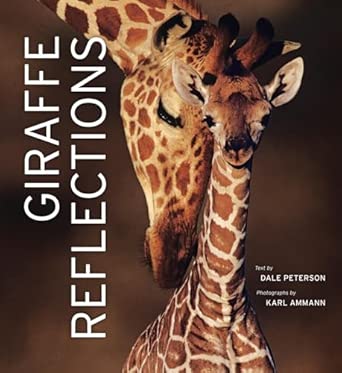
Giraffe Reflections
Author(s): Dale Peterson (Author)
- Publisher: University of California Press
- Publication Date: 6 Sept. 2013
- Edition: Illustrated
- Language: English
- Print length: 232 pages
- ISBN-10: 0520266854
- ISBN-13: 9780520266858
Book Description
Editorial Reviews
Review
From the Inside Flap
Marc Bekoff, author of
The Emotional Lives of Animals and editor of Ignoring Nature No More: The Case for Compassionate Conservation“With that tall neck, striking pelage, gentle face, and graceful gait, surely no land animal is more wondrous and unlikely than the giraffe. In these exquisite pages Dale Peterson and Karl Ammann have captured this remarkable creature as none before. Thanks to these lyrical words and soulful photos, you’ll never forget how blessed we are to have these prehistoric-looking animals on our planet–nor forgive the loss we’d endure should we allow them to vanish.”
Sy Montgomery, author of
Walking with the Great Apes and Spell of the Tiger“Karl Ammann’s photographs in this book are stunning! They vary from mood sequences that fill the reader with awe to shots of male giraffes fighting in a style that has never before been documented.”
Anne Innis Dagg, author of
Giraffe: Biology, Behaviour and Conservation“A masterpiece about one of the world s most fascinating but least understood animals,
Giraffe Reflections is utterly compelling a page-turner with glorious photographs. A reader cannot ask for more.”Elizabeth Marshall Thomas, author of
A Million Years with You and The Hidden Life of DogsFrom the Back Cover
–Marc Bekoff, author of
The Emotional Lives of Animals and editor of Ignoring Nature No More: The Case for Compassionate Conservation“With that tall neck, striking pelage, gentle face, and graceful gait, surely no land animal is more wondrous and unlikely than the giraffe. In these exquisite pages Dale Peterson and Karl Ammann have captured this remarkable creature as none before. Thanks to these lyrical words and soulful photos, you’ll never forget how blessed we are to have these prehistoric-looking animals on our planet–nor forgive the loss we’d endure should we allow them to vanish.”
–Sy Montgomery, author of
Walking with the Great Apes and Spell of the Tiger“Karl Ammann’s photographs in this book are stunning! They vary from mood sequences that fill the reader with awe to shots of male giraffes fighting in a style that has never before been documented.”
–Anne Innis Dagg, author of
Giraffe: Biology, Behaviour and Conservation“A masterpiece about one of the world’s most fascinating but least understood animals,
Giraffe Reflections is utterly compelling–a page-turner with glorious photographs. A reader cannot ask for more.”–Elizabeth Marshall Thomas, author of
A Million Years with You and The Hidden Life of DogsAbout the Author
Excerpt. © Reprinted by permission. All rights reserved.
GIRAFFE REFLECTIONS
By DALE PETERSON
UNIVERSITY OF CALIFORNIA PRESS
Copyright © 2013 The Regents of the University of California
All rights reserved.
ISBN: 978-0-520-26685-8
Contents
SPIRITSCHIMERASUNICORNSZARAFASGIRAFFIDSBODIESBEHAVIORSMOTHERSOTHERSKINDSAcknowledgmentsNotesReferencesIndex
CHAPTER 1
SPIRITS
IT WAS STILL DARK when Karl and I left camp. On the way to where we thought thegiraffes might be, we passed through a feeding group of Thomson’s gazelles.Illuminated starkly by our headlights, they looked like precious tchotchkes:delicate little legs, prancing style, nervously tic-tocking tails.
Fifteen or twenty minutes later, we surprised three giraffes lying down in thegrass and looking dazed, as if they had just woken up after a long andsatisfying night’s sleep. They were emerging from the darkness, bathed faintlyin the light-speckling dawn, and all we saw at first was what appeared to bethree swaying trees with heads on top. They became alert as we drove closer.They were in a small meadow, edged, protected perhaps, on two sides by a bit ofdark and thickety bush, and I imagined the spot as a comfortable bedroom forgiraffes.
Karl took some photographs, but instead of waiting patiently for the sun to riseand cast some interesting morning light on the sleeping beauties, he keptdriving around, looking for a better angle, taking one or two quick shots withthe engine off, then starting the car, moving to a new position. As he worked,he commented on his photography, the animals, the light. “Yeah, it’s the nicetype of light which says they’re just getting up,” he said. But the moment wasquickly gone. Soon the light had turned slightly harder, and the three lying-down giraffes were laboriously standing up. Then, slowly, they sauntered away.The sun rose and turned into a seething red ball at the horizon, and so the daybegan.
This happened in southwestern Kenya, in the Masai Mara: a rare place where themodern catastrophe has not yet fully dawned, where, in the fading darkness, itis momentarily possible to believe you have reached the fragile beginning oftime.
In the Mara, we saw giraffes singly, doubly. We saw them in groups of three orfour or a dozen or more. One time we emerged from a hiding place in the thicketsand discovered a group of eighteen. They were Masai giraffes, of course,patterned with brown and splotchy spots. One looked as if she had been madeentirely of cream and then one day had been struck forcibly by a mad flock ofbrown-sugared birds.
One was lying down, the rest standing, all with their ears flickering and theirtufted tails desultorily flicking back and forth. They stared. We stared. Theystared and chewed their cuds. We stared and took pictures. They stared and thenlooked at each other. We stared, took pictures, and then Karl started up the carto move closer and get a better position. Several minutes later, I saw a subtleemergence of giraffe consensus. One turned, another turned, a third turned. Soona half dozen had turned, and then they were all ambling undulously along,stately and elegant. Karl (working on his lenses, muttering to himself): “Try todo a very wide angle once, take them all in.”
* * *
Later, in northern Kenya’s Samburu National Reserve, we came upon a group of sixreticulated giraffes (whose markings look like brown plates caught in nets ofpale hemp) browsing in a nice pocket of trees and bushes. Four of them lookedyoung, one of them very young. They were spread out at first and chewing at thetrees and bushes, but eventually they moved out of the pocket and began slowly,patiently ambling in the same uphill direction. They seemed so finely built, sodelicate, and they gradually arranged themselves, as they walked, into singlefile, the four youngsters in the middle, the big adult male at the rear, theadult female at the head.
Then, for no good reason, they stopped and gathered to think about things, or soit seemed. They stood still. They looked in several directions. We saw, then,two more giraffes at some distance behind and moving uphill in their direction.The stragglers looked like adolescents or, possibly, full adults. But everythinghappened very slowly, and Karl and I remained in the car and then settled intoanother experience of time, where we were immersed in the sweet smell of drygrass and cooled by a dry wind blowing through the windows, heated by a slantinglate afternoon sun, fitfully distracted by the buzzing of a fly. I thought:blond savanna, brown bushes: fitting colors for a giraffe. Meanwhile, the tallfemale outside our vehicle stared at us for a very long time, then began eatinga small cache of green leaves edging a brown, thorny bush, while the twostragglers behind her slowly, slowly began to catch up. Now there were eight inthe group, pausing, looking, pausing, browsing, pausing.
A big male had a half dozen red-billed oxpeckers lined up on his back, pickingaway at a feast of ticks. Karl: “That’s quite a lineup. Must be somethingtasty.”
We followed them all slowly, the car grinding away in its lowest gear andstruggling heroically over a rough surface of bumps and holes, following thegiraffes as they slowly continued uphill, pausing opportunistically at eachgreenish-brown thornbush. They took bites, too, from the occasional high acaciatree, each filled with a hundred weaverbird nests that dangled like Chineselanterns. I gazed away momentarily, looking out across a spectacular vista ofsun-yellowed plains dropping down to a green-lined river. Then I returned to thegiraffes and was suddenly amazed at how narrow their necks are, ribbony even,yet very flexible and immensely strong.
* * *
In the Namibian desert, at a place called Twyfelfontein, we found giraffes intheir most ancient and ethereal form: wispy, rising representations carved intorock by Bushman artists who lived a few or several thousand years ago.
Twyfelfontein. A recent name, Afrikaans in origin, it describes the wistful hopea white farmer formed for this spare spot in the sparse desert. The nametranslates into English as Doubtful Spring.
The Bushmen camped in a small plateau or terrace just above the doubtful spring,and their camp was a gathering place, a passing refuge in the hard life ofhunting and gathering. They were protected by a high cliff and mountain behindthem, while before them lay the flat and splendid valley consisting mainly ofrust-red stone and sand, which is spotted, after the rains, by the green ofsmall thorn trees and scrub. The valley is surrounded by flattened, red-rockedmountains. The red rocks are Etjo sandstone, consisting of alluvialconglomerates and eolian sandstone—stone, that is, formed from sand that hasbeen sifted by the wind and is thus fine grained and capable of breaking intosmooth, even blocks.
The spring and the remnants of that camp are surrounded by a chaos of greatbroken sandstone boulders, arranged like a mythical giant’s fallen house ofcards, with the smooth surfaces covered by art. As many as 2,500 separateetchings on some 200 sandstone tablets depict a swirling congregation ofantelopes, elephants, leopards, lions, ostriches, rhinos, warthogs, zebras—andgiraffes—as well as some humans, the occasional animal and human hand or footprint, and a number of purely abstract forms and designs. The representationsare convincing and accurate and yet boldly stylized. There are rhinos, forexample, with impossibly long upturned horns, tapered and fragile. There is alion with a preternaturally long tail that curls back and then up and finallyterminates in a leonine paw print. A giraffe stands on finely tapered footlesslegs that look like wisps of smoke rising from a fire. Another giraffe,elsewhere in the stone, stands proudly with a five-pointed head, fiveprojections (two ears and two horns on top, a smaller horn pointing back) thatstrangely evoke the five digits of an outstretched human hand.
Before writing came art, and so it is art that draws us back to the beginning ofmemory. Africa is covered with such memory, which has been painted on or carvedand chipped into rock. The art embraces the artists themselves and their people,and it embraces the animals people lived with, the animals they saw and dreamedabout and hunted when hunger so required.
The art can be found far to the north, from the western edges of the Nile Riverall the way west across the Sahara, from there down to the eastern middle ofAfrica, and down again to the south. The northern art reminds us that the SaharaDesert was once, before a shift in climate that happened four to six thousandyears ago, wetter and richer and far more hospitable to large mammals and large-mammalhunters than it is today. Giraffes are depicted there, often, in thecontext of hunting and trapping. But the southern carvings and paintings, alldone by Bushman artists and revealed in thousands of different sites acrossAfrica’s great southern foot, evoke, I think, a more ancient life that tookplace under the sun and stars within a coherent and whispering cosmos.
The Bushmen were despised by the first white settlers in Africa, who saw them aswild men with clouded minds and filthy ways, a people inherently incapable ofgrasping the higher logic of Christian and colonial authority, with (in thewords of one early missionary) “a soul debased, it is true, and completely bounddown and clogged by his animal nature.” They were “savages,” to repeat thecalumny used by Sir John Barrow in his memoir of explorations in southern Africadone more than two hundred years ago. Barrow, though, was expressing a commonprejudice, and he probably did so ironically, while describing his earlydiscovery of the glorious art surrounding a Bushman camp, art so forceful andspirited, so accurate and yet expressive, that, he wrote with a critic’sunderstated certitude, “worse drawings … have passed through the [European]engraver’s hands.”
Barrow recognized the skill and intelligence involved in such art, and heresponded to it in aesthetic terms. This art is not the fading remnant of afeeble attempt at decoration or of casual vandalism, the graffiti of boredteenagers. It is the studied production of an active mind. Barrow saw beauty,and he recognized training and skill. That is an appropriate response, yet it isinappropriate to imagine that the Bushman artists intended these works to be, inthe European way, aesthetic productions that might be bought or sold or traded,thereby distinguishing the artist as an individual. Nor is there any clearsuggestion in this art of the simplistic tit-for-tat of sympathetic magic: theeffort to capture or freeze game animals symbolically with the fervent beliefthat an artist’s triumph can become the hunter’s.
The fires were scarcely extinguished, and the grass on which they slept was notyet withered. On the smooth sides of the cavern were drawings of several animalsthat had been made from time to time by these savages. Many of them werecaricatures; but others were too well executed not to arrest attention. Thedifferent antelopes that were there delineated had each their character so welldiscriminated, that the originals, from whence the representations had beentaken, could, without any difficulty, be ascertained. Among the numerous animalsthat were drawn, was the figure of a zebra remarkably well done; all the marksand characters of this animal were accurately represented, and the proportionswere seemingly correct. The force and spirit of drawings, given to them by boldtouches judiciously applied, and by the effect of light and shadow, could not beexpected from savages; but for accuracy of outline and correctness of thedifferent parts, worse drawings than that of the zebra have passed through theengraver’s hands. –SIR JOHN BARROW, 1806
Yes, individual artists must have been particularly skilled, and surely this artwould have generated aesthetic pleasure as well as a sense of wonder or magic.But its primary purpose may have been collective rather than individual, and itmust have worked in the same way that stained-glass windows did for illiteratemedieval Christians: as a cultural expression, a shimmering communal statementin which the ways and logic of a people within their cosmos were confidentlyremembered, rehearsed, and realized.
Our guide at Twyfelfontein, a slender and composed young Damara woman whointroduced herself as Thekla Tsaraes, explained that the carved rock art wasdone by Bushman shamans who had gone into a trance. During the trance, she said,they used their art, those ethereal representations of animals, as a route ofentry into the spirit world. The giraffes, for instance, were usually shownwithout their hooves, with their legs drawn away into long, thin linesexpressing the shaman’s experience of rising in the air when he enters a trance.Sometimes a giraffe etching would be twisted, in the way a shaman feels his ownbody changing, transforming as he enters the spirit world.
When she spoke of the Bushmen, Tsaraes said “Boesman,” and her English wassometimes hard to follow. “So the Boesman people,” she said, “have used theirfootprints to enter the solid rock without being seen.” When I pressed her aboutthe giraffe images, she declared, “Sometimes even the giraffe is regarded as aholy animal. They believe it’s close to the clouds and is bringing down therain.” And when I asked her how we could know such things about people who livedso long ago, she responded that anthropologists had studied their culture.
It is true. We know a good deal about the cultures of surviving Bushman groupsfrom the work of twentieth-century anthropologists. None of those survivors madethe art, however, and the primary source of knowledge about the art-makingBushmen comes from the nineteenth-century labors of Wilhelm Bleek, a Germanlinguist living in South Africa. Bleek was interested in studying the severallanguages of Africa’s First People, and when, in 1870, he learned that some /XamBushmen were imprisoned in Cape Town for various petty crimes, he convinced thecolonial governor to release a number of them to his care. One of them, a mannamed //Kabbo who was, in Bleek’s assessment, “a gentle old soul, lost in adream-life of his own,” proved to be his most prolific informant, although theother /Xam also contributed. They lived in Bleek’s house, taught him theirlanguage, and in the process described their lives and vanishing culture.
The /Xam lived in extended family groups of perhaps a half dozen to two dozenpeople, who would temporarily settle near a spring or water hole. They builttheir small huts far enough from the water to avoid frightening the animals, whoalso congregated around water, and they relied on a second spring or water holefor the change of seasons and the inevitable drying-up of the first. Getting tothe second might require two or a few days’ trek across arid lands, with themigrating group carrying water inside ostrich eggshells.
They were hunters and gatherers, with the women gathering vegetable foods andthe men hunting for meat using small bows and light, poison-tipped arrows. The/Xam poisons were lethal but very slow acting, which meant that the hunter hadto track his wounded quarry for hours or even days. Tracking, then, was anessential skill for these hunters and is expressed in the animal-track motif ofso much of their art.
But the /Xam worked to control their fickle and often hostile environmentthrough shamanism, which is even more of an essential theme for the art. All-night dances brought some of the men, carrying sticks and wearing rattles madeof dried seed pods or pebble-filled springbok ears, into a trance state. Thedancers, trembling, sweating, bleeding from their noses, became charged with apotent energy that seemed to boil out from within. Through succumbing to thisenergy they experienced their own death, leaving their physical bodies in orderto manipulate the occult forces of the world beyond. They became shamans, inother words, and they used their newly acquired powers to work on threeinterconnected problems having to do with health, game, and rain. Shamans whoacquired the power of healing might pull the illness out of a stricken personand into themselves, then sneeze it out along with a bloody discharge, which wasthen wiped onto the ill person with the theory that its smell protected againstevil. Game shamans—the rock art sometimes shows them wearing caps made from thescalp of an antelope, the ears sewn to stand upright—worked to control themovements of antelope herds and confuse the trickster deity, /Kaggen, who likedto protect the special animals. And finally, the rain shamans tried to outsmartand catch certain mythical rain animals, whose blood or milk, when spilled,would be transformed into water that fell as rain.
That, in any event, is what I learned at Twyfelfontein and later fromconsidering a handful of books on the subject. I also spoke about such thingswith Elizabeth Marshall Thomas, author of the anthropological classic TheHarmless People (1958) and, more recently, The Old Way: A Story of the FirstPeople (2006), both of which draw on her experiences as a girl visiting andliving among four language groups of the still surviving Kalahari DesertBushmen. She knew nothing about the rock art, Thomas told me, since theKalahari Bushmen did not do that kind of art. Their art was in their music—and,for the men, in their hunting and the mythlike stories they told about hunting.Also, she added, none of the Bushman groups she knew had shamans, at least notin the sense of someone being an elite, professionalized healer.
(Continues…)Excerpted from GIRAFFE REFLECTIONS by DALE PETERSON. Copyright © 2013 The Regents of the University of California. Excerpted by permission of UNIVERSITY OF CALIFORNIA PRESS.
All rights reserved. No part of this excerpt may be reproduced or reprinted without permission in writing from the publisher.
Excerpts are provided by Dial-A-Book Inc. solely for the personal use of visitors to this web site.


