 Wow! eBook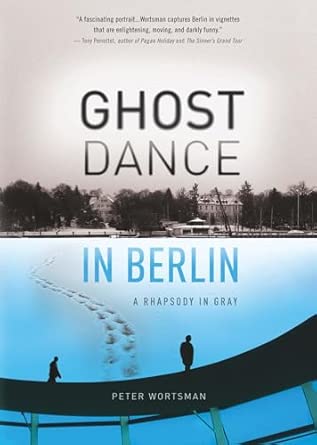
Ghost Dance in Berlin: A Rhapsody in Gray
Author(s): Peter Wortsman (Author)
- Publisher: Travelers' Tales
- Publication Date: 11 April 2013
- Edition: Illustrated
- Language: English
- Print length: 175 pages
- ISBN-10: 9781609520786
- ISBN-13: 1609520785
Book Description
Part memoir, part travelogue,
Ghost Dance in Berlin is an unlikely declaration of love, as much to a place as to a state of mind, by the American-born son of German-speaking Jewish refugees. Peter Wortsman imagines the parallel celebratory haunting of two sets of ghosts, those of the exiled erstwhile owners, a Jewish banker and his family, and those of the Führer’s Minister of Finance and his entourage, who took over title, while in another villa across the lake another gaggle of ghosts is busy planning the Final Solution.Editorial Reviews
Review
Tony Perrottet, author of Pagan Holiday and The Sinner’s Grand Tour
Praise for Peter Wortsman:
“I was particularly struck by the account of the visit to Auschwitz [in “Snapshots and Souvenirs”]. The behavior of the people was wonderfully human and moving the sort of thing even the best writers find it almost impossible to invent. The unexpected in human behavior is difficult to take out of the air, as opposed to the usual, which anyone can invent. So that it is precisely these unforeseen details which establish the authenticity of the text, and which give it its literary values. . . . The Auschwitz piece is excellent.”
Paul Bowles, author of
“
A Modern Way to Die is a fantastic book and I thoroughly enjoyed it. I have never read anything quite like this, but my enjoyment was due to more than just novelty, it was a response to marvelous writing, wonderful craft, and the breath of imagination. . . . [Wortsman] succeeded so well in his craft and art that it reads artless’ and spontaneous,’ which to me is the highest of compliments.” Hubert Selby, Jr., author of Last Exist to Brooklyn and other books
“Wortsman hangs with the masters.”
A. Scott Cardwell,
“His work reminded me some of E. B. White’s
New Yorker stuff observations turned into little reads but with a modernist twist.” Ruth Lopez, The New Mexican
“Wortsman achieves a level of spontaneity and accessibility . . . to which most writers can only aspire.”
David Ulin,
From the Inside Flap
Part memoir, part travelogue, Ghost Dance in Berlin is an unlikely declaration of love, as much to a place as to a state of mind, by the American-born son of German-speaking Jewish refugees. Peter Wortsman&;s fluency in German makes the text resound in eerie stereo. The winter of 2010 was so cold, he literally walked on water. From his perch in a lavish villa on Berlin&;s biggest lake, he imagines the parallel celebratory haunting of two sets of ghosts, those of the exiled erstwhile owners, a Jewish banker and his family, and those of the Führer&;s Minister of Finance and his entourage, who took over title, while in another villa across the lake another gaggle of ghosts is busy planning the Final Solution. Where a wall once stood dividing East and West the city remains bisected by invisible borderlines, back and forth across which the author blithely hops, with an eye, an ear and a tongue for telling detail. The text is studded with accounts of memorable conversations and encounters with a garrulous cabbie, a Michelin star chef, street musicians, winos, lawyers, bankers, politicians, and a hooker, with cameo appearances by Henry Kissinger and the ghost of Marlene Dietrich.
And when spring erupts and Berlin finally bursts out of hibernation, Wortsman&;s scintillating account of the celebration of the urban impulse is punctuated by, among other phenomena, trees shedding pods that look like snow, a bungee jumper leaping from the roof of a hotel, youth amassed to block a neo-Nazi march, and the first ever sighting of Siamese twin ladybugs.
From the Back Cover
Part memoir, part travelogue, Ghost Dance in Berlin is an unlikely declaration of love, as much to a place as to a state of mind, by the American-born son of German-speaking Jewish refugees. Peter Wortsman’s fluency in German makes the text resound in eerie stereo. The winter of 2010 was so cold, he literally walked on water. From his perch in a lavish villa on Berlin’s biggest lake, he imagines the parallel celebratory haunting of two sets of ghosts, those of the exiled erstwhile owners, a Jewish banker and his family, and those of the Führer’s Minister of Finance and his entourage, who took over title, while in another villa across the lake another gaggle of ghosts is busy planning the Final Solution. Where a wall once stood dividing East and West the city remains bisected by invisible borderlines, back and forth across which the author blithely hops, with an eye, an ear and a tongue for telling detail. The text is studded with accounts of memorable conversations and encounters with a garrulous cabbie, a Michelin star chef, street musicians, winos, lawyers, bankers, politicians, and a hooker, with cameo appearances by Henry Kissinger and the ghost of Marlene Dietrich.
And when spring erupts and Berlin finally bursts out of hibernation, Wortsman’s scintillating account of the celebration of the urban impulse is punctuated by, among other phenomena, trees shedding pods that look like snow, a bungee jumper leaping from the roof of a hotel, youth amassed to block a neo-Nazi march, and the first ever sighting of Siamese twin ladybugs.
About the Author
Excerpt. © Reprinted by permission. All rights reserved.
Picture my surprise last Wednesday on my way back to Wannsee, at the sight of a green hand gripping the railing before me on the crowded tram and artificial ruby-red hair flapping in a simulated tropical breeze. Part wildebeest, part uprooted palm tree escaping the inhospitable arctic chill into the hothouse on wheels. And in the startling blur a sudden burst of color blinds the green gloved hands became fluttering palm leaves and the electric redhead a fabulous fruit, a cross between a pineapple, a coconut and a ripe pomegranate more tantalizing and forbidding than Eve’s fabled apple of temptation. In vain did my nostrils flutter in search of an olfactory rush, for this exotic fruit had no scent. She was cold, an ice fairy, a Berlin mirage, dashing out ahead of me at Alexanderplatz, and promptly melting, the renegade burst of color immediately blending back into the ubiquitous gray.
* * *
Sunday, despite the sub-zero temperature, I trekked the considerable distance out to Charlottenburg Palace Berlin is a vast urban expanse to catch the closing of the Lucas Cranach exhibit. I admit to an erotic tingle at the sight of all those oddly titillating blond nudes: his quizzical Eve, fondling fig leaf and apple; a seductive Teutonic Venus engaged in a sultry bump and grind with a veil that reveals more than it hides; bold Judith, sword in hand outside the tent, just after beheading Holofernes; and the virtuous Lady Lucretia, all her soon-to-be self-sacrificed loveliness on display, preferring death to dishonor the pin-up girls of Antiquity priming and pricking burgeoning Protestant morality. But I was particularly taken by the small self-portrait of the painter, a personal friend of Luther, who, despite his considerable worldly success, opted to preserve this guilt-ridden gaze to pass on to posterity. My libido too numb to take the tingle along, Cranach’s uneasy look accompanied me on my chilly rush home.
At minus 10 Centigrade, the frigid sunset over Alexanderplatz, where I emerged from the U-Bahn (subway) to catch the S-Bahn (elevated), made the ground feel like a glacier underfoot. There on the frozen pavement sat a hooded black man playing pipes. Not bagpipes, mind you, massive metal pipes, a makeshift instrument composed of lead fittings twisted pretzel-like and painted blue, on which he banged a primal rhythm and blew a ululating wail, a cross between the guttural groan of an aboriginal didgeridoo and the mournful lament of a landlocked leviathan still aching with life while divining imminent death. His
Lied der Kälte (Song of the Cold) echoed in the arctic chill, each frozen note an inkling of eternity. Too cold to pull off my gloves, reach into my pocket and pluck out a coin, I rushed by, stirred by the sound, wondering how long he’d have enough breath and dexterity left in his frozen fingers to keep blowing and banging.Oblivious, meanwhile, to such rarefied aesthetic considerations, two homeless men, the one without gloves pushing the other, without legs, along in a rickety wheelchair with one wheel broken, the protruding spokes flicking a curious percussive accompaniment, went whizzing by to seek the tenuous shelter of the unheated station. Wintry Berlin is no place for beggars. From the corner of my eye I caught the legless one in the wheelchair shrugging at the musician, as if to say: He’s still got all his limbs, so what’s he wailing about? Or perhaps it was a grudging shrug of sympathy. Too cold to consider for long, we almost collided, exchanging chilly looks, and each rushed off to our separate destinies.
[From Chapter 6]
She is legs, she is guts, she is sex, arousal and restraint. Even in her seventies in the cheesy photo on the faded record jacket of a 33 rpm album prized by my father, the soundtrack over-orchestrated by Bert Bacharach, and skipping, Dietrich’s siren song is what men dream of. With a voice like a scratched record, she can compete for effect with any opera diva and still draw a more ecstatic crowd, belting it out for the boys in the backroom…. Reformed femme fatale, vixen turned heroine, eluding the innuendoes of Dr. Goebbels, who sought to make her a Nazi screen star, she ran off and embraced Hollywood, and with it the world arguably Berlin’s greatest export, the Axis Powers’ greatest tactical loss, and the Allies’ greatest gain after Albert Einstein. And for nostalgic emigres, like my father, not only did she remain the iconic blond Venus, before Marilyn Monroe and Brigitte Bardot, the idol that primed his portable libido, but also a statuesque German Athena, a veritable Blitzkrieg on two legs to fling back at Hitler.
Dietrich did good and made headlines in the process. No other star ever got such good press for changing studios…. And when, in 1984, Austrian actor-director Maximilian Schell sought to shoot a documentary, the highlight of which was to be an exclusive videotaped interview of the famously reclusive star in her Paris apartment in her twilight years, wily Marlene neglected to inform him, until he showed up with the camera crew, that he was free to film everything but her face. She, the original blond bombshell, would remain unseen, a disembodied voice, a teasing absence. But her smoky impression still filled the silver screen, her cigarette-smoking grunt and growl made the movie more memorable than any other Hollywood biopic before or since…. And even faceless and bodyless she continues to posthumously enthrall, her glamorous wardrobe having been acquired by to the Berlin Filmmuseum, at Postdammer Platz, the prize of the collection, like the relics of a saint, the last display you see before filing out, so that the sons of her erstwhile fans, can still admire the tight-fitting, fading contour of the myth. Gruff and grinning, teasing and withholding, daring and endearing, the Blue Angel rises again, phoenix-like, to entice posterity with peacock feathers and black garter belt the sultry soul of Berlin.


