 Wow! eBook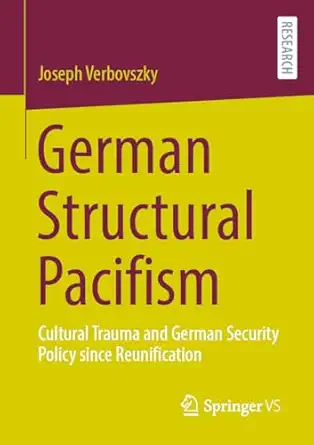
German Structural Pacifism: Cultural Trauma and German Security Policy since Reunification 2024th Edition
Author(s): Joseph Verbovszky (Author)
- Publisher: Springer VS
- Publication Date: April 6, 2024
- Edition: 2024th
- Language: English
- Print length: 332 pages
- ISBN-10: 3658440899
- ISBN-13: 9783658440893
Book Description
German Structural Pacifism examines the influence of Germany’s lessons of the past on its security policy since reunification in an approach that is both novel and timely in the context of the Russia-Ukraine War. Germany’s lessons of the past provide contradictory “right ways” for Germany to overcome its authoritarian past and serve to legitimate political interests in security policy decision-making. Reconciling competing political interests and contradictory narratives results in a security policy that prioritizes “the right way” to do security policy is over its effectiveness.
It is the author’s great merit to have defined the past 30 years of German security policy under the term Structural Pacifism. I find this conclusive.
Sönke Neitzel, Chair of Military History at the University of Potsdam
An accurate depiction of Germany’s systemic neglect of its armed forces since reunification, demonstrating why it is no surprise that our armed forces are naked. A follow up including the Zeitenwende would be very interesting.
Hans-Peter Barthels, President of the German Society for Security Policy
The book succinctly and accurately addresses the lack of an honest debate on the use of military force in the domain of German security policy, and explores its negative impact on military decision-making from political strategy all the way down to the tactical level.
Volker Wieker, Former Chief of Defense of the German Federal Armed Forces (2009-2018)
Editorial Reviews
From the Back Cover
German Structural Pacifism examines the influence of Germany’s lessons of the past on its security policy since reunification in an approach that is both novel and timely in the context of the Russia-Ukraine War. Germany’s lessons of the past provide contradictory “right ways” for Germany to overcome its authoritarian past and serve to legitimate political interests in security policy decision-making. Reconciling competing political interests and contradictory narratives results in a security policy that prioritizes “the right way” to do security policy is over its effectiveness.
It is the author’s great merit to have defined the past 30 years of German security policy under the term “Structural Pacifism.” I find this conclusive.
Sönke Neitzel, Chair of Military History at the University of Potsdam
An accurate depiction of Germany’s systemic neglect of its armed forces since reunification, demonstrating why it is no surprise that our armed forces are naked. A follow up including the Zeitenwende would be very interesting.
Hans-Peter Barthels, President of the German Society for Security Policy
The book succinctly and accurately addresses the lack of an honest debate on the use of military force in the domain of German security policy, and explores its negative impact on military decision-making from political strategy all the way down to the tactical level.
Volker Wieker, Former Chief of Defense of the German Federal Armed Forces (2009-2018)
About the Author
Dr. Joseph Verbovszky is a Research Fellow at the Defense AI Observatory at the Chair of Political Theory at the Helmut Schmidt University / University of the German Federal Armed Forces Hamburg.


