Wow! eBook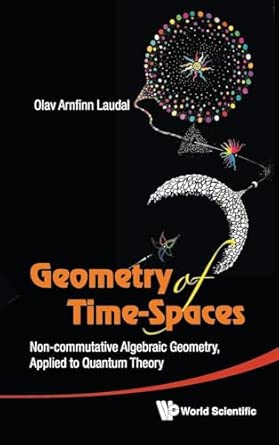
Geometry of Time-Spaces: Non-Commutative Algebraic Geometry, Applied to Quantum Theory
Author(s): Olav arnfinn, audal, (Author)
- Publisher: World Scientific Publishing Company
- Publication Date: 21 Mar. 2011
- Edition: Illustrated
- Language: English
- Print length: 156 pages
- ISBN-10: 981434334X
- ISBN-13: 9789814343343
Book Description
This is a monograph about non-commutative algebraic geometry, and its application to physics. The main mathematical inputs are the non-commutative deformation theory, moduli theory of representations of associative algebras, a new non-commutative theory of phase spaces, and its canonical Dirac derivation. The book starts with a new definition of time, relative to which the set of mathematical velocities form a compact set, implying special and general relativity. With this model in mind, a general Quantum Theory is developed and shown to fit with the classical theory. In particular the “toy”-model used as example, contains, as part of the structure, the classical gauge groups u(1), su(2) and su(3), and therefore also the theory of spin and quarks, etc.
Editorial Reviews
Review
Geometry of Time-Spaces is a labor of love on the part of a scholar who has a deep idea to promote; it’s a very interesting idea indeed, and relates to some very important avant garde topics. It is indeed a fascinating piece of work, well worth reading. —MAA Reviews
From the Back Cover
This is a monograph about non-commutative algebraic geometry, and its application to physics. The main mathematical inputs are the non-commutative deformation theory, moduli theory of representations of associative algebras, a new non-commutative theory of phase spaces, and its canonical Dirac derivation. The book starts with a new definition of time, relative to which the set of mathematical velocities form a compact set, implying special and general relativity. With this model in mind, a general Quantum Theory is developed and shown to fit with the classical theory. In particular the “toy”-model used as example, contains, as part of the structure, the classical gauge groups u(1), su(2) and su(3), and therefore also the theory of spin and quarks, etc.