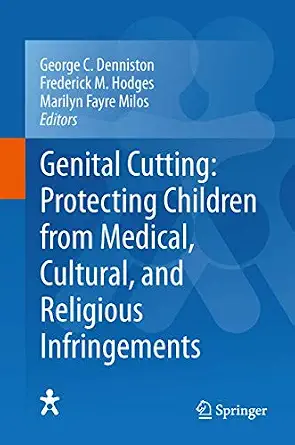
Genital Cutting: Protecting Children from Medical, Cultural, and Religious Infringements 2013th Edition
Author(s): George C. Denniston (Editor), Frederick M. Hodges (Editor), Marilyn Fayre Milos (Editor)
Publisher: Springer
Publication Date: June 17, 2013
Edition: 2013th
Language: English
Print length: 349 pages
ISBN-10: 9400764065
ISBN-13: 9789400764064
Book Description
This volume contains the proceedings of the 10th International Symposium on Circumcision, Genital Integrity, and Human Rights. Authors are international experts in their fields, and the book contains the most up-to-date information on the issue of genital cutting of infants and children from medical, legal, bioethical, and human rights perspectives.
Editorial Reviews
Review
From the reviews:
“The volume consists of 22 chapters … . This book is intended for medical professionals, researchers, students, and other professionals in diverse fields, including anthropology, nursing, psychology, psychiatry, public health, public policy, social work, and sociology. The organization and length of the book chapters make it easy for the intended audience. … This book is a useful primer or first step to a much-needed push for health education about male circumcision.” (Sussie Eshun and Irina Khusid, PsycCRITIQUES, Vol. 59 (19), 2014)
From the Back Cover
Every year, across the globe, an estimated 13.3 million boys and 2 million girls are involuntarily subjected to genital cutting. Both male and female genital cutting persist, generating a multi-billion-dollar-a-year industry that is defended by its proponents with dubious studies, manipulated statistics, and an appeal to “custom.” Physicians and parents alike have been misled into believing that these mutilations are beneficial, necessary, and harmless. Today, flawed studies have allowed the promotion of circumcision as a way of combating HIV/AIDS in Africa, an experiment that failed in the USA, where a half-million circumcised males have succumbed to AIDS. These facts notwithstanding, the public and legal outcry against these abuses is increasing. For instance, the high court in Cologne, Germany ruled in 2012 that circumcision harms the child, that the harm is irreversible, that it denies the child the right to his own body, and that circumcision denies the individual the right to choose his own religion. Thus, the issue of circumcision has expanded beyond the arena of medicine and is firmly established as a human rights and legal problem. The contributors to this volume, an international panel of experts in the fields of medicine, law, ethics, anthropology, sociology, history, religion, and politics, thoroughly examine and elucidate this violation of human rights.
Genital Cutting: Protecting Children from Medical, Cultural, and Religious Infringements 2013th Edition
Author(s): George C. Denniston (Editor), Frederick M. Hodges (Editor), Marilyn Fayre Milos (Editor)
Publisher: Springer
Publication Date: July 14, 2015
Edition: 2013th
Language: English
Print length: 349 pages
ISBN-10: 9400792751
ISBN-13: 9789400792753
Book Description
This volume contains the proceedings of the 10th International Symposium on Circumcision, Genital Integrity, and Human Rights. Authors are international experts in their fields, and the book contains the most up-to-date information on the issue of genital cutting of infants and children from medical, legal, bioethical, and human rights perspectives.
Editorial Reviews
Review
From the reviews:
“The volume consists of 22 chapters … . This book is intended for medical professionals, researchers, students, and other professionals in diverse fields, including anthropology, nursing, psychology, psychiatry, public health, public policy, social work, and sociology. The organization and length of the book chapters make it easy for the intended audience. … This book is a useful primer or first step to a much-needed push for health education about male circumcision.” (Sussie Eshun and Irina Khusid, PsycCRITIQUES, Vol. 59 (19), 2014)
From the Back Cover
Every year, across the globe, an estimated 13.3 million boys and 2 million girls are involuntarily subjected to genital cutting. Both male and female genital cutting persist, generating a multi-billion-dollar-a-year industry that is defended by its proponents with dubious studies, manipulated statistics, and an appeal to “custom.” Physicians and parents alike have been misled into believing that these mutilations are beneficial, necessary, and harmless. Today, flawed studies have allowed the promotion of circumcision as a way of combating HIV/AIDS in Africa, an experiment that failed in the USA, where a half-million circumcised males have succumbed to AIDS. These facts notwithstanding, the public and legal outcry against these abuses is increasing. For instance, the high court in Cologne, Germany ruled in 2012 that circumcision harms the child, that the harm is irreversible, that it denies the child the right to his own body, and that circumcision denies the individual the right to choose his own religion. Thus, the issue of circumcision has expanded beyond the arena of medicine and is firmly established as a human rights and legal problem. The contributors to this volume, an international panel of experts in the fields of medicine, law, ethics, anthropology, sociology, history, religion, and politics, thoroughly examine and elucidate this violation of human rights.
 Wow! eBook