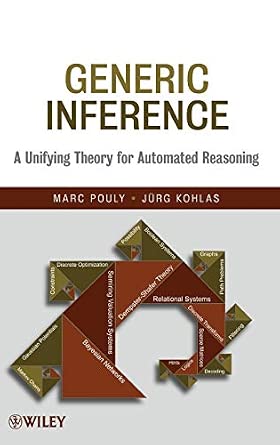
Generic Inference: A Unifying Theory for Automated Reasoning
Author(s): Marc Pouly (Author), Juerg Kohlas (Author)
Publisher: Wiley
Publication Date: 10 May 2011
Edition: 1st
Language: English
Print length: 484 pages
ISBN-10: 0470527013
ISBN-13: 9780470527016
Book Description
This book provides a rigorous algebraic study of the most popular inference formalisms with a special focus on their wide application area, showing that all these tasks can be performed by a single generic inference algorithm. Written by the leading international authority on the topic, it includes an algebraic perspective (study of the valuation algebra framework), an algorithmic perspective (study of the generic inference schemes) and a “practical” perspective (formalisms and applications). Researchers in a number of fields including artificial intelligence, operational research, databases and other areas of computer science; graduate students; and professional programmers of inference methods will benefit from this work.
Editorial Reviews
From the Inside Flap
A Rigorous Algebraic Study of the Most Popular Inference Formalisms
This unique text provides a complete algebraic and algorithmic study of generic inference methods that are derived from the general valuation algebra framework, with special focus on the many practical applications in computer science. Written by the leading international authorities on the topic, Generic Inference is divided into three parts:
Part I defines the valuation algebra framework and gives a first catalog of practically important examples; explains the generic inference problem and surveys fundamental applications that require the solution of such problems with knowledge bases from different valuation algebras; develops generic algorithms for the solution of single- and multiple-query inference problems with arbitrary valuation algebras; and discusses issues related to complexity and optimization
Part II identifies several important families of valuation algebras derived from other mathematical structures—including soft constraints, path problems, linear systems, and logical structures—and uncovers the close relationship between valuation algebras and semiring theory
Part III discusses various applications of generic inference, with chapters dedicated to dynamic optimization, sparse matrix techniques, and linear systems with stochastic disturbances
The text is accompanied by a large number of examples; at the end of every chapter are selected exercises and open research problems. A comprehensive bibliography on valuation algebras and local computation is provided, and all algorithms are developed mathematically and given in pseudo-code. Generic Inference is designed for researchers in a number of fields, including artificial intelligence, operational research, databases, and other areas of computer science; graduate students and other researchers interested in general reasoning frameworks; and professional programmers of inference methods.
From the Back Cover
A Rigorous Algebraic Study of the Most Popular Inference Formalisms
This unique text provides a complete algebraic and algorithmic study of generic inference methods that are derived from the general valuation algebra framework, with special focus on the many practical applications in computer science. Written by the leading international authorities on the topic, Generic Inference is divided into three parts:
Part I defines the valuation algebra framework and gives a first catalog of practically important examples; explains the generic inference problem and surveys fundamental applications that require the solution of such problems with knowledge bases from different valuation algebras; develops generic algorithms for the solution of single- and multiple-query inference problems with arbitrary valuation algebras; and discusses issues related to complexity and optimization
Part II identifies several important families of valuation algebras derived from other mathematical structures―including soft constraints, path problems, linear systems, and logical structures―and uncovers the close relationship between valuation algebras and semiring theory
Part III discusses various applications of generic inference, with chapters dedicated to dynamic optimization, sparse matrix techniques, and linear systems with stochastic disturbances
The text is accompanied by a large number of examples; at the end of every chapter are selected exercises and open research problems. A comprehensive bibliography on valuation algebras and local computation is provided, and all algorithms are developed mathematically and given in pseudo-code. Generic Inference is designed for researchers in a number of fields, including artificial intelligence, operational research, databases, and other areas of computer science; graduate students and other researchers interested in general reasoning frameworks; and professional programmers of inference methods.
About the Author
Marc Pouly, PhD, received the Award for Outstanding PhD Thesis in Computer Science at the University of Fribourg (Switzerland), in 2008. He was visiting researcher at the Cork Constraint Computation Centre in Ireland and, since 2010, he is researcher at the Interdisciplinary Centre for Security, Reliability and Trust of the University of Luxembourg.
Jürg Kohlas, PhD, is Professor of Theoretical Computer Science in the Department of Informatics at the University of Fribourg (Switzerland). His research interests include algebraic theory of information and probabilistic argumentation.
 Wow! eBook