 Wow! eBook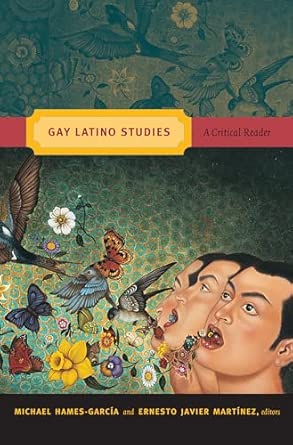
Gay Latino Studies: A Critical Reader)
Author(s): Michael Hames-García (Editor), Ernesto Javier Martínez
- Publisher: Duke University Press
- Publication Date: 13 April 2011
- Language: English
- Print length: 376 pages
- ISBN-10: 082234937X
- ISBN-13: 9780822349372
Book Description
Contributors. TomÁs Almaguer, Luz Calvo, Lionel CantÚ,, Daniel Contreras, Catriona Rueda Esquibel, RamÓn GarcÍa, RamÓn A. GutiÉrrez, Michael Hames-GarcÍa, Lawrence La Fountain-Stokes, MarÍa Lugones, Ernesto J. MartÍnez, Paula M. L. Moya, JosÉ Esteban MuÑoz, Frances NegrÓn-Muntaner, Ricardo L. Ortiz, Daniel Enrique PÉrez, RamÓn H. Rivera-Servera, Richard T. RodrÍguez, David RomÁn, Horacio N. Roque RamÍrez, Antonio Viego
Editorial Reviews
Review
“
Gay Latino Studies is an important reader that will be useful to students and scholars in a range of disciplines, including American, Chicano, Latino, and ethnic studies; queer, feminist, and gender studies; and performance studies, English, and sociology. . . . Gay Latino Studies: A Critical Reader will be a valuable reference work for any university or personal library, for readers familiar with the themes and debates in gay Latino and Chicano studies, and for readers who are just entering these vital conversations.”–Marci L. Carrasquillo “MELUS”“I breathe a sigh of relief with the publication of
Gay Latino Studies: A Critical Reader. Even before it existed, it was missing. . . . The chapters are speaking to each other, having conversations. This format invites readers to listen and chime in. . . . And that’s what’s so cool about Gay Latino Studies for me. It feels familiar, like I know these brothers, and I do. Like I’m in those pages here and there, and I am.”–Tatiana de la Tierra “La Bloga”“I’ve been waiting for a book like this – as personal and intellectually stimulating as this one – for over a decade. A book that uses, and yet does not take for granted, the very categories that inspire its existence. This inspiring compilation of chapters (some of which have been published in the previous decade) followed by recent critiques effectively offers a critical studies reader that moves between the categories, gay and queer, in complex ways. This, for some of us, is inevitably our bible.”–Salvador Vidal-Ortiz “Latino Studies”
“This collection will be an indispensable reference for any scholar working in queer or Latina/o studies. With its broad disciplinary and theoretical scope, it effectively establishes the field of gay Latino studies. It will shape the questions posed in this realm of study for some time to come.”–
Ramón Saldívar, author of The Borderlands of Culture: Américo Paredes and the Transnational Imaginary“
Gay Latino Studies is a startlingly original collection of essays on the culture and social worlds of gay Latinos. Using a wonderful format that pairs essays with response pieces, the book as a whole reads like a sparkling conversation full of wit, insight, cultural relevance, and political critique. Covering topics from gay shame and shamelessness, to dance and sexual identity, to the impact of HIV on gay Latino communities, Gay Latino Studies will quickly find its way onto bookshelves and into classrooms around the world.”–Judith Halberstam, author of Female MasculinityAbout the Author
Michael Hames-GarcÍa is Professor of Ethnic Studies at the University of Oregon.
Ernesto Javier MartÍnez is Assistant Professor of Women’s and Gender Studies and of Ethnic Studies at the University of Oregon.
Excerpt. © Reprinted by permission. All rights reserved.
Gay Latino Studies
A Critical Reader
Duke University Press
Copyright © 2011 Duke University Press
All right reserved.
ISBN: 978-0-8223-4937-2
Contents
Acknowledgments………………………………………………………………………………………………………………………….1Introduction. Re-membering Gay Latino Studies Michael Hames-García and Ernesto Javier Martínez………………………………………….19Queer Theory Revisited Michael Hames-García……………………………………………………………………………………………46COMMENT. It’s All in Having a History María Lugones…………………………………………………………………………………….55Gay Shame, Latina- and Latino-Style: A Critique of White Queer Performativity Lawrence La Fountain-Stokes…………………………………………81COMMENT Ramón García……………………………………………………………………………………………………………86The Place of Gay Male Chicano Literature in Queer Chicana/o Cultural Work Antonio Viego…………………………………………………………105COMMENT. Our Queer Kin Luz Calvo and Catriona Rueda Esquibel…………………………………………………………………………………113Carnal Knowledge: Chicano Gay Men and the Dialectics of Being Richard T. Rodríguez…………………………………………………………141COMMENT. Entre Machos y Maricones: (Re)Covering Chicano Gay Male (Hi)Stories Daniel Enrique Pérez……………………………………………147Entre Hombres/Between Men: Latino Masculinities and Homosexualities Lionel Cantú…………………………………………………………..168COMMENT. The Material and Cultural Worlds of Latino Gay Men Tomás Almaguer………………………………………………………………..175Gay Latino Cultural Citizenship: Predicaments of Identity and Visibility in San Francisco in the 1990s Horacio N. Roque Ramírez…………………198COMMENT Ramón A. Gutiérrez………………………………………………………………………………………………………204Feeling Brown: Ethnicity and Affect in Ricardo Bracho’s The Sweetest Hangover (and Other STDs) José Esteban Muñoz…………………………220COMMENT. Never Too Much: Queer Performance between Impossibility and Excess Ricardo L. Ortiz…………………………………………………….226Shifting the Site of Queer Enunciation: Manuel Muñoz and the Politics of Form Ernesto Javier Martínez……………………………………250COMMENT. Dancing with the Devil-When the Devil Is Gay Paula M. L. Moya………………………………………………………………………..259Choreographies of Resistance: Latino Queer Dance and the Utopian Performative Ramón H. Rivera- Servera……………………………………….281COMMENT Daniel Contreras…………………………………………………………………………………………………………………286Dance Liberation David Román…………………………………………………………………………………………………………311COMMENT. Dance with Me Frances Negrón-Muntaner…………………………………………………………………………………………321Bibliography…………………………………………………………………………………………………………………………….349Contributors…………………………………………………………………………………………………………………………….353
Chapter One
Queer Theory Revisited Michael Hames-García
QUEER THEORY AND ITS DISCONTENTS
The critical work most often cited in discussions of queer theory entered the academy around the same time I did. Judith Butler’s Bodies That Matter (1993), Michael Warner’s collection Fear of a Queer Planet (1993), and The Lesbian and Gay Studies Reader (1993) were all published during my first year of graduate school. Most of what are now considered the foundational texts for queer theory appeared while I was an undergraduate: Eve Kosofsky Sedgwick’s Epistemology of the Closet (1990), Butler’s Gender Trouble (1990), the Diana Fuss anthology Inside/ Out (1991), and “Queer Theory,” a special issue of differences edited by Teresa de Lauretis (1991). Others came out while I was still in high school: the first issue of the journal Out/Look (1988), Leo Bersani’s “Is the Rectum a Grave?” (1987), and Sedgwick’s Between Men (1985). Gayle Rubin’s oft-cited essay “Thinking Sex” (1984) was written in 1982. When I was in junior high and had my first serious homosexual fantasies, the so-called sex wars in feminism were already raging, as was the AIDS epidemic. I was just getting the hang of tying my shoes when the first volume of Michel Foucault’s History of Sexuality was published in France as La volonté de savoir (1976), and I was born two years after the 1969 Stonewall Rebellion.
I begin this way to emphasize the context in which I first encountered queer theory. Rather than a corrective to my past experiences within the feminist and gay rights movements (since I had none), queer theory (along with ACT-UP and Queer Nation) comprised the milieu in(to) which I came out sexually, politically, and intellectually. Queer does not feel to me like a reclaimed term of derision, anymore than gay does. Having accepted my sexuality before I graduated from high school I found waiting for me in college and graduate school an exciting, sexy academic discourse for interpreting my sexual identity and desires and imagining their political significance. As a Chicano first-generation college graduate, however, I soon began to have questions about this new academic discourse, particularly in relation to race and class. Imagine my surprise when, as I began to voice these questions to professors and fellow graduate students, I met with exasperated responses: “We haven’t read anything talking about race because you haven’t brought us anything yet”; “I don’t think racism is as big a problem in the gay community as some people say”; and “Well, I don’t go through authors’ footnotes to see the race of the people they cite.” Furthermore while there was often praise for my contribution of a (colored, classed) queer experience, it was always accompanied by dismissal of my attempts to theorize that experience for myself, especially when my theorization challenged dominant presuppositions in queer theory. The message seemed clear: people of color were to provide raw experience for white academics to theorize. (In reaction I spent the next several years eliminating anything personal from my writing.)
What did I want from queer theory anyway? I had hoped that queer theory would be able to make sexuality and desire central rather than peripheral to radical politics and would be unrelentingly critical, in Herbert Marcuse’s sense of simultaneously negating society as a given and imagining what more liberatory possibilities are being blocked by that given state of affairs. For me this had to include critical understandings of race, class, gender, and capitalism. Despite the promises of many of queer theory’s early proponents and its development over the past two decades, I still find myself at a loss to locate in it the tools for understanding such complex relations of meaning. None of the works listed in my opening paragraph tells me how to understand the connections between white homosexuality and white supremacy implied by my anecdotes, between the experience of class and that of race for a queer subject, or between the racialized misogyny faced (differently) by all straight women and the racialized homophobia faced (differently) by all gay men and lesbians. Nor do they engage the issue of how both gay white and straight white spaces serve class interests and how queer people of color might perceive the varying class inflections of those spaces. Certainly very little in queer theory has sought to answer such questions as effectively or with as much political conviction as some older works by feminists that queer theorists so often define themselves against. Given queer theory’s promise to integrate race, sexuality, gender, and class, how have texts that do not fulfill that promise emerged as the field’s classics? How do queer theory and lesbian and gay studies answer their discontents, those of us who signed on to their projects in the late 1980s and early 1990s, spending student budgets on Routledge books and GLQ only to find ourselves eventually (re)turning elsewhere for answers? And finally, what might an alternative to queer theory as it has come to be known in the U.S. academy look like?
In this essay I explore the construction of the dominant self-narratives of queer theory (queer genealogies) and some of their consequences. I then offer an alternative genealogy for critical thinking about sexuality in the United States, one that highlights the early emergence of intersectional thinking. This account is followed by an extended discussion of how some seminal texts in queer theory from the 1990s address (or fail to address) race, noting a consistent pattern of erasure, marginalization, and tokenization. I then explore a central claim to theoretical innovation within queer theory: the claim that the category of queer enables critique and transgression of boundaries, identities, and subject positions. Questioning some of the assumptions in this claim, I argue that it constitutes a form of ontological denial that enables queer theory to mask its own dependence on an unacknowledged white racial identity. The conclusion considers recent directions taken by activist-scholars who address the interrelations among race, gender, and sexuality. These include scholars who identify (often ambivalently) with queer theory and scholars who distance themselves from it. A closing look at recent work on the modern/colonial gender system points to some resources for thinking about sexuality outside the Eurocentric and colonial frameworks of queer theory.
Before continuing I want to separate my criticisms of broad tendencies (of which I see the texts and passages I discuss here as indicative) from a critique of individual theorists, their intentions, or the sum total of their ideas. For this reason I have chosen to engage with the projects of theorists whom I see as either especially prominent or generally sympathetic to my own positions. To see my position as one of rejection would be to participate in one of the things for which I criticize gay and lesbian studies and queer theory: the tendency to view criticism from people of color as external rather than internal to gay, lesbian, and queer debate. I hope that others will approach this essay as a productive engagement with queer theorists.
QUEER GENEALOGIES
Genealogies of queer theory and gay and lesbian studies became something of a cottage industry in the 1990s. From these genealogies emerge two dominant narratives of the birth of queer theory, which I will call the separatist and integrationist accounts. Neither mutually exclusive nor solely identifiable with or identical to the positions of the authors with whom I associate them, these two accounts reflect differences in emphasis and strategy (for example, I see Sedgwick’s Epistemology of the Closet as primarily separatist, but her later book, Tendencies, as primarily integrationist). Separatist and integrationist accounts differ most in their narration of the institutionalization of the academic study of sexuality in the United States and of its relation to feminism.
The proponents of separatist accounts for queer theory focus on the articulation of sexuality (sometimes, but not always, understood as only lesbian and gay sexuality) as distinct from gender, race, and class. These narratives depend for their coherence, however, on the erasure or rejection of several decades of persistent calls within feminism, antiracist movements, and lesbian and gay of color theory and activism to understand how different aspects of identity interconnect and mutually constitute each other so as to make separation futile at best and mystifying at worst. In offering a genealogy for queer theory proponents of the separatist account generally begin with Rubin’s “Thinking Sex,” one of the first articles to stake out a postfeminist space for theorizing sexuality. The essay is often characterized as a sex-positive response to feminism: feminism of the 1970s, lesbian feminism, Catherine McKinnon’s feminism, or the feminism of Rubin’s own The Traffic in Women (1975). Rubin argues that one should not reduce the politics of sexuality to the politics of gender and that it is therefore a mistake to assume that feminism (understood as the politics of gender) should occupy a privileged site for understanding all the workings of sexuality in our society. For her the politics of sexuality include the demands of prostitutes, “boy-lovers,” and s/m practitioners, as well as gay men and lesbians. She therefore advocates the creation of “an accurate, humane, and genuinely liberatory body of thought about sexuality.” She claims that feminism has (or rather had) not (yet) done this. Rubin is aware of the multiplicity of approaches to sexuality within feminism from its earliest days to the present. However, she advocates for a separate theorizing of sexuality, “challeng[ing] the assumption that feminism is or should be the privileged site of a theory of sexuality,” reducing feminism to “the theory of gender oppression.” She goes on to argue, “It is essential to separate gender and sexuality analytically to more accurately reflect their separate social existence. This goes against the grain of much contemporary feminist thought, which treats sexuality as a derivation of gender.” By collapsing feminism into gender and then pointing out the lack of congruence between sexuality and gender, Rubin argues for the study of sexuality outside of a feminist context.
In Epistemology of the Closet Eve Sedgwick takes her cue from Rubin. Defining sexuality more narrowly than Rubin does, Sedgwick provides a persuasive account of the uniqueness and importance of the binary division between homosexuality and heterosexuality in Western culture. Biddy Martin has carefully delineated Sedgwick’s theoretical moves: the analytical separation of sexuality from gender and from race and the consequent argument for disarticulating gay theory from feminism and antiracist theory. Paradoxically Sedgwick’s argument for separating sexuality from gender relies on Rubin’s claim that the polymorphous quality of sexuality is lost when its forms that focus on gender relations are privileged. Sedgwick continues, however, to privilege that classification of sexuality that is made according to gender of sexual object choice (homo-hetero) and to privilege especially male homosexuality, making her project gender-specific while simultaneously claiming to investigate sexuality without viewing it in relation to gender.
Writing in 1996 Lauren Berlant and Michael Warner further develop a separatist account of queer theory, charting the contours of what they loosely characterize as “queer commentary,” something that “cannot be assimilated to a single discourse, let alone a propositional program.” They do, however, have a sense of how queer commentary differs from lesbian and gay studies:
Queer commentary has refused to draw boundaries around its constituency. And without forgetting the importance of the hetero-homo distinction of object choice in modern culture, queer work wants to address the full range of power-ridden normativities of sex…. Queer commentary in this sense is not necessarily superior to or more inclusive than conventional lesbian and gay studies; the two have overlapping but different aims and therefore potentially different publics.
Queer commentary thus promises a broad and expansive study of sexuality. In keeping with both Rubin and Sedgwick, however, Berlant and Warner do not see queer commentary as necessarily promising a greater attentiveness to race or class. Rather it simply offers a different kind of attentiveness to sexuality, although one might wonder how different, given that queer commentary still seeks to separate sexuality from race—or at least to leave the whiteness of its object of study unmarked. Warner has elsewhere charted a genealogy for “queer social theory,” which he situates within a lineage of radical thought that includes Georges Bataille and Herbert Marcuse as well as white gay liberationists and white feminists. He notes that queer theories of sexuality have been unable to answer fundamental questions about “whether or in what context queers have political interests, as queers, that connect them to broader demands for justice and freedom.” The emphasis he gives to “as queers” perhaps indicates why, for example, he does not imagine a queer political genealogy beginning with (or at least including) James Baldwin, Bayard Rustin, or Audre Lorde. Indeed, citing Sedgwick, Warner is at pains to separate sexuality as a political issue from race and gender (which he associates with reproductive metaphors): “This very incommensurability between genetic and erotic logics suggests that queerness, race, and gender can never be brought into parallel alignment.” Warner is aware of relations among these categories, but he argues that it is the unique task of queer social theory to “disarticulate” them as “styles of politics.”
Integrationist accounts of queer theory, on the other hand, attempt to respond to the challenges posed by the multiplicity of identity that separatist accounts avoid. While separatists attempt to distinguish or “disarticulate” sexuality from race and gender, integrationists advocate for queer theory as a way to address the multiple relations among race, gender, class, and sexuality better than how feminism or other progressive movements and theories have. Integrationists do so most often, however, by eschewing or bracketing identity questions and using the deliberately vague category queer to blur lines among different social locations. The most strident versions, drawing from postmodern critiques of the subject, see identity itself as oppressive and always or nearly always dangerous. They dismiss the concept of identity, writing instead of “discourses,” “practices,” “desires,” and the “subjects” that they create. In her introduction to “Queer Theory,” a special issue of differences, de Lauretis recounts the motivations behind a conference held in 1990, from which the special issue emerged:
It was my hope that the conference would also problematize some of the discursive constructions and constructed silences in the emergent field of “gay and lesbian studies,” and would further explore questions … such as the respective and/or common grounding of current discourses and practices of homo-sexualities in relation to gender and to race, with their attendant differences of class or ethnic culture, generational, geographical, and socio-political location.
As de Lauretis chronicles the emergence of lesbian and gay studies and theory she notes the separate trajectories of white gay studies and white feminism in the 1970s and 1980s. Next she introduces race, noting how little critical work has been produced by lesbians and gay men of color and suggesting that this may be due both to “restricted institutional access to publishing and higher education” and to “different choices, different work priorities, different constituencies and forms of address.” She adds that the importance of race “urge[s] the reframing of the questions of queer theory from different perspectives, histories, experiences, and in different terms.” In her account gay liberationism and lesbian feminism appear to have been developed by whites without significant participation from people of color, with the consequence that their histories can be told without reference to works by people of color. The issue of how race relates to sexuality is asked at a chronologically later time, and will now be addressed by queer theory.
(Continues…)
Excerpted from Gay Latino Studies Copyright © 2011 by Duke University Press. Excerpted by permission of Duke University Press. All rights reserved. No part of this excerpt may be reproduced or reprinted without permission in writing from the publisher.
Excerpts are provided by Dial-A-Book Inc. solely for the personal use of visitors to this web site.


