Wow! eBook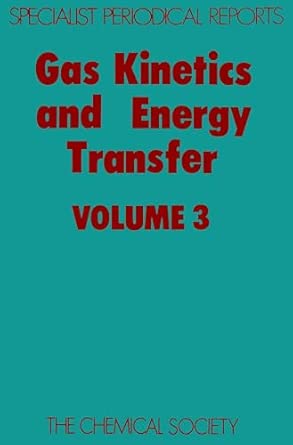
Gas Kinetics & Energy Transfer Vol 3: Volume 3 Edition. ed. Edition
Author(s): P G Ashmore
- Publisher: CRC Press
- Publication Date: 1 July 1988
- Edition: Edition. ed.
- Language: English
- Print length: 235 pages
- ISBN-10: 0851867766
- ISBN-13: 9780851867762
Book Description
Reflecting the growing volume of published work in this field, researchers will find this book an invaluable source of information on current methods and applications.
Editorial Reviews
Excerpt. © Reprinted by permission. All rights reserved.
Gas Kinetics and Energy Transfer Volume 3
A Review of the Literature Published Up to Early 1978
By P. G. Ashmore, R. J. Donovan
The Royal Society of Chemistry
Copyright © 1978 The Chemical Society
All rights reserved.
ISBN: 978-0-85186-776-2
Contents
Chapter 1 Unimolecular Reactions By H. M. Frey and R. Walsh, 1,
Chapter 2 Chemiluminescence in the Gas Phase By I. M. Campbell and D. L. Baulch, 42,
Chapter 3 An Overview of Molecular Energy Transfer in Gases By A. B. Callear, 82,
Chapter 4 Laser Studies of Vibrational, Rotational, and Translational Energy Transfer By R. T. Bailey and F. R. Cruickshank, 109,
Chapter 5 Potential Energy Surfaces for Studying the Reactions and Molecular Dynamics of Small Polyatomic Molecules By J. N. Murrell, 200,
Author Index, 223,
CHAPTER 1
Unimolecular React ions
BY H. M. FREY AND R. WALSH
1 Introduction
In the first volume of this series Robinson presented a comprehensive account of the subject which together with his book brought together in tabular form most of the unimolecular reactions that had been reported and for which there were accurate Arrhenius parameters. Quack and Troe in Volume 2 did not attempt a complete compilation of experimental data but concentrated on progress in theory together with selected .experiments related to fundamental aspects of unimolecular reactions. The high standard set by these previous Reports has been hard to follow and the volume of work which has since been published difficult to digest. This Report is intended to be ‘consumer oriented’ in that coverage of theory, in the main, is limited to those theories which can be readily applied to practical calculation. In selecting topics for coverage we have if anything reverted to the pattern of Robinson’s article although inevitably with some modifications. For example, multiphoton i.r. photochemistry, a rapidly expanding area, is covered for the first time (although relatively briefly).
Unfortunately we have found it too difficult to attempt a comprehensive tabulation of high-pressure rate constants since the Robinson Report (Quack and Troe covered a good deal although by no means all of these). In this area we have tried to cover most of what appeared in 1976 and 1977 and additionally we have included the relevant area of radical recombinations (the reverse of unimolecular dissociation). Diatomic molecules (and atom recombination) present special problems and have, therefore, been omitted. There has been a tendency in the past, which we have not been able to avoid, of giving undue emphasis to presenting data where Arrhenius parameters have been reported without a critical analysis of the likely errors in the quoted values. Such a critical evaluation (which would be extremely time-consuming) is now overdue; the work reported since Benson and O’Neal’s, ‘Kinetic Data on Gas-phase Unimolecular Reactions’ has probably equalled in volume all that available prior to 1969. We would like to reiterate a plea we have made previously, that all rate constants should be reported as well as the Arrhenius parameters on which they are based, and again that values of the pre-exponential factor and the energy of activation should always be given even if values of ΔS* and ΔH* are presented.
The number of recent reviews that have been published relevant to unimolecular reactions is not large. Troe’s chapter in ‘Chemical Kinetics’ and Tardy and Rabinovitch’s review on intermolecular vibrational energy transfer in unimolecular systems are required reading. However, there have been numerous reviews which have dealt with some aspects of particular series of unimolecular reactions which contain useful compilations of data, e.g. on the vinylcyclopropane rearrangements and azo decomposition. Mechanisms of some specific cyclopropane rearrangements have been dealt with in great detail. Other reviews have dealt with some thermal sigmatropic rearrangements and the decomposition of a number of heterocycles. A comprehensive survey on strained organic molecules contains much useful information on data and theories and especially energetic. Other reviews on aspects of Transition State Theory (TST) and use of local modes in the description of highly vibrationally excited molecules raise interesting ideas in relation to unimolecular reactions. Lee’s review on laser photochemistry of selected states outlines an area that may well become of great importance for testing theory in the future.
After much debate it was decided not to devote a major section of this Report to the reactions of ions. We judged the time not quite ripe but it was a marginal decision. The area is growing very rapidly and as well as now covering a large number of species of a great range of complexity the precision of the quantitative information is approaching that of conventional thermal studies. Williams has discussed how the unimolecular decompositions (and isomerization) of ions in the field free region of a conventional (magnetic sector) mass spectrometer can be studied to give detailed information on potential energy surfaces. It is often necessary for the construction of ‘unimolecular potential surfaces’ to use information obtained from ion cyclotron resonance experiments on bimolecular reactions. Indeed RRKM calculations have been helpful in the latter area. Field isomerization techniques allow one to look at ion isomerizations occurring in the pico second time scale and the use of photoelectron-photoion coincidence spectrometry can give very precise values of the translational energy ielease during ion fragmentation reactions at specific energizations and time delays. Some of these techniques have yielded results which have provided searching tests of RRKM theory and later we mention phase-space theory.
2 General Theoretical Considerations
Despite many independent developments and much criticism it is still clear that RRKM theory occupies the centre of the stage of unimolecular reaction theory. This is partially because workers in this field have become familiar with its use and there are excellent textbooks describing it. But it is also because alternative and more fundamental theories, making fewer (or different) assumptions have not yet been fully developed to a point where they can be easily and practically applied. It is, however, true that the underlying assumptions of the RRKM theory have come increasingly under fire. The assumption of strong collisions is no longer regarded as integral to the theory, and indeed has been largely abandoned. RRKM calculations are routinely carried out incorporating specific models of weak collisional behaviour.
The related random lifetime and free intramolecular exchange assumptions, while still seemingly reliable under a variety of experimental conditions, are however being probed with increasing vigour. There has been considerable discussion in recent years of the application to unimolecular reactions of the ergodic hypothesis (which states that the time average of a system property is the same as the average of the property over all parts of the system at a single time instant). In this context, of course, ergodic behaviour may be identified with free and complete energy randomization, implying that a specifically energized molecule decays with a single rate constant irrespective of its initial mode of excitation. The limitations of this are being increasingly explored (see Section 3). However, it should be noted that ergodic behaviour is not necessarily synonymous with rapid intramolecular energy randomization since energy randomization may be brought about by collisions. The assumption of ergodic behaviour in collisions is also under investigation (see Section 3).
The equilibrium hypothesis of the transition state theory (underlying the use of RRKM theory) has been the subject of criticism. In the earlier report Quack and Troe described the relationship of more fundamental dynamic theories to RRKM, and this is not repeated here. More recently Kay, on the basis of an earlier dynamic theory, has presented a statistical treatment for isolated molecules in which states near the critical surface for decomposition are not in statistical equilibrium with the bulk of reactant states. Nevertheless he has derived an RRKM-like expression for the rate constant with a correction factor Γ, roughly independent of energy, which must be ≤ 1. Miller has developed a unified statistical model for direct and complex bimolecular reaction mechanisms, which, in the former case, is the usual transition state theory but in the latter corresponds to the statistical phase space theories of Light and Nikitin for long lived complexes. This theory is clearly of interest to molecular beam specialists as is another version by Zvijac and Light in which a hybrid quantum mechanical-statistical theory is developed for the purpose of deriving product energy distributions. For a model without any exit barrier product transitional energy distributions do not differ substantially from those of RRKM. Marcus has addressed himself to a number of current problems in unimolecular reaction theory concerning energy distribution within a long-lived complex and amongst the products of its decomposition. Still in this area, Case and Herschbach have published a statistical theory of angular distributions and rotational orientation.
In the field of thermal unimolecular reactions, Troe has published a solution to the master equation at the low pressure limit, by incorporating an exponential model for energy transfer (for both vibrational only and coupled rovibrational cases). The theory presents the low piessure rate constant as a product of easily calculated terms comprising a strong collision rate constant, ksc0 and a collisional efficiency factor βc analytically related to the parameters of the energy transfer model. In a second paper the calculation of the various terms is discussed and the model is applied to a number of experimental decompositions. This is discussed in more detail in Section 5. Pritchard has also addressed himself to the master equation solution but without any detailed model of collisional energy transfer. It is demonstrated that, not unexpectedly, a Kassel-like fall-off curve is predicted. The paper contains an interesting discussion of the case of a reactant with more than one decomposition channel. Other theoretical contributions have been made by Nordholm and Grigolini.
Finally we note that the successful application (and indeed tests) of RRKM depended on the availability of computer programs essentially to calculate values of sums and densities of states. Numerous approximate methods have been used and indeed are still being suggested, but the development of fast and efficient procedures by Stein and Rabinovitch to carry out exact state counting using the Beyer, Swinehart algorithm would have been expected to have closed this area to further development. It was, therefore, worrying to note the letter of Hayward and Henry on some difficulties in using exact count procedures to determine densities of states. These problems were certainly known to practitioners in the field but the choice by these authors of some rather unrealistic (pathological) situations highlighted them. However, with minimal care even these situations can be handled without more than minor program changes.
3 Energy Transfer
Intramolecular Energy Randomization. — Experiment. It is now seven years since Rynbrandt and Rabinovitch’s seminal experimental determination of the limiting rate of intramolecular energy transfer in a carefully tailored chemical activation system. Many subsequent studies involving a bewildering variety of techniques have purported to shed further light on this subject, but it is probably still true that bulk chemical activation experiments of the original type have provided the most concrete evidence. Further chemical activation experiments by Rabinovitch’s group involving substituted cyclobutanes have substantiated a time scale 10-12 for energy redistribution in these molecules just as in the earlier cyclopropane. The recent evidence arises from both positive and negative observations. Where high pressure turn-up can be observed in some of the plots of k(=βω D/S) against pressure, actual, although approximate, figures can be obtained. If no turn-up is observed even at high pressures (ca. 15 atm) then a lower limit to the rate of redistribution is obtained. The differences in the behaviour of the system [FORMULA NOT REPRODUCIBLE IN ASCII] and that of the system [FORMULA NOT REPRODUCIBLE IN ASCII] are rationalized on the assumption that non-random decomposition – will occur only for those excited molecules prepared with energy deposition near to the site of decomposition and then only if the molecule has a sufficient side chain (with poorly coupled vibrational modes).
In i.r. chemiluminescence or beam experiments, product energy distribution measurements from reactions involving long-lived complexes were earlier thought to provide evidence of a breakdown in energy randomization. However, it is now widely recognized that non-statistical product energy distributions cannot per se be taken as evidence of non-randomized energy in a reaction intermediate, due to intermode vibrational coupling after the exit channel energy barrier (see for example refs. 3, 27) or other dynamical effects. Thus the experimental tests in this area have to be of a more penetrating kind than previously. Notable among the molecuiar beam studies bearing on this question is the study of Farrer and Lee, who extending earlier work on the F + C2H4 system found that average product recoil kinetic energies constituted ca. 50 % of the total available independent of reactant collision energy (over a range 9 — 51 kJ mol -1). They then argued that although exit channel energy barriers can distort product energy distributions away from statistical, nevertheless a statistical energy redistribution ought to be more likely at increasing energies above the barrier and the observed invariance of the proportion of product kinetic energy argues against statistical energy randomization in the intermediate C2H4F. The shape of these distributions were also argued to be inconsistent with statistical (phase space) theory. It should be added that symmetrical product angular distributions were observed indicating a lifetime of greater than a rotation period (10-12 s) for the intermediate.
In the i.r. chemiluminescence area a study by Durana and McDonald 46 (using the arrested relaxation technique) singled out the reaction
[FORMULA NOT REPRODUCIBLE IN ASCII] (1)
by observing a non-statistical vibrational energy distribution in the allylchloride product. As this reaction is thought to involve little or no energy barrier (for loss of Br’ from the intermediate 1-chloro-3-bromo-Zpropyl radical) this appears to support a non-randomization of internal energy in the intermediate and confirms an earlier beam study which found a very short lifetime for the radical (or complex) in this system. This reaction is unusual since other similar reactions (Cl + bromo-olefins) do give rise to statistical product vibrational distributions.
It has been claimed that certain photochemical experiments provide evidence of non-randomization of vibration energy. In a beam-laser experiment Sander, Soep, and Zare have concluded that internally converted pentacene (with ca. 200 kJ mol-1) fails to redistribute its energy (initially preferentially stored in a C — C vibration) on a μs timescale. This result is to be contrasted, however, with a time-resolved study of internally converted cycloheptatrienes where the vibrationally excited species (with ca. 430 kJ mol-1) decay in the time scales (10-6 — 10-9 s) expected from RRKM calculations, thus implying effective internal energy randomization. It is possible that the different levels of excitation of these molecules account for the different results but in view of the possible complexities of interpretation we would caution against a too-ready acceptance of non-randomization in the pentacene experiment. Chloroacetylene offers another photochemical system where non-randomization of energy has been claimed but trajectory studies are in conflict with this conclusion.
Work on the decomposition of ions and ion molecule reactions can also yield results germane to the problem of energy transfer. Application of Phase Space Theory (with conservation of energy and angular momentum) to the product kinetic energy distribution of the reaction [FORMULA NOT REPRODUCIBLE IN ASCII] by considering the potential energy surface in the region of the complex C4H+8 yields results in agreement with experiment. This contrasts with the findings of Lee et al. who suggested that energy was not randomized in the collision complex. Similarly a detailed consideration of the unimolecular reactions (2) and (3)
[FORMULA NOT REPRODUCIBLE IN ASCII] (2)
[FORMULA NOT REPRODUCIBLE IN ASCII] (3)
showed that RRKM theory yielded values for the lifetimes of the reactants in agreement with experiment, whereas the very loose transition state used for the application of Phase Space Theory (PST) produced upper limit values very much greater than observed. However, PST did give good values for the product kinetic energy distributions.
(Continues…)Excerpted from Gas Kinetics and Energy Transfer Volume 3 by P. G. Ashmore, R. J. Donovan. Copyright © 1978 The Chemical Society. Excerpted by permission of The Royal Society of Chemistry.
All rights reserved. No part of this excerpt may be reproduced or reprinted without permission in writing from the publisher.
Excerpts are provided by Dial-A-Book Inc. solely for the personal use of visitors to this web site.