Wow! eBook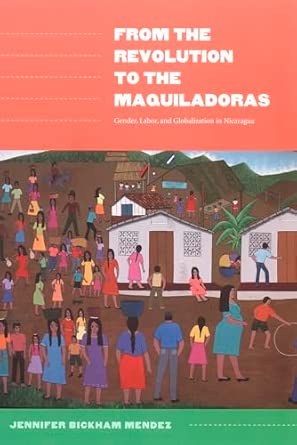
From the Revolution to the Maquiladoras: Gender, Labor, and Globalization in Nicaragua
Author(s): Jennifer Bickham Mendez (Author)
- Publisher: Duke University Press Books
- Publication Date: 7 Sept. 2005
- Language: English
- Print length: 304 pages
- ISBN-10: 0822335522
- ISBN-13: 9780822335528
Book Description
Mendez draws on interviews with leaders and program participants, including maquiladora workers; her participant observation while she worked as a volunteer within the organization; and analysis of the public statements, speeches, and texts written by mec members. She provides a sense of the day-to-day operations of the group as well as its strategies. By exploring the tension between mec and transnational feminist, labor, and solidarity networks, she illustrates how mec women’s outlooks are shaped by both their revolutionary roots within the Sandinista regime and their exposure to global discourses of human rights and citizenship. The complexities of the women’s labor movement analyzed in From the Revolution to the Maquiladoras speak to social and economic justice movements in the many locales around the world.
Editorial Reviews
Review
“This is a compelling case study of a women’s NGO organizing women workers in a Free Trade Zone in post-Sandinista Nicaragua. Jennifer Bickham Mendez’s account reveals the challenges faced by a feisty NGO trying to survive and maintain its autonomy—from capital, the state, and the good intentions of international donors. It is a testimony to the strengths, but also the fragility, of civil society in today’s struggling democracies.”—Jane S. Jaquette, coeditor of
Women and Democracy: Latin America and Central and Eastern Europe“
From the Revolution to the Maquiladoras is written on the basis of ethnographic research and the author’s personal involvement over the course of a decade; it is therefore a historical chronicle, an investigation into the operations of a unique women’s organization, and a personal testimony.” — Patricia Fernández-Kelly ― Signs“A must-read text for anyone interested in contemporary women’s movements, labor organizing, and issues of transnationalism and globalization in Latin America and elsewhere.” — Lynn Stephen ―
American Ethnologist“This well-written, well-organized and accessible book is exemplary in its ability to locate a case study within a larger context and reveal the connections between day-today organizing and the transnational links and multiple global spheres stimulated by globalization.” — Norma Stoltz Chinchilla ―
Contemporary SociologyFrom the Back Cover
About the Author
Jennifer Bickham Mendez is Associate Professor of Sociology at the College of William and Mary.
Excerpt. © Reprinted by permission. All rights reserved.
FROM THE REVOLUTION TO THE MAQUILADORAS
GENDER, LABOR, AND GLOBALIZATION IN NICARAGUABy Jennifer Bickham Mendez
DUKE UNIVERSITY PRESS
Copyright © 2005 DUKE UNIVERSITY PRESS
All right reserved.
ISBN: 978-0-8223-3552-8
Contents
About the Series…………………………………………………………………………………….viPreface…………………………………………………………………………………………….viiAcknowledgments……………………………………………………………………………………..xi1 “Just Us and Our Worms”: The Working and Unemployed Women’s Movement, “Mara Elena Cuadra”…………………12 Oppositional Politics in Nicaragua and the Formation of MEC…………………………………………….253 Gendering Power and Resistance in an Era of Globalization………………………………………………594 “Autonomous but Organized”: MEC’s Search for an Organizational Structure…………………………………795 “Rompiendo Esquemas”: MEC’s Political Strategies and the Free Trade Zone…………………………………1336 MEC and the Postsocialist State: Democracy, Rights, and Citizenship under Globalization……………………1777 Resistance Goes Global: Power and Opposition in an Age of Globalization………………………………….205Notes………………………………………………………………………………………………227Abbreviations and Acronyms……………………………………………………………………………239Bibliography………………………………………………………………………………………..241Index………………………………………………………………………………………………267
Chapter One
“Just Us and Our Worms”: The Working and Unemployed Women’s Movement, “Mara Elena Cuadra”
Organizers from the Working and Unemployed Women’s Movement, “Mara Elena Cuadra” (MEC) like to talk about how nervous and insecure they felt in their early days as members of a newly formed autonomous women’s organization. They were intensely aware that “no one knew who we were.” They felt like “cuatro loquitas hablando all” (four crazy women talking there) when they attended public events organized by national and international organizations or meetings with government officials-a labor conference organized by the Nicaraguan labor movement and its international supporters, an audience with the Ministry of Labor, an international women’s conference, or a forum organized by international NGOS. The story goes that at such an event someone in a position of authority would ask the women, “Who are you? Whom do you represent?” (In other words, “What gives you the right to participate in this event?”) To which the women would reply defiantly (and this is the reoccurring phrase that they would repeat in different renditions of the same narrative), “Slo nosotras y nuestras lombrises”-“Just us and our worms.”
The Working and Unemployed Women’s Movement, “Mara Elena Cuadra” was born in May 1994, when it emerged as an autonomous women-only organization from a deep-seated crisis within the Sandinista Workers’ Central (CST), the largest trade union confederation in Nicaragua. Since its birth as an independent organization, much of MEC’s work has revolved around organizing women workers in the country’s free trade zones (FTZS) and working to improve conditions in maquiladora factories. In addition, MEC’s programs provide job training and income-generating opportunities to unemployed women and sensitize women to gender issues such as domestic violence and reproductive health while teaching them about their rights. In their work in the FTZS, MEC has struggled to raise national, regional, and international public awareness regarding the situation of maquila workers and to lobby for pressure on maquila factory owners to uphold workers’ human rights and comply with local labor laws. Since 1994 over seven thousand female maquila workers have participated in MEC’s programs (Kpke 2002). Although currently workers in the FTZs number around forty thousand (Observador Econmico 2002), no other organization in the country can claim to have reached so many workers-men or women. MEC’s struggle to improve conditions for maquila workers has transcended national borders, and the organization coordinates its efforts with other Central American women’s organizations through a regional network that lobbies state officials and factory owners in several countries in the region.
Although I interviewed and had regular contact with women at different levels of the MEC organization-unemployed women who participated in MEC’s job-training and microcredit programs; maquila workers who acted as “promoters” (promotoras) within FTZ factories; and workers who participated in MEC’s workshops or whom MEC assisted in filing grievances after experiencing violations of their human or labor rights-the major actors portrayed in this book are the teams that made up MEC’s leadership. I worked closely as an international volunteer, or cooperante, with these organizers, who numbered approximately twenty-five (with some fluctuation as some women left and others joined over the course of my research).
Why write a book about this relatively small organization? From the Revolution to the Maquiladoras offers an ethnographic account of the strategies and practices of the Working and Unemployed Women’s Movement, “Mara Elena Cuadra” in order to demonstrate the implications of this case for the study of grassroots engagements-both resistance and accommodation-to economic globalization. Three large-scale political and economic phenomena set the stage for the story that unfolds in this book: (1) the dramatic growth of global capitalism and its incorporation of women as assembly workers; (2) political and economic transition within Nicaragua from a revolutionary socialist regime with a state-centered economy to a neoliberal “market democracy” (Robinson 2003) that emphasizes free trade, privatization, and the reduction of the public sector; and (3) the growth of women’s autonomous political organizing in Latin America and around the world.
Gender is an integral component of globalization, with gender-specific consequences for women’s lives. The worldwide shrinking of public services that has occurred under the global hegemony of neo-liberalism has increased women’s labor burden as they struggle to meet the needs of their families. More women participate in the paid labor force than ever before, and women increasingly take on breadwinner roles in the global economy in ways that both draw on and undermine traditional gender roles (Peterson and Runyan 1999: 130-47; Mies 1998: 112-44). In search of an ever cheaper, more docile workforce, transnational corporations locate production in the developing world, targeting a young female labor force for employment in assembly factories where they face long workdays, harsh working conditions, sexual harassment, and other human and labor rights violations. The International Labor Organization (2003b: 21) estimates that some 42 million people are employed in FTZS around the world and that 90 percent of the workforce is female, prompting some to hail women workers as the “paradigmatic subjects” of the international division of labor (Spivak 1988: 29).
Although there have been many excellent studies about women workers in the global economy, far fewer studies examine women’s movements in a global context. A primary theoretical goal of From the Revolution to the Maquiladoras is to examine how transnational, national, and local processes interact in complex ways to shape the politics of local actors and how local movements participate in and sometimes reconfigure aspects of globalization. In order to do so, this book explores both structural and cultural elements of MEC and applies a gender analysis to the politics of resistance and accommodation under globalization.
THE WORKING AND UNEMPLOYED WOMEN’S MOVEMENT, MARA ELENA CUADRA
MEC’s birth was precipitated by repeated conflicts between the CST’s national and regional women’s secretariats, on the one hand, and union federation and national confederation leaders on the other, regarding the administration of project funds and program priorities. Such conflicts came to a head at the CST’s 1994 national congress, when to the horror and outrage of the membership of the women’s secretariats, the CST’s national leadership (all male) failed to appoint to the national executive council even one of the seven women nominated at the women’s national congress, held a month earlier. Even more shocking-the secretariats’ elected choice for the next director of the National Women’s Secretariat lost in favor of the rumored lover of a CST leader. In addition, the national executive council revoked the financial autonomy of the National Women’s Secretariat, making all of its projects and programs subject to administration by the CST (male) leadership.
Disillusionment stemming from the election results fueled plans by a group of disgruntled women unionists and former leaders of the women’s secretariats-among them Sara Rodrguez, who had recently announced her resignation as the director of the National Women’s Secretariat-to form an independent working women’s organization. In May 1994 former leaders of the women’s secretariats, along with approximately four hundred women workers and unemployed women, voted to create a new, autonomous women’s organization. Following the Sandinista custom of naming a group for a hero or martyr, they chose the name the Working and Unemployed Women’s Movement, “Mara Elena Cuadra,” after a domestic worker and union organizer who had recently been killed by a drunk driver.
The general secretary of the CST was quick to react with a bitter defamatory campaign against these women, which was whipped into a national “scandal,” resulting in the issuance of a warrant for the arrest of two former secretariat leaders. The CST also ousted all the women who were working on the various projects that the former secretariat had implemented, closing the clinics and day-care centers opened by the local secretariats, ousting women from small businesses established through the secretariat’s micro-credit program, and expelling the domestic workers’ union from the CST’s national office.
As one MEC leader contends, then, the organization was “born out of a storm”-a storm resulting from a group of women claiming their own voices as leaders and asserting their autonomy as political actors. But what is the significance of this case? Sociologists often worry about the issue of generalizability-that is, can we learn anything from an n of one? All over the world women have organized around their multiple identities as mothers, workers, nationalists, and members of racial minorities; and each case helps build a better understanding of possibilities for struggle and action (Basu 1995). The struggle of the women of MEC who created a space for “just ourselves and our worms” deserves to be a focus of intellectual inquiry because of what it represents-a group of women from poor backgrounds, from the second poorest country in Latin America, who have taken up the struggle to improve women’s lives under global capitalism. But beyond this, MEC stands at the intersections of some key theoretical debates regarding globalization, the global hegemony of neoliberalism, and women’s organizing in postsocialist contexts.
MEC’s efforts as an autonomous organization that deals with working women outside of the framework of unionism raises important questions for scholars, students, and activists interested in the struggles of women and workers under global capitalist conditions and in the intersections of feminism and labor organizing. What does it mean to organize and support women workers as both women and workers in this context? What kinds of local, national, and transnational struggles have resulted as women are increasingly incorporated into the global economy and organize to defend their rights?
In order to counter the mobility of transnational corporations, MEC has engaged in political strategies and practices that span national borders. Through its membership in the Central American Women’s Network in Solidarity with Maquila Workers, a transnational association of women’s organizations that addresses issues facing women in maquila factories, MEC coordinates with other women’s organizations to lobby state officials and negotiate with factory owners in Nicaragua as well as in other parts of Central America. Furthermore, MEC’s formation and continued existence have been supported and sustained by the organization’s transnational linkages with NGOS and solidarity groups in Europe and North America, upon which the group depends for financial support. Global discourses, such as human rights, and global trends, such as transitions to neoliberal democracies and the accompanying importance of national discourses of rights and citizenship, have shaped MEC’s strategic orientation and informed its practices.
Exploring deeper subtextual meanings behind MEC organizers’ self-description as representing only themselves and their “worms” (lombrises) elucidates some of the complexities regarding these women’s identities and perceptions of themselves as political actors. For example, it is perhaps significant that the Spanish word lombriz, a general word for worm in Nicaragua and most of Latin America is used here, as opposed to parsito (parasite), which, as in English, refers more specifically to creatures that reside in the human body. On the surface, the word choice of lombriz in “just us and our worms” simply reflects a common saying in Nicaraguan Spanish-comparable to “no one here but us chickens.” But “lombriz” can also refer to earthworms or any other kind of worm, and the organizers’ association with the humble, but hard-working, worm carries symbolic significance. The parasite connotes a disgusting creature that feeds o the lifeblood of its victim, but any gardener knows how beneficial it is to have earthworms in one’s flower garden. Parasites suck the life out of their hosts, but the earthworm’s productive and largely invisible activities create the possibility for life. The rather crude mention of being afflicted with worms also reflects these women’s stubborn identification with the poor. The women of MEC see and talk about themselves in this way to portray the work that they carried out within the popular organizations of the Sandinista National Liberation Front (FSLN), and they see themselves continuing this kind of “grassroots” work with and as mujeres de base (grassroots women) in the autonomous, women-only space of MEC.
But MEC cannot be understood without considering its historical and geographical location. Nicaragua’s relatively late integration into the global economy of the latter part OF the twentieth century, as well as its history as a postrevolutionary society makes it an ideal site for the study of oppositional initiatives under globalization. Emerging four years after the ruling Sandinista party was defeated at the polls, MEC is illustrative of the shifting challenges and opportunities that Nicaraguan social justice groups confront. In some ways the case is unique, as MEC is the only organization in that country that applies a gender perspective in its efforts to organize maquila workers and address their needs. On the other hand the case of MEC is representative of a larger process that is occurring throughout Central America and, indeed, in many parts of the developing world where societies are undergoing transitions to democracy. Social justice movements have shifted their orientations away from the revolutionary goal of state takeover and, instead, make claims based on rights and citizenship, addressing not only state, but also global institutions, such as the United Nations, and even multilateral lending organizations, such as the World Bank and the International Monetary Fund (IMF).
In this study I employ the research strategy of “global ethnography” (Burawoy et al. 2000) and use local participant observation to theorize “the global.” This approach recognizes that the “global” and the “local” are not separate realms (Freeman 2001; Grewal and Kaplan 1994), nor are global conditions merely ethnographic backdrop for a local case study. Rather, globalization itself becomes an object of study, and micro-level processes are seen as an expression of the macro (Burawoy 2000: 27, 29). This research strategy calls for the examination of local movements within a “global here and now,” “strategically situated” within a national and globalized political economy (Marcus 1995: 111).
This approach specifies the ways in which power and inequalities, particularly those based on gender, shape transnational politics. Contrary to the cooperative image of a global village, what emerges is a picture of transnational political fields that are also arenas of struggle, presenting the actors in social movements with daunting obstacles as well as sometimes surprising opportunities.
(Continues…)
Excerpted from FROM THE REVOLUTION TO THE MAQUILADORASby Jennifer Bickham Mendez Copyright © 2005 by DUKE UNIVERSITY PRESS. Excerpted by permission.
All rights reserved. No part of this excerpt may be reproduced or reprinted without permission in writing from the publisher.
Excerpts are provided by Dial-A-Book Inc. solely for the personal use of visitors to this web site.