Wow! eBook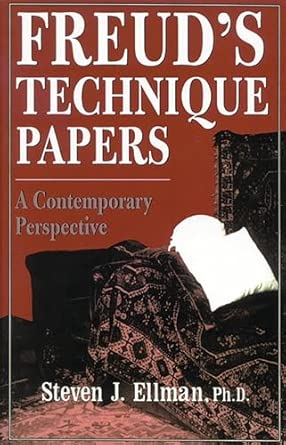
Freud's Technique Papers: A Contemporary Perspective ,
Author(s): Steven J. Ellman (Author)
- Publisher: Jason Aronson, Inc. (UK)
- Publication Date: 7 July 1977
- Edition: First Edition, First Printing
- Language: English
- Print length: 381 pages
- ISBN-10: 0876686196
- ISBN-13: 9780876686195
Book Description
Editorial Reviews
Review
In his new Freud”s Technique Papers: A Contemporary Perspective, Steven Ellman has written a rich and complex review of the Freudian clinical opus. What he gives us is this: an introduction to the issues in Freud”s writings on technique in the areas of transference, dreams, clinical practice, and termination; an annotated commentary on the reprinted papers themselves; and a comparison and contrast to various major contemporary contributors. It is a brilliantly conceived format that works wonderfully to inform and challenge the reader. The book, written by a first-rate thinker and teacher, is an invaluable contribution. The student will get a broad, nonpolemical education. The teacher will find a goldmine of ideas for a fascinating model of teaching. And the advanced professional will encounter a mind-stretching review that will stimulate integration as well as controversy. It is truly a book that is valuable at many levels. I recommend it highly. — Fred Pine, Ph.D.
Steve Ellman has written an original, ingenious, and very intelligent book that will be of use to all students of Freud. It contains a careful and scholarly tracing of Freud”s development as an investigator of the mind, as a clinician, and as a theorist of psychoanalytic therapy and technique. . . . This book is a coherent, challenging, complex, and yet highly intelligible series of accounts on a number of important intellectual as well as psychoanalytic subjects. — Steven Marcus, Ph.D.
The appearance of this book will be welcomed by all therapists who base their technique on psychoanalysis. In a carefully thought out and critical presentation of Freud”s papers on technique, the author traces the influence of Freud”s seminal ideas as they appear in the writings of psychoanalysts today. The writing is engagingly lucid and the presentation commendably objective. This book represents one of the most comprehensive overviews of the evolution of psychoanalytic technique since the beginning of psychoanalysis. — Jacob A. Arlow, M.D.