Wow! eBook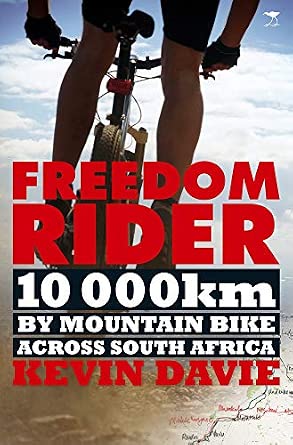
Freedom rider: 10 000 kms by mountain bike across South Africa
Author(s): Kevin Davie (Author)
- Publisher: Jacana Media
- Publication Date: 13 July 2013
- Language: English
- Print length: 240 pages
- ISBN-10: 1431405582
- ISBN-13: 9781431405589
Book Description
Editorial Reviews
About the Author
Excerpt. © Reprinted by permission. All rights reserved.
Freedom Rider
10 000km by Mountain Bike Across South Africa
By Kevin Davie
Jacana Media (Pty) Ltd
Copyright © 2012 Kevin Davie
All rights reserved.
ISBN: 978-1-4314-0558-9
Contents
Foreword,
Prologue: Trail Head,
1 Trance Karoo,
2 A Trail Called Freedom,
3 The Freedom,
The Drakensberg,
4 Kestreling through the Berg,
5 Trekking with Trichardt,
6 The Road Never Travelled,
7 Connecting the Drakensberge,
8 Minus Eight in Memel,
Spinerun: Wolkberg to Dordrecht,
9 Black Mambas and Fanta Grape,
10 The Dog Did Not Bark,
11 A Valley of My Own,
12 Riding with Eland, White-out in Mcambalala,
Lesotho,
13 In Thin Air,
14 With Dagga Smugglers and Cattle Rustlers,
15 On the Trail of Soai,
The Ganna: Beitbridge to Cape Point,
16 Riding with Baobabs,
17 Mpumalanga Mountains and Plantations,
18 Christmas in Heaven on Earth,
19 Windmills Aplenty, Spaza Shops None,
20 Headwinds into the Cape,
21 Trail End,
Epilogue,
Photo Captions,
Acknowledgements,
Bibliography,
CHAPTER 1
Trance Karoo
Prince Albert to Worcester via Anysberg, Montagu and McGregor, April 2006, six days, 400km.
We arrived at Klein Spreeufontein by following the Freedom Trail, which takes mountain bikers along a 2 300km trail on back roads and tracks from Pietermaritzburg to Paarl. My wife, Lucille, and I were tackling a relatively modest section of 400km from Prince Albert to Worcester, where we planned to get the Shosholoza Meyl train back to our point of departure.
Klein Spreeufontein is a good place to think about floods. It appears as an oasis from kilometres away; it is an outpost of trees, water and habitation in the desolate nothingness that defines the Karoo. When we got there, it was deserted. Once prosperous with a large dam, several buildings and even its own petrol pump, the farm of Klein Spreeufontein had been abandoned. Its mud-based buildings were being reclaimed by their harsh, unforgiving surroundings.
In the Karoo, you are sometimes surrounded by large, imposing mountains, but Klein Spreeufontein sits on the top of this part of the world. There is no catchment area to speak of, yet a flood had come through here. It had torn apart the dam wall, with a phalanx of rocks and bricks encased in wired cages as its base, as though it wasn’t even there.
Driving down from Johannesburg the day before, we overnighted at the delightful Meltonwold near Victoria West, which lost 79 of its citizens in a massive flood in 1909. This may seem like a long time ago, but we were warned by our hosts that the area had suffered a flood only a month or two previously. It was hard to work out where a flood could have come from. There were small dry water courses, and our accommodation backed up against a kopje, yet a metre and a half of water had flowed through the room we were going to sleep in. The walls still had to be painted and the damage to the wooden floorboards was clearly evident.
We walked around the farm trying to understand how this might have happened. The barman eventually enlightened us – over 100mm of water had fallen in an hour, in a hailstorm. The hail and leaves clogged the drainage system behind the main house where guests stay. When the flash flood rose above window height, the staff decided to open them rather than have the windows break under the pressure of the mounting water.
Not too many kilometres into the nothingness that surrounds Meltonwold is the complete skeleton of a Bradysaurus. It lies exposed, so visitors can see the whole beast, almost exactly as it was when it died an aeon ago. It is easy to imagine it being caught by a flood, covered in soil and left to fossilise. We had asked to see the graves of the Van Wyks, one of the founding families at Meltonwold. Those of the more recent owners can be visited, but in just 150 years all trace of the founding Van Wyks has gone. Incomprehensibly though, you can still visit the Bradysaurus 250 million years later. I took some satisfaction, for reasons I can’t explain, in passing a little earlier a living contemporary of the Bradysaurus, a tortoise, whose forbears poked around these parts when the fossil was still alive.
Prince Albert
We cycled 43km from a very dry Prince Albert with the majestic Swartberg, the country’s second longest mountain range, for company at our side. Cars can drive on this dirt road, and we saw one, but there is no point, really. The road runs straight into a dam and there is no bridge, no pont and no way of getting to the road on the other side – unless you know about Fox the ferryman. We knew about Fox because David Waddilove, the founder of the Freedom Trail, had arranged for him to pick us up. We waited at the water’s edge with nothing but the intense silence of the Karoo surrounding us. After a while, an inflatable boat appeared in the distance. ‘I’m Fox,’ said the ferryman, offering a handshake.
We balanced our two bikes in the middle of the boat and pushed it into the just-deep-enough water. Before starting the engine, Fox started pumping, explaining that the inflatable had a slow leak. We were warned that about halfway across he might need to pump the boat up again.
Fox Ledeboer, a refugee from KwaZulu-Natal, where he completed 18 Dusi’s, now lords over this domain. He is the only resident in a 40km radius and shopping, at Ladismith, is a 250km round trip. He operates the Gamkapoort Dam, is an honorary nature conservator and helps hikers who use the Gamkapoort to get into Die Hel.
This is the Gamkaskloof, to give it its official name, a place of myths and legends where a tight-knit community thrived for decades in the valley without road access. Many of Die Hel’s stories have improved with retelling, although some are hard to believe. There is a story, for example, that residents carried a car into the valley before the mountain road was built. The remains of the car can still be viewed by any disbelieving visitors.
Vleiland
We slept our first night at Hartland, a farm near Vleiland, a hamlet on the other side of the Bosluiskloof Pass, which is an 8km climb, ascending about 700m. River Rosenthor, a matured hippie who retired to this farm to grow lavender, explains that a farm dam is like your bank balance – you watch it getting lower and lower while you wait for rain. ‘Just one good rain is enough to fill it to last the whole season until the next rains come,’ he said.
Vleiland is big enough to have a store, but not a soul was stirring as we cycled through it on our second morning. We crossed the Buffels River, which was flowing, and then branched off on a road that took us past Rietpoort se Leegte (Rietpoort’s emptiness) and through the Volstruisnek into the top section of the Anysberg Nature Reserve. We had been on roads little travelled, but when we climbed over locked gates with our bikes, we were on a road seemingly never travelled.
On the edge of Anysberg we met Pieter Fourie, a farmer who has somehow survived here for 25 years. If Rosenthor’s dam is his bank balance, Fourie’s water supply, which comes from a borehole, is his artery. There had been floods further north, such as those at Meltonwold earlier in the year, but precious little rain had fallen here. There were stories of springs that had run for generations drying up.
I found myself staring at Fourie, uncomprehendingly. How could he survive in such a harsh environment? We told him we were cycling through the Karoo for six days. He stared back at us, uncomprehendingly. We asked him if we were on the right road and he assured us we were not. ‘The gates further along are locked,’ he said. We cross-checked our maps and showed them to him. He agreed that we were, in fact, on the correct road.
We learned over the days that asking locals for directions is generally not a good idea. Even though we might have been heading for a farm just on the other side of the mountain, the chances were that they had not heard of it. If they knew of a track leading across the mountain, they would probably not have tried it themselves. More often than not, they assured us that our intended route was incorrect. So, we had to trust our maps and our sense of direction on this route seldom travelled.
The section from Fourie’s farm proved to be the hardest of the trail with long stretches of sand that was too soft to cycle, alternating with rock-strewn sections that were equally hazardous.
Anysberg
Ten hours of exposure to the harsh Karoo had passed by the time we put Klein Spreeufontein behind us and made it to a farming homestead, which now serves as the headquarters of the Anysberg Nature Reserve. Our spirits were low. We were tired, dirty, hungry and had no food and no water. The place was deserted. A sign on a door said ‘Fietsryers. Julle is in Gecko. Totsiens. Waddilove.’ (Bike riders. You are in Gecko. Goodbye. Waddilove.)
David Waddilove, a 40-year-old environmental lawyer from Cape Town, is the reason we were there. Three years ago, Waddilove left Cape Town the day after running the 56km Two Oceans Marathon and ran to KwaZulu-Natal, where he completed the 90km Comrades Marathon. Sticking to the back routes, it took him 70 days to complete the 2 300km run, covering roughly the equivalent of a marathon a day.
He then decided that the run would be too hard to stage annually, but that it had the makings of a great mountain-biking trail. The following year, Waddilove and two others ran the Comrades and then left Pietermaritzburg the next day by mountain bike for Paarl, where they completed the four-day Berg River Canoe Marathon to Velddrif. This all seems more than a little extreme, but probably not more so than cycling the 3 500km Tour de France.
The result of Waddilove’s epic journey is an annual race, the Freedom Challenge, along a defined route with places to stay. These include B&Bs, lodges, hotels, farmhouses and even a cave. Riders compete in the annual race, but they are also able to ride it socially on sections of the whole. On our five-night trip we stayed in three national monuments, including a historical farmhouse, a wine estate and a nature reserve.
Our host at Anysberg, where we stayed in Gecko, which was once a worker’s cottage, was Makie Fullard, the only woman resident there. She appeared in a bakkie, like an angel, with a hot cooked meal of roast chicken, potatoes and vegetables. She then proceeded to fill our larder with juice, tea, coffee, milk, baked beans, sweet corn, rusks, cereal, chocolate bars, cheese, ham, bread and jelly with custard. We ate, showered, ate some more, and slept.
Anysberg is as dry as the Karoo gets. There was no sign of rain or water. It would be ridiculous to ask if the area had ever had floods, but I found myself asking this of Willem Fullard, Makie’s partner. He answered as though the question was entirely reasonable, pointing in three opposing directions just beyond the mountains that surrounded us. ‘Laingsburg, Montagu and Ladismith have all had floods, but not here.’
I was impressed with the game we had seen, mostly springbok, but also the odd klipspringer, two of which came really close, as well as gemsbok and, in a ravine, a giant female kudu.
Montagu
On the third day, we reached Montagu. Our hosts, Peter and Deon, fussed about us as though we were the only people in the Karoo. We were ferried to and fro from the hot springs and had places pointed out where floods had wreaked havoc. They had a big one in 1981, and the official history of Montagu seemed more than a little peeved that its 13 deaths were eclipsed by the 81 who drowned in nearby Laingsburg. There were stories of whole families making it to the safety of the roof of their home, only to have a huge tree wash all of them to their deaths.
I must make it clear that this is not a once-in-a-generation event. We drove past a house, a national monument, which was nearly wiped out in 2003. Flash floods are not uncommon. I ventured to Deon and Peter that the memories of the Karoo that I would take away with me would not be drought or dryness, but floods. Deon, who could be tight-head prop for the Boks if he didn’t prefer to be a cook, agreed. ‘It’s really terrifying here during the flood season. I find myself looking in the sky at the clouds to see if a flood could happen.’
By morning, just before we left, I had built up enough courage to ask when it was flood season. ‘Now,’ he said.
McGregor
The next three days brought us slowly back to reality as we got used to habitation after the emptiness of the Karoo. In McGregor, we met John Hargreaves, a one-man garagiste, who makes his own certified wine.
Nor far from Worcester, we were hosted by Albertus de Wet, a fifth-generation wine farmer who runs Le Grand Chasseur. De Wet opened his wine cellar to us. We tasted his fine wines and learned that the vast spread is run by no more than a handful of people and a computer.
We somehow found the old wagon route over the mountains to the farm of Kasra where Elsa Crohn and Alda Botha had a table set for lunch – a splendid repast with a neck of lamb at its centre. Two huge jugs of fresh lemonade were dispatched before we did the only sensible thing we could do: pass out in the shade on the lawn.
Elsa has watched riders of the Freedom Challenge pass through this lawn for two years. ‘The race leader, a dominee, was four days ahead when he got here,’ she said of the previous year. ‘They arrive at all times, eat a whole farm, sleep for three hours and then they’re gone. The dominee didn’t even have a proper bike [it was an entry-level machine] and he cycled in velskoens.‘
We had been lucky. We had no mechanical problems, no injuries, just two punctures and one half-fall. We had no headwinds and had enough liquid, four litres each, to last between refills. Temperatures had been kind – no more than in the mid-30s when they can rise to the 40s. There had also been no floods.
CHAPTER 2
A Trail Called Freedom
Pietermaritzburg to Rhodes via Donnybrook, Ntsikeni, Masakane, Malekhonyane and Vuvu, June 2006, seven days, 500km.
A few months after the Karoo ride with Lucille, I entered the Ride to Rhodes, a 500km expedition ride from Pietermaritzburg in KwaZulu-Natal to Rhodes in the Eastern Cape, which is also the first part of the Freedom Trail. The Ride to Rhodes is much shorter than the Freedom Challenge and riders have a backup vehicle to carry their equipment and supplies.
Six riders started the Ride to Rhodes and another six started the Freedom Challenge. We cycled through the KwaZulu-Natal Midlands from Pietermaritzburg, through sugar and timber plantations, to the southern Drakensberg. We crossed the Umkomaas, the Umzimkulu and the Umzimvubu rivers. We marvelled at magnificent churches – cathedrals really – at Centacow and Mariazell. We traversed the valley that is the genesis of one of the most famous sentences in South African literature. Alan Paton described these hills as ‘lovely beyond any singing of it’ and his description held true for our entire journey.
As we cycled through the Bisley Valley Nature Reserve, just a few kilometres from the KwaZulu-Natal capital, we heard a fish eagle’s cry, heralding what was to come.
We traversed a vast space; each vista was as majestic as the last. We were hosted on a farm, in a rural township, in a community-run lodge, at a mission and at a school. Where cyclists did not reach the overnight stations, they were taken in by a farmer, a shopkeeper, a school principal or a group of shepherds. They told stories of being humbled by the generosity of their hosts.
Ntsikeni
Within 2km of our destination on the second night, our group got lost. The mist descended and we could not see Ntsikeni, the peak that dominates the area. Then there was a drunken voice calling out in isiZulu and a fellow appeared from the darkness. We could either carry on being lost or follow this inebriated soul. We decided to follow him. He shouted curses at unseen people, his sentences beginning or ending with ‘fug off’, but he took us to exactly where we wanted to be.
Ntsikeni Lodge is set in as fine an area as I have seen, with a giant vlei as its centrepiece. At 1 752m above sea level, Ntsikeni is somewhat higher than Jo’burg. The area is home to wattled cranes, but their breeding has been less than successful, as grass fires have prevented their eggs from hatching. Now, under a new conservator recruited locally, cattle grazing is only permitted so long as there are no fires.
Leaving the reserve in the morning, someone said, ‘Look what’s coming down the hill.’ It was a pair of wattled cranes, coming to get a closer look at us. They are surprisingly tall. ‘Six foot,’ said Pete, a farmer from Umzimkulu.
There were no signs to tell us that we were on the Freedom Trail and sometimes there were no tracks at all. Typically, we cycled on dirt roads and on jeep tracks, then followed footpaths and animal tracks as we lost sign of anyone having been there before us. We followed our maps to the other side of the escarpment where, for instance, there would be a single, unused kraal with a jeep track leading to it. Our route was not linked by roads. It was usually of no use asking locals for directions because they had never used our route.
On day five we came down a ridge to the Tinana Mission. A lunch of roast chicken and sandwiches with boiled eggs, chips and Coke, and Waddilove, was waiting for us. We had followed the tracks made by the wheel-less sledges which are used in the area. Waddilove said that we could have taken a more direct route. All I could see was bush and sheer cliff faces. He calls this most direct route the ‘line of desire’.
I realised that afternoon – as we navigated yet another area that had no footpaths and, in this case, huge dongas as well – that Waddilove had connected 2 300km of the country on a ‘line of desire’.
(Continues…)Excerpted from Freedom Rider by Kevin Davie. Copyright © 2012 Kevin Davie. Excerpted by permission of Jacana Media (Pty) Ltd.
All rights reserved. No part of this excerpt may be reproduced or reprinted without permission in writing from the publisher.
Excerpts are provided by Dial-A-Book Inc. solely for the personal use of visitors to this web site.