 Wow! eBook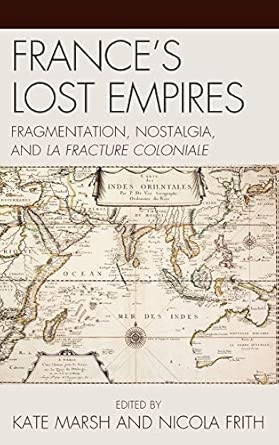
France's Lost Empires: Fragmentation, Nostalgia, and La Fracture Coloniale
Author(s): Kate Marsh (Editor), Nicola Frith
- Publisher: Lexington Books (UK)
- Publication Date: 16 Jan. 2011
- Language: English
- Print length: 202 pages
- ISBN-10: 9780739148839
- ISBN-13: 0739148834
Book Description
In analyzing the longevity of these tropes of loss and nostalgia, and their importance in shaping Frances identity as a colonial power both during and after periods of colonization, Frances Lost Empires reveals a basic premise: it is not simply successful conquest which creates a self-validating colonial discourse; failure can do so too. Indeed, the pervasive and tenacious nostalgia for past colonial glories, variously identified by the contributors to this volume, suggests that, for some, the emotional attachment to Frances colonies has not waned and remians today as it was in nineteenth-century France.
Editorial Reviews
Review
This volume constitutes an important contribution to a more complex understanding of the evolution of French colonialism from the 18th to the 20th century. Through its focus on fracture, loss and nostalgia, the text reveals how earlier waves of colonialism inspired colonial actors and ideologues in later centuries. In particular, Kate Marsh’s introduction provides a brilliant overview of the issues at stake in developing greater historical awareness within the field of Francophone postcolonial studies. — David Murphy, University of Stirling
This book captures a real intellectual exchange between scholars from several continents, with diverse chronological, national, linguistic, and disciplinary interests. The articles engage with each other and thus make visible how thinking with “Lost India” crystallizes certain common themes and upends some problematic commonplaces in postcolonial studies. The authors explore “infelicitous” chronologies; forgetting and memory; the intersections between territorial holdings and imaginary maps; and the extra-European as foundational for thinking intra-European conflicts. They all highlight how crossing boundaries―between British, French, and Mughal empires; “early modern” and “modern” histories―allows for new thinking. This, then, is a book about “French India”―where actual colonialism always references lost hopes and persistent yet out of reach possibilities―that will allow scholars to see that the time has come to resituate French colonial histories in larger contexts, what Kate Marsh identifies as “global concerns.” — Todd Shepard, Johns Hopkins University
Those interested in particular areas of the French empire, or the general phenomenon of the place ofcolonialism in French society and culture, will find valuable essays here to attract them.
This original contribution to postcolonial studies offers several articles that will be of interest to specialists and generalists alike.
About the Author
Kate Marsh is senior lecturer in French at the School of Cultures, Languages, and Area Studies at the University of Liverpool.
Nicola Frith is a lecturer in French at the School of Modern Languages at Bangor University.


