 Wow! eBook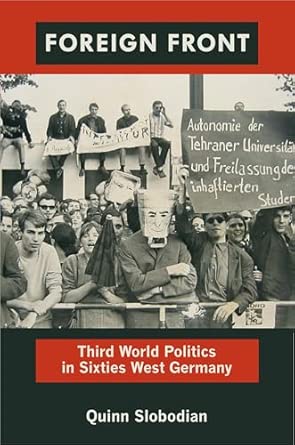
Foreign Front: Third World Politics in Sixties West Germany
Author(s): Quinn Slobodian (Author)
- Publisher: Duke University Press Books
- Publication Date: 21 Mar. 2012
- Language: English
- Print length: 320 pages
- ISBN-10: 0822351706
- ISBN-13: 9780822351702
Book Description
Editorial Reviews
Review
“This carefully researched and well written book convincingly brings the foreign students and international influence back into the story of the 1960s in Germany.”—
Peter C. Caldwell, author of Love, Death, and Revolution in Central Europe“
Foreign Front is an important contribution to our understanding of the place that the Third World occupied in the imagination of the West German student movement. In particular, Slobodian provides an excellent account of the role that students from Africa, Asia and Latin America played in the West German New Left in the 1960s as he discusses the complex relationship between intellectuals in the West and revolutionaries in the Third World.” — Hans Kundnani ― TLS“To this body of scholarship [on the ‘Third World Politics’ of 1968 in Germany] Quinn Slobodian now adds an important contribution.” — Detlef Siegfried ―
American Historical Review“Slobodian’s book is a welcome corrective to the traditional narratives of the West German student movement and West German history writ large, as well as a fascinating example of the importance of international events, ideologies, and texts, to national histories.” — Julia Sittmann ―
H-Soz-u-Kult, H-Net Reviews“
Foreign Front takes activists’ support for anticolonial struggles in the ‘Third World’ seriously and, in doing so, manages to refocus our attention on aspects of West Germany’s turbulent sixties that had been buried under subsequent interpretations. It is a beautifully written and timely addition to a thriving research field that deserves a wide readership.” — Anna von der Goltz ― German Politics and Society“[T]his is an excellent addition to the ever-expanding canon of 1960s studies. Slobodian breathes life into the relationship between West German and Third World students as it existed not in the imagination, but on the ground. . . . He is able to recover Third World students, who have been written out of West German national history, and demonstrate the central role that they played in challenging the West German state.” — Zachary Scarlett ―
H-Diplo, H-Net Reviews“
Foreign Front is a superb contribution to scholarship on the German sixties and highly recommended for any scholar of the global sixties or recent German history.” — Caroline Hoefferle ― Journal for the Study of Radicalism“Some of the freshest moments in Slobodian’s book point beyond the student movements themselves, highlighting the dangers of distant strife for Germany’s own civil peace…This is exemplary transnational history and essential reading for today’s graduate students.” — William Glenn Gray ―
Central European History“
Foreign Front is a lucid, well-researched work that calls attention to an oft-ignored but critical component of the New Left in West Germany. In doing so, Slobodian adds an important dimension to our view of the student movement, making his book a significant contribution to our understanding of West Germany’s 1968 and postwar history more generally.” — Thomas W. Goldstein ― International Social Science ReviewAbout the Author
Quinn Slobodian is Assistant Professor of History at Wellesley College.
Excerpt. © Reprinted by permission. All rights reserved.
FOREIGN FRONT
Third World Politics in Sixties West GermanyBy Quinn Slobodian
Duke University Press
Copyright © 2012 Duke University Press
All right reserved.
ISBN: 978-0-8223-5170-2
Contents
About the Series………………………………………..viiAcknowledgments…………………………………………ixAbbreviations…………………………………………..xiIntroduction……………………………………………11. Dissident Guests……………………………………..172. Third Worldism and Collaboration……………………….513. The Rupture of Vietnam………………………………..784. The Missing Bodies of June 2…………………………..1015. Corpse Polemics………………………………………1356. The Cultural Revolution in West Germany…………………170Conclusion……………………………………………..200Notes………………………………………………….209Works Cited…………………………………………….265Index………………………………………………….287
Chapter One
DISSIDENT GUESTS
In the first part of the 1960s, West German universities experienced what one observer called an “invasion of students from African and Asian countries.” The number of students from those countries newly designated as “developing” had risen from 200 in 1951 to about 12,000 by 1962. Financed through state scholarships and family funds, students from developing countries were to be new national elites, gaining practical knowledge with which to return to their home countries. Officials intended their presence in West Germany as temporary “guests” to demonstrate the openness of the German state and society to the world beyond Europe and augment the program of industrialization loans and grants to Third World nations begun in earnest in 1961. To the surprise and concern of officials in both West Germany and the home countries, many African, Asian, and Latin American students quickly began to deviate from their prescribed role by organizing politically in West Germany, using publicity campaigns, hunger strikes, and demonstrations to bring to light instances of injustice and state violence in their home countries.
As foreign students faced censorship, blocked money transfers, and threats of deportation for their activism, they urged West German students to act in solidarity with them. Dissident guests from the Third World acted as models of the political role that students could play on the national and international level, encouraging the umbrella West German Verband Deutscher Studentenschaften (Association of German Students; VDS) to take political stances for the first time in its history. In the first half of the 1960s, the internationalism of West German student activists developed in significant part through concrete collaboration and relationships of solidarity with individuals from the Third World who shared their status as students and young intellectuals.
The emerging transnational narrative of 1968 that recognizes the role of the Berkeley Free Speech Movement as a “model for campus revolts,” as Wolfgang Kraushaar puts it, must also acknowledge the activism of Third World students on West German campuses in the early 1960s. Education migrations from the Third World created the conditions for African and Asians to speak in their own names rather than as distant objects of charity or romantic identification. The defense of the right of non-Germans to free political expression in West Germany became an important site for the expansion of human-rights claims beyond a national framework and exposed the limits of democratic tolerance in the postwar German state.
African and Asian Students Mobilize alongside West Germans
The most visible Third World campaigns in West Germany in the early 1960s were directed against Portuguese colonialism, South African racism, and political repression in Iran. In each case, the official and popular West German relationship with the countries was good. Portugal was a fellow member of the North Atlantic Treaty Organization (NATO); South Africa still benefited from what Immanuel Geiss in 1963 called a “deep-rooted Boer-Romantik“; and the private life of the Shah of Iran was such a beloved subject of the tabloid press that some dubbed it the “Soraya-Press” after his second wife. Iran was also the single largest source of West German oil imports, which grew ten times over from 1957 to 1962, helping fill the needs of a rapidly motorizing population. By 1961, West Germany imported one-third of its oil from Iran at an annual worth of more than $200 million.
Most important, despite some aid from the Soviet Union to Iran, all countries were firmly in the U.S.-led “Western” bloc and refused to recognize the German Democratic Republic (GDR) diplomatically. To mobilize public opinion against the injustices of these states, foreign students had to work outside the categories of Cold War competition. They needed to convince West Germans that allies in the struggle between the blocs could also be criticized for their internal policies, a difficult proposition in a public sphere dominated, as scholars have shown, by an emphasis on consensus rather than critique into the early 1960s. Dissident students also had to overcome wariness on the part of West Germans, even those on the left, about the capability of non-Western populations to be responsible political actors. The West German labor leader Ludwig Rosenberg summarized the caution in this relationship in 1960, writing that West Germans were watching the developing countries with “concern” about the “uncertainty of the political path they are striking out on, their deficient preparedness for self-sufficiency, and the interruption of existing economic connections.” He also expressed the common anxiety about the vengeful volatility of postcolonial populations whose experience of colonialism often led them to “doubtless excesses and misguided hate” against their former oppressors. Rosenberg, like many others, suggested that West Germany’s relationship toward the developing nations must be one of cautious accommodation with new governments. West German influence would be exercised through the soft power of economic investment and foreign aid and the cultural diplomacy of state and unions. Strident demands for human rights and political freedom expressed by African and Asian students did not sit well with this model of interstate relations.
Two events in early 1961 provoked the first major intervention of African and Asian students and their first appearance in West German streets: the closing of Tehran University after a demonstration against parliamentary fraud and the murder of the Congolese leader Patrice Lumumba. On February 19, a female Iranian medical student led a march in Cologne of 300 Iranian, Egyptian, and West German students to protest the Iranian university’s closure, with further protests in Munich, Erlangen, Gõttingen, and Düsseldorf. Police forbade a sixth demonstration planned for Mainz. On February 20, in Bonn, Egyptian and African students protested Lumumba’s murder, with some demonstrators carrying the cover of the leftist magazine Konkret and its image of Lumumba accompanied by the caption “Murder” (see figure 2). Further Lumumba demonstrations were held in Hamburg, Erlangen, Kiel, and Frankfurt. West German officials reported that some of the same students participated in both protests, with Egyptian students playing a leading role.
Both demonstrations contradicted the official West German position, which was supportive of the shah and critical of Lumumba, and challenged the intolerance for alternatives in the Cold War thinking of West German officials. In labored logic, Eugen Gerstenmaier, president of the West German Bundestag, expressed the impossibility of Lumumba’s independence from both blocs, saying in an interview months before his murder, “A Lumumba in power can ruin everything and throw the door to Bolshevization wide open, even if he is not a communist and does not want to comply with Moscow in any way.” State officials similarly refused to concede a third space between the blocs in their reaction to the demonstrations of Iranian students. A Foreign Office memo acknowledged that “the overall tendency of the [dissident Iranian] students is not communist but socialist. They are striving for a democratic system after the model of an India and want to follow a neutral course in foreign policy.” Nonetheless, because of the perceived likelihood of socialist students’ falling “more and more into communist channels” over time, and of communist agents’ “exploiting the unrest among Afro-Asian students by stoking the fires of their political passion,” the official recommended working to restrict the “all too liberal” attitude of universities and the state toward the political activity of foreign students.
In the wake of the demonstrations of 1961, another Foreign Office official asked with concern, “What would it come to when every student group from every which foreign country were allowed to drag their internal political problems from home out into the street here?” In the following years, this is precisely what happened as foreign students took political positions that troubled Cold War dichotomies. Campaigns of foreign students against colonialism, apartheid, and political oppression appealed to universals, including democracy and human rights, but worked practically through solidarity actions with individual victims of state violence. Such actions of solidarity moved West German student groups to political action. In 1961, the VDS, which had taken no official positions in the late 1950s (though cooperating unofficially with the Foreign Office in attempting to subvert the communist World Youth Festival in Vienna in 1959) surprised reporters by calling a press conference at which a refugee Angolan student spoke under a pseudonym against the persecution of Angolan students by the Portuguese colonial state. Upon discovering that the West German relationship to Portugal, which was a member of NATO and a recipient of Western European foreign aid, would be criticized, most journalists from major newspapers in attendance left the event early, one leaving “angrily” before it even began.
The unwillingness to tolerate criticism of the West German state or the Western bloc reflected the dominant tendency in the press at the beginning of the 1960s and its self-understanding more as an instrument of the state position than as the state’s critical interlocutor. The conformity of opinion between press and party had already begun to rankle West German students in the late 1950s, preparing a ready foundation for mobilization in Third World causes. The Social Democratic Party (SPD) had cut funding to its student organization, the Sozialistischer Deutscher Studentenbund (SDS), in 1959 for participating in a conference protesting nuclear weapons that included communist organizations. Angry about what it saw as its continued misrepresentation in the press, the SDS responded by beginning to print and distribute its own leaflets unauthorized by the mother party, creating what movement historians call “the first attempts at a student counter-public (Gegenöventlichkeit).”
In a similar move of defiance against the established system of press and party, the VDS declared its first political position in 1962, the year after the press conference, against the apartheid policy of South Africa and the colonial wars of Portugal in Angola and France in Algeria. The following year, the organization declared its solidarity with students facing state repression in Iran and Morocco, two nations that were partners of West Germany and major recipients of its foreign aid. When the West German vice-president returned from Angola in 1963 and justified Portuguese racial policies, the VDS spoke publicly about the suppression of indigenous intellectuals by the colonial government and called for the end of NATO military aid for use in the colony. As student groups became bolder about staking out positions independent from the mainstream political parties, Third World issues became an important site for them to assert their autonomy.
In an article in Konkret in 1964, the journalist and poet Reimar Lenz, who had been active in solidarity campaigns with Algerians during their war against the French, asked “what had happened with the German students” that had driven them to begin taking political positions, even against allies of West Germany. He answered: “In their encounter with national student associations from Asia, Africa and Latin America, German student representatives have developed an idea of the political importance of young intellectuals in the developing countries, and how difficult the struggle for freedom of opinion, freedom of research and teaching, and the autonomy of the universities can sometimes be.”
West German students watched the development of politicized students in Africa and Asia keenly and responded to their calls for solidarity. Klaus Meschkat, active in the SDS in putting together a proposal on university reform, wrote an article in 1961 on the founding of an exile association for Students of Black Africa under Portuguese Rule (UGEAN). Meschkat commented that “part of the unique form of this congress was that [it was] not concerned with the so-called purely academic issues” but was also taking explicit positions against Portuguese colonialism. Meschkat ended the article by saying, “The VDS will be observed with great attention. The president, as well as the vice-president of the association of students from the Portuguese colonies, studies in the Federal Republic.” The VDS worked in conjunction with African students on campuses, who were staging their own campaigns. In August 1963, Meschkat traveled to Morocco to take part in the second UGEAN congress, sending a letter back to the SDS with a member of UGEAN who studied in West Germany, asking that the African student be ensured a chance to speak at the upcoming SDS delegates’ conference. In 1963, the African Student Union at the university in Aachen released a leaflet denouncing the use of foreign aid from NATO by the Portuguese state to finance state repression in Angola, citing in particular the massacre of civilians in 1961 as retaliation for attempts of nationalist guerrillas to free political prisoners.
In the same year, solidarity with a former fellow student, Neville Alexander, led to the first major protest of German students against the racist South African regime (see figure 3). Alexander’s biography reads like a précis of the trajectories leading to the emergence of an international New Left in the 1960s. A member of SDS in Tübingen, where as a Humboldt Foundation fellow he completed a dissertation on Gerhart Hauptmann in 1961, Alexander arrived with his politics already formed by participation at the University of Cape Town in the liberationist African National Congress, as well as in the Trotskyist Non-European Unity Movement (NEUM). In West Germany, Alexander befriended both Algerian and Cuban students and became heavily involved with the Algerian solidarity movement. He also made connections with the labor movement, writing articles on African labor politics for the West German metalworkers’ union as it was seeking to organize Italian guest workers. He met Leon Trotsky’s wife, Natalia Sedova, in Paris before her death, and his opposition to communist parties loyal to Moscow, including the South African Communist Party, deepened during his time in West Germany.
(Continues…)
Excerpted from FOREIGN FRONTby Quinn Slobodian Copyright © 2012 by Duke University Press. Excerpted by permission of Duke University Press. All rights reserved. No part of this excerpt may be reproduced or reprinted without permission in writing from the publisher.
Excerpts are provided by Dial-A-Book Inc. solely for the personal use of visitors to this web site.


