 Wow! eBook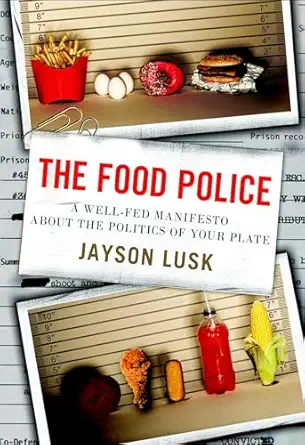
The Food Police: A Well-Fed Manifesto About the Politics of Your Plate
Author(s): Jayson Lusk (Author)
- Publisher: Forum Books
- Publication Date: April 16, 2013
- Edition: 1st
- Language: English
- Print length: 240 pages
- ISBN-10: 0307987035
- ISBN-13: 9780307987037
Book Description
A catastrophe is looming. Farmers are raping the land and torturing animals. Food is riddled with deadly pesticides, hormones and foreign DNA. Corporate farms are wallowing in government subsidies. Meat packers and fast food restaurants are exploiting workers and tainting the food supply. And Paula Deen has diabetes!
Something must be done. So says an emerging elite in this country who think they know exactly what we should grow, cook and eat. They are the food police.
Taking on the commandments and condescension the likes of Michael Pollan, Alice Waters, and Mark Bittman, The Food Police casts long overdue skepticism on fascist food snobbery, debunking the myths propagated by the food elite. You’ll learn:
– Organic food is not necessarily healthier or tastier (and is certainly more expensive).
– Genetically modified foods haven’t sickened a single person but they have made farmers more profitable and they do hold the promise of feeding impoverished Africans.
– Farm policies aren’t making us fat.
– Voguish locavorism is not greener or better for the economy.
– Fat taxes won’t slim our waists and “fixing” school lunch programs won’t make our kids any smarter.
– Why the food police hypocritically believe an iPad is a technological marvel but food technology is an industrial evil
So before Big Brother and Animal Farm merge into a socialist nightmare, read The Food Police and let us as Americans celebrate what is good about our food system and take back our forks and foie gras before it’s too late!
Editorial Reviews
Amazon.com Review
Amazon Q&A with Jayson Lusk
Q. In your book, you really pull the lid off of the hypocrisy surrounding “the food police” and the crusade against big food companies. Why?
A. Two reasons. The first is that, having grown up around many people involved in agricultural and food production, it was time to set the record straight, and to reveal that these folks are neither stupid nor sinister but rather care passionately about their land, their children, and the foods they make. Secondly, it was becoming apparent that the policies proffered by the food police were largely based on ideological agenda rather than empirical evidence that they’d actually work; rather, the evidence is that the implementation of those policies would harm the very people the food police purport to help.
Q. Do you think salt, sugar, and fat are really addictive? If so, can the “fat taxes” really save us?
A. Eating salt, sugar, and fat are enjoyable. Thus it shouldn’t be surprising that the reward centers of our brain get fired up when we eat them. The argument that these ingredients are addictive teeters on calling anything pleasurable addictive. Calling salt, sugar, and fat addictive is stretching the science to fit an agenda.
The economic research on “fat taxes” shows that the policy will have only trivial effects on weight. Adding a new tax is akin to lowering someone’s income, and few of us are happier with less money. The logic that “fat taxes” will actually help the people who are supposed to be helped is untenable.
Q. In your book, you discuss the importance of us consumers making our own choices. Are we as consumers really so weak as to succumb to the whims of Big Food and their flavor construction, marketing, and placement at the grocery store or deli?
A. There is schizophrenic paternalism that results from an awkward attempt to walk a fine line between a liberal agenda that yields to freedom of choice and expression when it comes to abortion, sex, speech, and drugs but stops short when those same freedoms might benefit evil corporations like Big Food. It is an odd position that posits us so weak as to fall for anything offered by Ronald McDonald or Tony the Tiger yet so strong as to know when to keep a baby alive or which truths to speak to power.
It is true, of course, that we are affected by advertising. However, much of the research shows that advertising is primarily used to persuade consumers to switch brands (rather than buy more). The truth is that Big Food can’t force us to buy anything, and they constantly scurry to meet our every whim.
Q. Are organic or locally grown foods actually better for you?
A. By and large, the answer is no. Numerous scientific studies have shown that the nutritional content of organic is essentially equivalent to conventional. Furthermore, it is a complete misnomer that organics are pesticide-free. Organic producers do use “natural” pesticides, many of which are more toxic than “synthetic” pesticides used on conventional farms. You have to remember that organics are much more expensive than the conventional, and if the choice is between eating fewer organic veggies (because they are more expensive) or more conventional veggies (because they are cheaper), the healthier choice is probably to go with the conventional. Local is a whole other issue, which I unpack in the book. You can eat unhealthy local food or healthy foreign food. One has nothing to do with the other.
Q. Are you concerned with the rise in obesity in America? What are some things that you think can improve this issue?
A. I think a better question is: what should the government do about your weight? That is a much more uncomfortable question but it is the better question to ask. There are a lot of personal incentives to reduce weight. The evidence suggests that people with very high levels of obesity earn lower wages, die sooner, have higher medical costs, and face a lot of social scorn. So, the question isn’t whether I’m concerned about obesity but rather whether the obese are concerned about it themselves.
The good news is that the upward trend in obesity is beginning to level off, and among some groups, has actually begun to decline in recent years. It is important to keep in mind the reasons why we experienced a rise in obesity in the first place, and many of those reasons—from less strenuous jobs to more convenient foods to more air-conditioned offices to less expensive food to the development of microwaves and dishwashers—are cause for rejoicing rather than dismay. That doesn’t mean we can look for ways to have our cake and eat it, too, only that we shouldn’t forget how we got the cake.
Review
“Jayson Lusk boils down and slices and dices the hypocrisy of liberals ever growing fetish with America’s food in a way nobody has before. No empty calories in this expose. You’ll be hungry for more.” –Andrea Tantaros,
New York Daily News columnist and co-host of The Five on Fox News“This is hard hitting and to the point., And scary. The Food and Drug Administration is mainly known for its activities that “protect” consumers from new and beneficial drugs. But, as Jayson Lusk, shows in powerful and pointed detail, the FDA creates massive levels of mischief and confusion through its misguided regulation of food and drink. Chocked-filled with telling anecdotes, and informed by strong economic theory, Lusk offers a compelling expose of government misadventure that tends to hurt the very people whom it is said to protect.” – Richard Epstein, law professor at university of Chicago and author of several books
“This is a wonderful and well-written book. Reading it was a cathartic experience. It packs an awful lot of common sense and clear headed thinking into a small space. Lusk makes clear that a lot of what academics and politicians take for granted about our agricultural system is in fact nonsense. It is tempting to dismiss the food police as well-intentioned, if not exactly well-informed about the science and economics of food production and consumption. Lusk has reinforced my conviction that to ignore them would be irresponsible. The food police have considerable clout at the highest levels of government and they think they know best about what everyone should eat, including you and me. If they get their way, they would put at risk the ability of our farms to produce healthy and nutritious food at a price the whole world can afford.” – Jay Bhattacharya, M.D., Ph.D. Associate Professor of Medicine, Stanford University
“The conclusions from [Lusk’s] research will do more to advance healthy eating than would a nation of Mayor Bloombergs.” – Jeff Stier in the New York Post.
“Lusk makes a strong case that the food police are a major obstacle to the kind of innovation we need. Their intransigence on many of the benefits of food modernization — from genetically modified food to industrial farming and synthetic fertilizers, and even modern conveniences such as large-scale grocery stores and today’s shipping methods — is the kind of thinking that will, as Lusk warns, ultimately doom us to poverty.” – Julie Gunlock in The National Review
“Sometimes sacred cows must be slaughtered to get to the truth. Lusk does that, and in a way that reads like a charming personal memoir by your favorite college professor.” – Henry Miller at Forbes.com
“to newcomers who want the story of how a few cranks took over how a country thinks about food, The Food Police provides an excellent primer.” – Center for Consumer Freedom
“This book is amazing at how it thoroughly describes the how the food police screw things up, increase costs, hurt the environment, and ultimately, cost us freedom.” – Matt Rousu
“Whether or not readers agree with Lusk’s on agriculture and the politics of food production, he will make you think about your food choices.” – Kirkus reviews
About the Author
Excerpt. © Reprinted by permission. All rights reserved.
A Skeptical Foodie
A catastrophe is looming. Farmers are raping the land and torturing animals. Food is riddled with deadly pesticides, hormones, and foreign DNA. Corporate farms are wallowing in government subsidies. Meatpackers and fast-food restaurants are exploiting workers and tainting the food supply. And Paula Deen has diabetes.
Something must be done.
Or so you would believe if you listened to the hysterics of an emerging elite who claim to know better what we should eat. I call them the food police to be polite, but a more accu- rate term might be food fascists or food socialists. They are totalitarians when it comes to food, and they seek control over your refrigerator, by governmental regulation when they can or by moralizing and guilt when they can’t. They play on fears and prejudices while claiming the high mantle of science and impartial journalism. And their dirty little secret is that they embrace an ideological agenda that seeks to control your dinner table and your wallet.
A chorus of authors, talk show hosts, politicians, and celebrity chefs has emerged as the self-appointed saviors of our food system. They are right about one thing: There is something sinister about our dinner plans. The food police are showing up uninvited.
Whatever tonight’s plans, you’d better make room for another guest. It isn’t the polite sort who calls ahead and asks what he can bring; it’s the impertinent snob who’s coming over whether you like it or not, demanding his favorite dish to boot. Be careful what you choose to serve—if isn’t made with the finest local ingredients painstakingly bought from small organic farms, expect an evening of condescension and moralizing. And at all costs, avoid the meat from cows fed corn, or you’ll have a riot of political correctness on your hands.
Like it or not, the food police will be at dinner. It is impossible to turn on the TV, pick up a book about food, or stroll through the grocery store without hearing a sermon on how to eat. We have been pronounced a nation of sinful eaters, and the food police have made it their mission that we seek contrition for every meal. We are guilty of violating the elite’s revelations. Thou shalt not eat at McDonald’s, buy eggs from chickens raised in cages, buy tomatoes from Mexico, or feed your infant nonorganic baby food. There can be no lack of faith in the elite’s dictates. There are no difficult trade-offs and no gray areas. Thou shalt sacrifice taste for nutrition, convenience for sustainability, and low prices for social justice.
And if we won’t willingly repent, the high priests of politically correct food will regulate us into submission. If you aren’t convinced, consider just a few examples of the food police in action.
4 Trans Fat Bans
Try a doughnut the next time you’re in New York City or Philadelphia. Not as tasty as it used to be, is it? For this we can thank the food police and their war on trans fats.1 And what a service it has been; we should be grateful to have been taught the shocking truth that too many Oreos and doughnuts are unhealthy!
4 Outlawed Happy Meals
Do you have children? Want to reward them for an A+ on their spelling test? Don’t even think about taking them to McDonald’s in San Francisco or you’ll have a backseat of unhappy campers. The city’s board of supervisors tried to ban toys in Happy Meals as a way of “moving forward an agenda of food justice.”2 The hypocrisy is astounding. So now, “in the City by the Bay, if you want to roller skate naked down Castro Street wearing a phallic-symbol hat and snorting an eight-ball off a transgender hooker’s chest while underage kids run behind you handing out free heroin needles, condoms and coupons . . . that’s your right as a free citizen of the United States. But if you want to put a Buzz Lightyear toy in the same box with a hamburger and fries and sell it, you’re outta line, mister!”3
4 Twinkie Taxes
Despite the economic research clearly showing that fat taxes will do little to slim our waistlines, food police across the nation are hiking food prices by implementing various forms of taxes on soda, fat, and fast food. In his book The World Is Fat, University of North Carolina professor Barry Popkin says, “Taxing the added sugar in beverages is a favorite strategy of mine.”4 So now you know whom to thank when your grocery bill is 100 percent higher and half as tasty.
4 Local Food Subsidies and Purchasing Requirements
Rather than using our tax dollars to shore up Medicare or Social Security, the food police want to subsidize your neighbor’s purchase of local asparagus. With the help of lawmakers, bestselling author Michael Pollan wants to “require that a certain percentage of that school-lunch fund in every school district has to be spent within 100 miles.”5 Tough luck for citrus-loving children in Minnesota.
4 Affirmative Action for Cows
The Obama administration tried to implement rules on the “fair” pricing of livestock that would have required ranchers and meatpackers to justify to the government the prices they freely pay and accept for cattle. Cowboys across the nation would have had to tell Uncle Sam why they paid more for a hearty registered Angus than a scrawny half-breed. In a move projected to have cost farmers and consumers more than $1.5 billion annually, and radically altered the structure of the livestock sector, the food police unwittingly married George Orwell’s two greatest works by bringing Big Brother onto Animal Farm.6
4 Dirt Taxes
As if just now realizing that corn grows in the ground, the Environmental Protection Agency is trying to implement rules enabling it to fine farmers if their tractors kick up too much dust. Charlie Brown’s friend Pig-Pen had better watch his back.
4 Fruit and Veggie Subsidies
Convinced that the food industry is “incapable of marketing healthier foods,” New York Times food writer Mark Bittman wants to expand the welfare state by cajoling farmers and consumers into growing and buying the stuff he prefers that we eat. Bittman wants to enact policies that will “subsidize the purchase of staple foods like seasonal greens, vegetables, whole grains, dried legumes and fruit.”7
4 Foie Gras Bans
Only after a groundswell of outrage from chefs and restaurant-goers did the city of Chicago rescind its ban on the duck and goose liver delicacy. Undeterred by the suffering palates of their Midwestern brethren, the state of California now bars its own citizens from buying what can be found on almost every street in Paris.
4 Regulating Happy Hens and Hogs
Despite the fact that fewer than 5 percent of consumers buy cage-free eggs or pork, activist efforts have led to ballot initiatives and legislation in at least eight states requiring farmers to use cage-free production systems. The laws force farmers to adopt practices that consumers aren’t fully willing to pay for.8
4 Technophobia
Wirelessly pontificating on Facebook and Twitter via their 64 GB iPads, the food police welcome new technology—that is, unless it relates to food. Unwilling to accept the scientific evidence on the potential price-reducing and safety-enhancing advantages of new food technologies, the food police promote bans, taxes, restrictions, and propaganda on technologies such as preservatives, irradiation, biotechnology, cloning, and pesticides. They even spread fear about age-old practices such as pasteurization, hybrid plant breeding, and grain-fed livestock.
4 Schoolroom Indoctrination
The food police seek to indoctrinate our children, not by teaching food science and nutrition, but by advancing the cause of fashionable foods. Famed food activist and restaurant owner Alice Waters wants “a total dispensation from the president of the United States who will say, ‘We need a curriculum in the public school system that teaches our kids, from the time they are very little, about food and where it comes from. And we want to buy food from local people in every community to rebuild the agriculture.’ ” She says that we “must get Obama to understand the pleasures of the table.”9 His wife was listening. Michelle Obama’s signature childhood nutrition bill took $4.5 billion away from food stamp recipients to expand the federal government’s role in regulating school lunches and significantly increased food costs to local schools throughout the nation.10
4 Restrictions on Freedom of Speech
A team of four government agencies—the Federal Trade Commission, the Food and Drug Administration, the Department of Agriculture, and the Centers for Disease Control and Prevention—have banded together under the auspices of an Interagency Working Group to recommend prohibitions against certain food advertisements to children. Some like-minded members of the food elite want to invoke a version of the Fairness Doctrine, demanding equal airtime to run government and activist-sponsored ads about food.
These are but a few examples of the growing intrusions by the food police. Taken in isolation, any one of the regulations might not seem so bad and may even appear helpful. Therein lies the danger. You won’t yet find a single omnibus piece of legislation restricting your food freedoms, but the planks in the road are slowly being replaced without the travelers even realizing construction is under way. And guess who is left to pay the toll at road’s end? With a ban on trans fats here, a fat tax there, here a local foods subsidy, there a pesticide ban, everywhere an organic food—before you know it, Old McDonald has a new farm.
Michelle Obama’s White House garden was a symbolic nod granted to the growing reality of a movement that seeks more control over what we eat. Even New York City mayor Michael Bloomberg supports the encroaching government hand in food. After congratulating himself on helping New York City ban trans fats, successfully pressuring food companies to reduce salt, and selectively licensing “green” produce vendors, Bloomberg told the UN General Assembly that “Governments at all levels must make healthy solutions the default social option. That is ultimately government’s highest duty.”11 Never mind national defense or the government’s duty to life and liberty or leaving unenumerated powers to the states: healthy food is now apparently the be-all and end-all of good government.
These are many of the same people who scream, “It’s a woman’s body,” any time the subject of abortion comes up. According to them, a woman has the right to do what she wants with her body. That is, unless she wants to eat something deemed morally defunct. You know, something as reprehensible as a Nestlé Toll House cookie or a Big Mac.
Susan Dentzer, former PBS news correspondent and current editor in chief of Health Affairs, wants to change our eating habits by creating a “broadbased set of interventions comparable in scope to the four-decade assault on smoking.”12 Others are “turning to multilevel interventions, which . . . target . . . the individual, the social network, the community, and policy.”13
What exactly are these interventions? Consider the proposal mentioned in Harvard Magazine: “There was once a very successful U.S. government program aimed at changing eating habits . . . It happened during World War II, and it was called ‘food rationing.’ They made it a patriotic thing to change the way you ate. The government hired the best people on Madison Avenue to come to Washington and work for the War Department. It worked splendidly.”14
Food rationing! Really? I suspect that many of the millions of people who actually lived through food rationing during World War II would recall the policy as being anything but splendid. But apparently if the food police are to have their way, we must be prepared to stand in line and register for a coupon booklet to buy sugar, bread, and flour. It’s as if we have already forgotten the dreaded food lines of the USSR.


