 Wow! eBook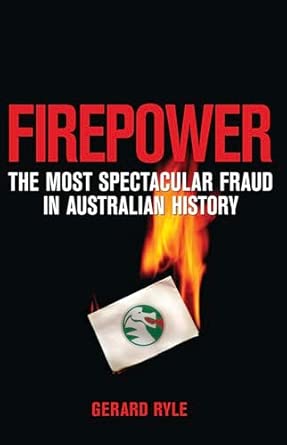
Firepower: The Most Spectacular Fraud in Australian History
Author(s): Gerard Ryle (Author)
- Publisher: Allen & Unwin
- Publication Date: 5 Jan. 2009
- Edition: Illustrated
- Language: English
- Print length: 296 pages
- ISBN-10: 1741753554
- ISBN-13: 9781741753554
Book Description
Editorial Reviews
About the Author
Excerpt. © Reprinted by permission. All rights reserved.
Firepower
The Most Spectacular Fraud in Australian History
By Gerard Ryle
Allen & Unwin
Copyright © 2009 Gerard Ryle
All rights reserved.
ISBN: 978-1-74175-355-4
Contents
Acknowledgements,
Prologue: The joke,
1 Perpetual motion,
2 Choosing sides,
3 Abracadabra,
4 Big concepts,
5 Wanting to believe,
6 A new beginning,
7 Foreign shores,
8 Gaining credibility,
9 The emperor’s new clothes,
10 Little helpers,
11 Mr Big,
12 Changing the guard,
13 The big distraction,
14 Oranges and lemons,
15 Raining money,
16 Escape routes,
17 Behind the curtain,
18 The money pit,
Epilogue,
Sources,
CHAPTER 1
PERPETUAL MOTION
Australian investors have long had a weakness for fuel-saving devices.
Ever since Ralph Sarich appeared on the ABC television show The Inventors in 1972 and revealed a new type of engine, fortunes have been won and lost on assurances to revolutionise the car industry. Sarich’s compact design promised more power, fewer emissions and significant fuel economy. The fact that his Orbital engine remained untested failed to dampen the resultant frenzy. Australia’s largest company, BHP, formed a joint venture to develop the technology. Shares that once traded for 20 cents went to $24 each. Investors and analysts brimmed with confidence about the potential for lucrative multimillion-dollar contracts from big car manufacturers.
Governments got involved. During the 1987 federal election campaign, the then prime minister, Bob Hawke, announced that $500 000 of taxpayers’ money would be used to assess the viability of an Orbital engine manufacturing plant. He was responding to fears that Australia would lose the project to foreign interests. But the inflated confidence overlooked a number of fundamental problems. Key components of the Sarich engine couldn’t be cooled. Others couldn’t be readily lubricated. The engine was susceptible to overheating and was eventually deemed too impractical.
By 2004, the Orbital Engine Company had accumulated losses of $480 million, and had defeated BHP, which unloaded its stock in 1998 and 1999 at prices below $1 per share. Sarich had been fortunate enough to get out sooner. He sold his shares for $3 each and did what every sensible millionaire does — he bought property in Perth’s central business district.
But the perceived success of Orbital spawned a number of imitators. In 1988, another radical engine design began making headlines. Split-Cycle Technology also promised more power, fewer emissions and better fuel economy. Rick Mayne, the New Zealand inventor, had appeared in Australia two years earlier. He had previously made his living selling caravans and trailers built from second-hand parts, arguing that because the material he used was second-hand, no sales tax was payable.
Mayne sold shares to the general public in his new Split-Cycle venture without going through the usual step of listing on a stock exchange. Instead, trading in the shares occurred at the Split-Cycle headquarters on the Gold Coast and during sweaty revival-hall-style gatherings in packed hotel rooms. One story told by promoters was of the Split-Cycle dealer who made $139 000 running up and down between different floors of the Split-Cycle offices between buyers and sellers. Doctors, nightclub owners and accountants abandoned their careers to join the action, often contacting each other through newspaper advertisements, where the trading was perpetuated. An estimated 111 million shares changed hands.
Stimulating the interest were Mayne’s confident assertions. In 1992, he said his engine would be powering its first car within eighteen months. Soon after, he announced the multimillion-dollar sale of development rights to a Slovakian company. He also unveiled plans for an ambitious multi-billion-dollar joint research venture with four major American universities.
The publicity-conscious Mayne enlisted the celebrity train robber Ronald Biggs as a representative, and hired three-time Formula One world champion Sir Jack Brabham to chair the company. At its peak, Split-Cycle was valued at more than $200 million. Mayne, as the biggest shareholder, was worth $50 million. In 1993, he was named as one of Australia’s richest people, the owner of a string of exotic cars, including a $670 000 Lamborghini. That same year he was arrested when he returned to his native New Zealand for evading a $1 million tax bill on the caravans and trailers. The tax dispute was settled, but Mayne eventually shuffled off into the sunset, leaving behind thousands of empty-handed shareholders and a posse of frustrated corporate regulators.
Market governance failed to save investors in Red River Limited, once one of the most traded stocks on the Australian Stock Exchange. The company’s share price went from 9 cents in December 1993 to $1.85 in early May 1994 after it released test results on a device that claimed to radically reduce petrol consumption using a common garden hose.
Red River had started life as a mining company, and its journey to automotive technology had involved prior stints importing waterbeds, trading confectionery and managing time-share properties. But it hit the big time when tests on its contraption the Econo Power apparently showed a 75 per cent fuel saving on a 1986 Holden Commodore driven over a distance of 1400 kilometres, without any loss of performance or other adverse occurrences. The Econo Power involved installing a separate water tank in the boot of the car, converting the water into vapour, then combining it with petrol before injecting the mixture into the engine. The company was expected to complete further independent trials with a major automotive company or university within four months. But only days after going public with the test result, the car burst into flames.
Celebrities have often been caught up in the folly. The late Kevin Charles ‘Pro’ Hart came up with his own fuel-saving concept in the mid-1980s, but his initial prototype for the Zero Emission Fuel Saver was too large to be practical. The world-renowned Australian bush painter spent more than a decade refining the device before sharing his secret in 1997 with the fast-talking and charismatic Jeffrey Alan Muller.
Muller was a one-time Sydney real-estate salesman who was then in his late forties. Like many in the fuel-saving business, he laid claim to an extraordinary personal history. He was a former champion speedway driver, a one-time successful property developer, and a friend of celebrities such as Ted Turner, Olivia Newton-John and John Denver. He also boasted ownership of a now defunct rugby league team called the Gold Coast Chargers. What he failed to mention was that the sporting franchise was taken away from him after only a couple of months. He hadn’t come good with the promised finance, had brought in a faith healer and, according to a judge, had ineptly interfered in the club’s affairs ‘creating such instability that its chief executive officer and some other important personnel associated with it resigned’.
Hart and Muller met by chance on the Gold Coast and according to a Sydney Morning Herald article dated April 2001, Muller claimed to have secured a ‘marketing and manufacturing agreement’ that would give the entrepreneur exclusive worldwide distribution rights to the device, in exchange for 20 per cent of the anticipated profits. Hart denied ever having signed this agreement, never received a cent from Muller, and was outraged by what happened next. Muller bought a United States shelf company, changed its name to Save The World Air Inc, made himself president and sold the company his rights to the device.
Save The World Air Inc was premised entirely on a piece of shiny metal the size of a packet of cigarettes with holes drilled through it — a compact and updated version of Hart’s original prototype — that sold for US $195. The company claimed it could decrease fuel consumption by 42 per cent and virtually eliminate poisonous exhaust gases.
This wasn’t the first time that Muller had attempted to profit from green technology. Some years earlier, the Sydney Morning Herald reported that he’d claimed to have developed an engine ‘which runs on nothing but compressed air’. He then got involved in promoting something he called a ‘super kiri tree’, which he claimed was the world’s fastest-growing hardwood. This turned out to be a small plantation of paulownia trees, a popular tax-minimisation scheme of the mid-1990s.
Even amid the high-tech hyperventilation of the late 1990s, the promotion of Save The World Air Inc was extraordinary. Muller was relentless. He pumped out scores of media releases via the internet. He demonstrated the device on Fox TV and was written up in the New York Times. He recruited a stable of sporting and show business celebrities to endorse the product, including Sir Jack Brabham, the Split-Cycle chairman, and champion golfer Wayne Grady. According to the Sydney Morning Herald, Steven Seagal, the Hollywood movie star, videotaped a testimonial for the gadget, and John Brown, the former Australian sports minister, wrote: ‘I have never been more impressed over my long life in business and politics with any other venture’. All later repudiated those endorsements. But whipped along by internet chatter — some of it planted by Muller’s friends — shares in Save The World Air Inc went from being worth a few cents each when it listed in 1999 to a peak of US $28 each in July 2000. This valued the company at an extraordinary $420 million. And Muller, who owned about one-quarter of the stock, joined the ranks of Australia’s wealthiest men, worth more than $100 million on paper.
‘I’ve been told we’ve got the potential to be as big as Microsoft,’ he crowed to a Bloomberg business wire reporter after he claimed to have just sold his first distribution franchise for ‘a guaranteed $4 million’ to a Jamaican auto-parts dealer. According to the Herald, he said he planned to sell a hundred more for $20 million a piece — a cool $2 billion.
But the deals promised by Muller came to nothing. Unlike Microsoft, the company never manufactured anything. The only Zero Emission Fuel Savers in existence were about a dozen closely guarded prototypes used for demonstrations. Adrian Menzell of Ashmore Wreckers, a Gold Coast car-parts yard, had knocked them up using simple, cheap magnets. ‘Once somebody sees one and holds one in their hand they can go out and make one in their garage,’ Muller’s former associate Joe Daniels told the Sydney Morning Herald in April 2001. ‘He’s got no product — he’s out there peddling air.’
Muller had another problem, one that would bring his wild ride to a grinding halt. His claims for the device had never been independently tested or scientifically verified. Muller had only ever performed undemanding demonstrations using rudimentary pollution-testing apparatus. Despite this, the company’s press releases heralded the ‘successful test’ of the device by two service technicians at a local New York auto dealership; another assessment conducted by ‘Sun Electric and Snap On Tools’ at a due diligence conference for stockbrokers in Boca Raton, Florida; and two others carried out at a petrol station in Brentwood, California and a car dealership in Los Angeles. Also featured prominently on the Save The World Air Inc website was an apparent endorsement from an academic at Queensland’s Griffith University. The website claimed that Dr Allan Edwards certified that he had seen the machine work under ‘credible circumstances’ and believed it to be ‘highly effective’. But when contacted by the Sydney Morning Herald in April 2001, Edwards said he had no expertise in vehicle emissions. He was, in fact, a teacher of sports management and marketing. Muller was a friend who had invited him to a demonstration of the device and he had written the letter not realising how it would be used. ‘I feel really ashamed and angry,’ he said. ‘I was a frightful goose.’
Muller’s golden run came to an end in July 2000 when the consumer website Stock Patrol published a two-part investigation headlined ‘Stock or Schlock?’, which focused on the fact that the hot ‘tech’ company appeared to have no assets and no prospects. The next day, as the share price fluctuated wildly, the US Securities and Exchange Commission moved in. Citing a misleading media release implying the Ford Motor Company was interested in the device, the corporate watchdog suspended trading in the stock on 20 July 2000, saying in a press release it was ‘because of questions raised about the accuracy and adequacy of publicly disseminated information concerning the results of tests of Zero Emission Fuel Saver’.
The commission sued Muller for fraud. It claimed in the US District Court he made a personal profit of US $9 million and had ‘carried out a fraudulent promotional campaign using press releases, internet postings, an elaborate website, and televised media events to disseminate false and materially misleading information about STWA’s product and commercial prospects’. Purported licensing agreements, it said, and other business developments ‘simply did not exist’.
On 15 November 2005, a US District Court in New York ordered Muller to hand over US $7.5 million and another US $100 000 in civil penalties. He was barred from being an officer of a company for twenty years.
But that wasn’t the end of Save The World Air Inc. Muller was replaced as the company’s chief executive officer by the late Edward Masry, better known as the Californian attorney who hired the struggling single mother Erin Brockovich as a legal assistant and, with her, achieved a landmark environmental legal victory, as portrayed in the Hollywood movie that won Julia Roberts an Oscar.
Another fuel-saving celebrity was the late Peter Brock, an Australian rally driver known to an adoring public as Peter Perfect. Before his untimely death in a car accident in September 2006, Brock had achieved a long list of memorable moments. His first win at Bathurst, Australia’s premier road-racing event, was in 1972, driving single-handed for 500 miles in a customised Holden Torana. He underlined his superiority at the event in 1979, winning by six laps and setting a record on his last lap. In 1980, he became the first driver to win Bathurst, Sandown and the Australian Touring Car title in the same year. Many Brock stories passed into folklore. How he developed his legendary skills by thrashing an old Austin around his father’s farm on the northern fringes of Melbourne. How fans asked for his autograph on their body, then tattooed over their hero’s scrawl.
Less remembered is Brock’s stubborn belief — inspired by his spiritual teacher, Eric Dowker — in a mysterious device said to improve the performance and fuel economy of his cars. It was called the Energy Polariser and was nothing more than an assortment of common magnets and crystals wrapped in tinfoil. But Brock claimed it was a highly advanced energy machine that altered molecular structures, bringing order to an otherwise random pattern and rendering it more efficient.
Brock claimed the device had been tested and approved by General Motors, and that the giant global corporation was so impressed it was considering attaching them to all their vehicles. The bond between Brock and Holden — the local arm of General Motors — ran deep, dating back to 1980 when Brock’s special vehicle company began building thousands of modified high-performance Holden Commodore cars that were offered for sale through the Holden dealership network. In return, the dealers contributed to the running of Brock’s Commodore race team. It was a successful relationship that lasted seven years. Brock’s well-funded Commodores were regular winners on the track, and the limited-build Brock Commodore road cars were strong sellers in the showrooms. They had image, prestige and a fat margin on the sticker price. In the dark days of the early 1980s when Holden lost the market leadership it had held for more than thirty years in Australia to its main rival Ford, and Commodore sales slumped from a high of 64 000 to barely 35 000 units a year, Brock was the one bright spot on a bleak corporate horizon.
But his insistence that the Energy Polariser be fitted to the engine bay of all cars bearing his name ultimately cost him his relationship with his main sponsor. Holden knew its parent company hadn’t carried out any scientific trials in the United States, as Brock had implied. Instead, Holden itself had subjected the Energy Polariser to a series of tests over four days in late 1986, at its proving ground at Lang Lang, about 150 kilometres from Melbourne. The device was found to make no difference, either to performance or to fuel economy, and Holden was anxious to distance itself from the nonsensical claims.
Yet right to the very end, Brock’s faith in the Energy Polariser was unswayed. ‘How do we prove it works?’ he said to the Melbourne’s Herald Sun newspaper shortly before his death. ‘They haven’t invented the machine yet to prove it works.’
Such absolute personal conviction — in the absence of any scientific proof — goes some way towards explaining how these supposed fuel-saving devices appear again and again in Australia’s recent history.
Australia doesn’t have a dedicated laboratory for testing the various fuel-saving devices that emerge on the market. What it does have is Project 55 at the Railway Cooperative Research Centre, headed by Dr Damon Honnery and funded by Australia’s biggest private railways in an attempt to cut their half-a-billion-dollar-a-year fuel bills. The testing is done on a stripped-down truck engine that sits in a room at the back of the engineering wing of the sprawling Clayton campus of Monash University in Melbourne.
(Continues…)Excerpted from Firepower by Gerard Ryle. Copyright © 2009 Gerard Ryle. Excerpted by permission of Allen & Unwin.
All rights reserved. No part of this excerpt may be reproduced or reprinted without permission in writing from the publisher.
Excerpts are provided by Dial-A-Book Inc. solely for the personal use of visitors to this web site.



