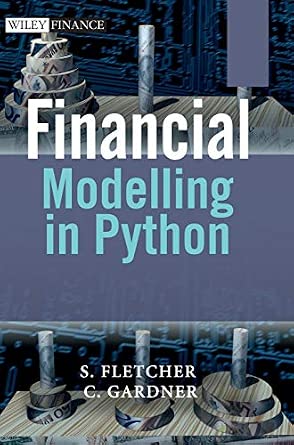
Author(s): Shayne Fletcher (Author), Christopher Gardner (Author)
Publisher: Wiley
Publication Date: 26 Jun. 2009
Edition: 1st
Language: English
Print length: 248 pages
ISBN-10: 0470987847
ISBN-13: 9780470987841
Book Description
"Fletcher and Gardner have created a comprehensive resource that will be of interest not only to those working in the field of finance, but also to those using numerical methods in other fields such as engineering, physics, and actuarial mathematics. By showing how to combine the high-level elegance, accessibility, and flexibility of Python, with the low-level computational efficiency of C++, in the context of interesting financial modeling problems, they have provided an implementation template which will be useful to others seeking to jointly optimize the use of computational and human resources. They document all the necessary technical details required in order to make external numerical libraries available from within Python, and they contribute a useful library of their own, which will significantly reduce the start-up costs involved in building financial models. This book is a must read for all those with a need to apply numerical methods in the valuation of financial claims." –David Louton, Professor of Finance, Bryant University
This book is directed at both industry practitioners and students interested in designing a pricing and risk management framework for financial derivatives using the Python programming language.
It is a practical book complete with working, tested code that guides the reader through the process of building a flexible, extensible pricing framework in Python. The pricing frameworks' loosely coupled fundamental components have been designed to facilitate the quick development of new models. Concrete applications to real-world pricing problems are also provided.
Topics are introduced gradually, each building on the last. They include basic mathematical algorithms, common algorithms from numerical analysis, trade, market and event data model representations, lattice and simulation based pricing, and model development. The mathematics presented is kept simple and to the point.
The book also provides a host of information on practical technical topics such as C++/Python hybrid development (embedding and extending) and techniques for integrating Python based programs with Microsoft Excel.
Editorial Reviews
Review
Select Guide Rating
From the Inside Flap
"Python is extensively used is quantitative finance applications, and yet there is a surprising scarcity of material covering this area. This book helps fill that gap, by showing how to unlock the power of the Python language for financial modeling, and providing an excellent insight into the programming techniques needed if it is to be used for practical pricing applications in the industry. Key language capabilities are described in parallel with the development of a comprehensive framework for the pricing of derivatives in a powerful and generic way. The authors also share their mathematical expertise, giving us a tour of an array of advanced numerical and quantitative techniques." ―Peter Broadhurst, Complex Foreign-Exchange Option Analytics, Bank of America Merrill Lynch
From the Back Cover
"Fletcher and Gardner have created a comprehensive resource that will be of interest not only to those working in the field of finance, but also to those using numerical methods in other fields such as engineering, physics, and actuarial mathematics. By showing how to combine the high-level elegance, accessibility, and flexibility of Python, with the low-level computational efficiency of C++, in the context of interesting financial modeling problems, they have provided an implementation template which will be useful to others seeking to jointly optimize the use of computational and human resources. They document all the necessary technical details required in order to make external numerical libraries available from within Python, and they contribute a useful library of their own, which will significantly reduce the start-up costs involved in building financial models. This book is a must read for all those with a need to apply numerical methods in the valuation of financial claims." –David Louton, Professor of Finance, Bryant University
This book is directed at both industry practitioners and students interested in designing a pricing and risk management framework for financial derivatives using the Python programming language.
It is a practical book complete with working, tested code that guides the reader through the process of building a flexible, extensible pricing framework in Python. The pricing frameworks' loosely coupled fundamental components have been designed to facilitate the quick development of new models. Concrete applications to real-world pricing problems are also provided.
Topics are introduced gradually, each building on the last. They include basic mathematical algorithms, common algorithms from numerical analysis, trade, market and event data model representations, lattice and simulation based pricing, and model development. The mathematics presented is kept simple and to the point.
The book also provides a host of information on practical technical topics such as C++/Python hybrid development (embedding and extending) and techniques for integrating Python based programs with Microsoft Excel.
About the Author
SHAYNE FLETCHER has a BSc. from the University of Sydney, Australia. He has had more than 10 years experience working for major investment banks in London, The Netherlands and Japan. In 2009 he founded QuantSoft (http://www.quantsoft.co.jp) providing technical consulting services to meet the financial engineering programming needs of its clients.
CHRISTOPHER GARDNER has a PhD in Applied Mathematics from King's College, London. He began his career working for UKAEA Fusion at Culham Laboratory before moving to the City of London. He has 10 years experience working as a Quantitative analyst. He is currently working on the pricing of Life derivatives for the Asset Management Pricing Desk at Swiss Re.
 Wow! eBook