Wow! eBook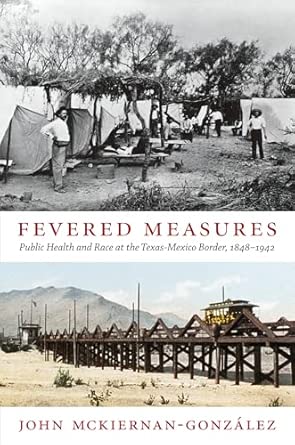
Fevered Measures: Public Health and Race at the Texas-Mexico Border, 1848–1942
Author(s): John Mckiernan-González (Author)
- Publisher: Duke University Press
- Publication Date: 29 Aug. 2012
- Language: English
- Print length: 440 pages
- ISBN-10: 0822352575
- ISBN-13: 9780822352570
Book Description
Editorial Reviews
Review
“
Fevered Measures gives us a penetrating view of the intersections between race and public health policies, bringing new insights to the history of both the borderlands and US public health. It will be valuable to students and researchers in Chicano/Latino studies, in social sciences and humanities. Appealing also to a broader audience, this welcome book contributes significantly to the current debates about Latinos and American public health. . . .”–Ana I. Ugarte “Latino Studies”“
Fevered Measures is a wonderful and significant contribution to Latina/o studies, medical history, and borderlands history.”–Mark Allan Goldberg “Pacific Historical Review”“
Fevered Measures is an engaging and multi-layered historical narrative that underscores the centrality of public health to daily life, social relations and power dynamics along the TexasMexico border over one century. . . . What makes this story particularly compelling is that Mckiernan-González frames it with a compassionate and informed plea for greater awareness of Latina/o health disparities.”–Alexandra Minna Stern “Global Public Health”“Mckiernan-Gonzalez . . . adds substantially to the large literature on the history of public health, particularly its role in controlling immigration into the United States.”–Stephen J. Kunitz “American Historical Review”
About the Author
John Mckiernan-GonzÁlez is Assistant Professor of History at the University of Texas, Austin.
Excerpt. © Reprinted by permission. All rights reserved.
FEVERED MEASURES
PUBLIC HEALTH AND RACE AT THE TEXAS-MEXICO BORDER, 1848–1942By John Mckiernan-González
Duke University Press
Copyright © 2012 Duke University Press
All right reserved.
ISBN: 978-0-8223-5257-0
Contents
Notes on Labeling Places, Peoples, and Diseases…………………………………………………………………………………….1Introduction……………………………………………………………………………………………………………………18ONE From the U.S.-Mexican War to the Mexican-Texas Epidemic: Fevers, Race, and the Making of a Medical Border…………………………….59TWO The Promise of Progress: Quarantines and the Medical Fusion of Race and Nation, 1890–1895……………………………………..78THREE The Appearance of Progress: Black Labor, Smallpox, and the Body Politics of Transnational American Citizenship, 1895…………………123FOUR The Power of Progress: Laredo and the Limits of Federal Quarantines, 1898–1903………………………………………………165FIVE Domestic Tensions at an American Crossroads: Bordering on Gender, Labor, and Typhus Control, 1910–1920…………………………198SIX Bodies of Evidence: Vaccination and the Body Politics of Transnational Mexican Citizenship, 1910–1920…………………………..236SEVEN Between Border Quarantine and the Texas-Mexico Border: Race, Citizenship, and National Identities, 1920–1942…………………..274Epilogue: Moving between the Border Quarantine and the Texas-Mexico Borderlands………………………………………………………..285Acknowledgments…………………………………………………………………………………………………………………289Notes………………………………………………………………………………………………………………………….363Bibliography……………………………………………………………………………………………………………………403
Chapter One
From the U.S.-Mexican War to the Mexican-Texas Epidemic
Fevers, Race, and the Making of a Medical Border
In 1847, public health matters concerned Americans in Mexico. The advent of fevers and disease among soldiers turned the initial military victories over Mexico into medical disasters. American soldiers and volunteers had started dying from typhomalarial fevers, dysentery, and yellow fever even before the American invasion of Port Isabel and Matamoros, Nuevo León, in May 1846. There was agreement regarding why Mexico was so harmful to Americans when the United States was supposed to be the healthier, more physically vigorous and energetic nation. For Samuel Curtis, the American military governor of Matamoros, Nuevo León, the American occupation of the lower Rio Grande Valley meant “sustaining a position where the loathsome diseases of the south carried off hundreds around us.” The Veracruz campaign in the summer of 1847 exposed another set of troops and volunteers to the sickly season (la epoca malsana) in lowland Mexico. By the winter of 1847, the U.S. Army calculated that there had been more hospital visits than troops in Mexico and that approximately one of eight American troops died of illness during the occupation. Facing the same conditions after the winter of 1847, American military authorities warily prepared for another season of fevers and agues.
The American military reality of illness shaped diplomatic proceedings in Mexico. Nicholas Trist, the U.S. agent for negotiations between Mexico and the United States, had developed a close working relationship with General Winfield Scott in Mexico City. Everyone was aware of the high level of illness and deaths among the troops stationed in Matamoros, Veracruz, and Monterrey. General Scott and the Mexican negotiator Manuel Peña y Peña wanted to end the American presence in Mexico as quickly as possible, but the reality of fevers during the summer gave the U.S. military pause. Trist and Peña agreed that, according to Article III, “the final evacuation of the territory of the Mexican Republic, by the forces of the United States, shall be completed from the said exchange of ratifications, or sooner if possible.” The clause spelled out the ways the Mexican military would help American troops avoid la temporada malsana in lowland Mexico:
If, however, the ratification of this treaty by both parties should not take place in time to allow the embarcation of the troops of the United States to be completed before the commencement of the sickly season, at the Mexican ports on the Gulf of Mexico, in such case a friendly arrangement shall be entered into between the General-in-Chief of the said troops and the Mexican government, whereby healthy and otherwise suitable places, at a distance from the ports not exceeding thirty leagues, shall be designated for the residence of such troops as may not yet have embarked, until the return of the healthy season. And the space of time here referred to as comprehending the sickly season, shall be understood to extend from the first of May to the first day of November.
This language dramatically illustrated the way the public health concerns of the American military became diplomatic concerns between Mexico and the United States. The high medical casualty rates among American troops in Mexico created a medical exception to the new political border. Public health exercised its own state of exception across America’s new international border. Matamoros military governor Samuel Curtis, two months into his occupation of Matamoros, after nearly a third of his regiment had spent time in the makeshift camp hospital and he had weathered his own bouts of fever and agues, had already concluded that “the malignant diseases of this climate appear unconquerable.” The treaty language moved medical concerns into the language of diplomacy and provided for an extended temporary occupation in the name of American public health. Article III of the Treaty of Guadalupe Hidalgo provides a graphic example of the way American fears of disease forged a set of medical and political practices that transcended immediate political borders. This power and associated mobility defines the American medical border since 1848. The visible presence of state medical authority in the Texas borderlands throughout the nineteenth century challenges the assumption that American medical authority at the Mexican border began with the Mexican Revolution.
American military leaders were not the first people to search for ways to make northern Mexico and South Texas medically safe for national purposes. Men and women in the Texas-Mexico borderlands had been grappling with the political and social implications of modern public health measures for nearly half a century before Winfield Scott composed Article III in the Treaty of Guadalupe Hidalgo. Spanish, Mexican, and American authorities all sought to create policies to contain smallpox, typhus, cholera, pneumonia, and yellow fever at the nation’s outer edges. This chapter begins at the end of the Spanish empire in Mexico and traces the interactions between local people and national health initiatives up to the establishment of a U.S. Marine Hospital Service presence at the Texas-Mexico border through the aptly named Mexican-Texas epidemic. Conditions in the Mexican towns of northern Mexico and South Texas encouraged people to rely on each other, to draw on commercial and political resources beyond immediate national borders, and to create a sense of local autonomy in the midst of an epidemic. Locals, immigrants, and soldiers shaped the local contours of public health within the Texas borderlands.
Civil wars and foreign military interventions also shaped conditions for public health practice in the Texas borderlands. The Texas Revolution and the U.S.-Mexico war of 1846–1848 installed new political authorities over already existing commercial relationships. The aftermath of the U.S.-Mexico war of 1846–1848 led to open conflicts over slavery in the new territories acquired by the United States, which in turn led to the American Civil War. In Mexico, conservative opposition to liberal economic and political reforms led to an open civil war and to French intervention after the passage of the Leyes de Reforma. The French occupation of Mexico and the Confederate allegiance in Texas disrupted any consistent relationship with a federal public health service during both civil wars. A concern over public health accompanied national reconstruction efforts after each nation’s civil wars.
Civilian federal medical authority followed the military medical presence to the Texas-Mexico border. After the devastating Mississippi Valley yellow fever epidemic in 1878, the U.S. Congress created the first national civilian health authority, the National Board of Health (NBH), to outline the necessary policies to prevent future yellow fever epidemics. Four years later, the U.S. Marine Hospital Service (USMHS) wrested this authority from the NBH. When news of yellow fever in Brownsville hit Washington in 1882, the USMHS adopted two very different approaches to the challenge posed by the disease. At the heart of the yellow fever epidemic in Brownsville, the USMHS employed Spanish-speaking ethnic Mexican nurses, established free dispensaries and an open grocery, and treated the majority of patients in their own homes, beyond the boundaries of the USMHS field hospital. The USMHS also deployed their first military quarantine around what they ultimately called Mexican Texas. The 190-mile-long quarantine line, set along the Texas-Mexico railroad connecting Laredo and Corpus Christi, medically separated and segregated the region from the rest of Texas. The USMHS trumpeted its experience incorporating communities outside the quarantine and containing goods and people within the quarantine to demonstrate to Congress that it had found the administrative means to contain yellow fever. The USMHS turned Brownsville and South Texas into the first American communities to wrestle publicly with the simultaneous medical outreach, political loss of autonomy, and federal exclusion that came with an American federal quarantine.
Making It Stick: Vaccination and Belonging in Late-Colonial Spanish Texas
The encounters among Tejanos, Mexicans, Anglo-Texans, European Americans, and African Americans in national public health ventures in the Rio Grande borderlands began at the end of the Spanish era in Texas and Mexico. A royal mandate brought vaccination, the quintessentially modern public health intervention, to the Texas borderlands. There had been an ongoing demand and hunger for an effective smallpox prevention measure since a disastrous regionwide epidemic struck New Spain in the 1780s. Edward Jenner published his experience with cowpox and the creation of vaccine lymph in 1798. Writers and publishers quickly copied and translated Jenner’s work for wider distribution, and by 1803, Dr. Francisco Javier de Balmis had translated Jacques-Louis Moreau’s writings on Jenner’s vaccination techniques into Spanish. In early 1804, King Charles IV charged Dr. de Balmis with transferring vaccine lymph and implementing vaccination techniques to the Americas, China, the Philippines, and other overseas dominions. On May 2, 1804, the military governor of Coahuila y Tejas ordered every military doctor in Texas to follow the vaccination procedure spelled out by the Balmis expedition and Charles IV. The military outpost nature of Spanish Texas shaped the Texas phase of the world’s first immunization campaign.
To this end His Majesty wishes that in imitation of what has been done in the peninsula, you should destine one room in the hospital of the city and another one in each of these provinces of his district where the vaccine can be preserved fresh and administered precisely from arm to arm to all that may come, furnishing it free to the poor. The doctor appointed for this purpose must make periodical and constant operations at intervals and on a limited number of persons. It shall be furnished to the children born in a year in that place and on other places of the capitals of his orders. In this manner the inhabitants of the capitals as well as those of the respective provinces will have secured resources in order to avoid destroying or altering the vaccine.
This was a burdensome order for Mexican and Native families in Texas. The forts housed the only hospitals in San Fernando de Bexar, Laredo, and Matamoros, and the doctor’s primary responsibilities were to the troops in his care. Families had to bring their children into the hospital on a staggered basis to ensure the potency of the vaccine lymph for each arm-to-arm vaccination. They had to stay in the general vicinity for at least ten days to ensure that there was a good take: an immune response to cowpox lymph. Vaccination in Texas required a public commitment to stay by the army doctor.
Viceroy Don Felix Maria Calleja, concerned with keeping his subjects alive against the threat of smallpox epidemics that might emerge during the wars for independence in Mexico, circulated a medical handbill to all military governors describing “the proper way to administer the vaccine, the only means to prevent the contagion of smallpox.” The handbill describes the painful effects of a successful vaccination:
From the first to the third day, there will be no real discomfort. On the fourth and fifth day the incisions made by the lancet will begin to burn. A sunken pox [pus blister], accompanied by a heightened burning sensation will begin to form between the fifth and seventh day. By the seventh day the pox will grow. The borders of the pox will contain a clearer more transparent matter. The center of the blister will begin to sink and a fleshy colored areola will form. On the eighth day, the pus blister will itch. This is the time to remove the clear fluid lymph for the next vaccination. This can be removed by lancet or incision. On the tenth day a yellowish scab will begin to form in the middle of each incision. This material is now useless for vaccination. The scab will fall off by the twenty-fifth or thirtieth day. If the original incisions were too deep or the boy scratched too frequently, there will be a permanent scar.
The doctor and the procedure required substantial cooperation from child and family. The length of cooperation extended far past the initial incision, all the way to the point of maximum irritation, when the doctor had to start removing the vaccine lymph from the pus blister or pox. The intimate yet public nature of this complicated vaccination procedure turned into a public performance of military belonging. The town residents witnessed the involvement of a now-registered member of the community in this high-level medical matter. The vaccinated child and family, on the other hand, performed their belonging—down to the painful extraction of vaccine lymph from the cowpox blister—for the rest of the fort’s community. This public health measure forced individuals, families, and local communities to weigh the costs and benefits of belonging in the Spanish imperial community. The isolated conditions on the northern Spanish frontier turned vaccination into, in historian Natalia Molina’s words, a way to delineate social membership.
Vaccinations could go awry for a variety of reasons and complicate this form of national belonging. There could have been a previous exposure to smallpox. The level of cowpox in the vaccine lymph might be too low to generate an immune reaction, and the patient might be responding to another disease in the lymph. The circular explained that if the pus blister was irregular, the course of the inflammation seemed quicker, or the lymph in the pus blister was cloudy there had been no immune reaction to cowpox. In this case another vaccination was required. If the doctor was vaccinating one child at a time, the unsuccessful vaccination meant the end of that particular chain of vaccinations. Thus the doctor needed ongoing access to vaccine lymph from other sources.
The threat of smallpox gave vaccination a presence on the Texas edge of the Spanish imperial borderlands. Towns and presidios across Coahuila y Tejas started registering and vaccinating the children of military families, local families, and enrolled Apache families. Jaime Gurza requested additional personnel familiar with vaccination “to observe the personnel and the transport of recently vaccinated children, to ensure the quality and the spread of vaccination.” Vaccination practices started to reflect military hierarchies among soldiers, settlers (gente de razón), and recently settled Indian families (indios civilizados). General Antonio Cordero y Bustamante recorded that four hundred additional points (units of vaccine lymph) arrived in San Fernando de Bexar, some of which would be shipped to Nacogdoches to be a regalo de yndios, part of the tribute given to keep peaceful and profitable relations with the Caddos, Wichitas, and Comanches around that northern trading post. Manuel Salcedo reported that he started the process of vaccinating mission Indians around San Fernando de Bexar (contemporary San Antonio) with the cooperation of mission priests. Originally, vaccination was an imperial imposition, but doctors, soldiers, and families in Texas quickly turned vaccine lymph and vaccination into tools that strengthened the military outposts’ position relative to American settlers and emerging Indian nations like the Apache and the Comanche.
In 1810, early Mexican victories over Spanish and Creole forces in the War for Independence shook Spanish trust of local political authorities. In Texas, Spanish military authorities responded by arresting residents with close ties to central Mexico, including Dr. Jaime Gurza. San Antonio residents circulated an anonymous petition asking for clemency, “because of the zeal with which he attended them during the most dangerous epidemics,” and requesting that the viceroy grant Dr. Gurza “his liberty so that the people may enjoy his faculties.” Gurza’s work with patients and vaccines embedded him in the everyday life of San Antonio. An anonymous petition in a small military outpost brought out the ways people in San Antonio embraced Dr. Gurza and took him as their own in the face of a violently imploding Spanish empire. Dr. Gurza and San Antonio residents transformed vaccination from an imperial imposition to a matter of local belonging in six short years. The Spanish counterinsurgency efforts turned public health into a site of dissent.
The Challenge of Independence: Making Public Health Local in Mexican Texas
The reappearance of civilians in public health matters in Texas became one of the legacies of Mexican independence. Texas, for Spain, had been the place to project Spanish military strength against French and American incursions. The joint Mexican and American commercial development of cattle and cotton enterprises after 1821 turned Texas into one of the few commercially vibrant territories in war-ravaged Mexico. Mexican authorities feared Americans would turn their commercial presence into something else. Colonel Jose María Sanchez believed that Tejanos, “accustomed to the continued trade with the North Americans, have adopted their customs and habits, and one may say truly that they are not Mexicans, except by birth.” For Mexican onlookers, the local initiative taken in San Fernando de Bexar during an epidemic of intermittent fevers, possibly malaria or yellow fever, demonstrated the extent of Tejano dependence on the United States. The onset of the fevers was so extreme, and the cases so severe, that Juan Padilla, the military commander of San Fernando de Bexar, hired an American physician despite the near state of war with the United States. Padilla had him treat first the officers and their families, and then the troops. He then asked the American physician to offer his services to the residents of San Fernando de Bexar for fifty pesos a month. The doctor’s presence was part of Tejano autonomy and initiative in community medical affairs.
(Continues…)
Excerpted from FEVERED MEASURESby John Mckiernan-González Copyright © 2012 by Duke University Press. Excerpted by permission of Duke University Press. All rights reserved. No part of this excerpt may be reproduced or reprinted without permission in writing from the publisher.
Excerpts are provided by Dial-A-Book Inc. solely for the personal use of visitors to this web site.