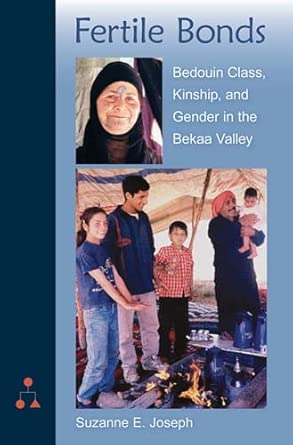
Fertile Bonds: Bedouin Class, Kinship, and Gender in the Bekaa Valley
Author(s): Suzanne E. Joseph (Author)
Publisher: University Press of Florida
Publication Date: 30 Sept. 2013
Edition: Illustrated
Language: English
Print length: 256 pages
ISBN-10: 0813044618
ISBN-13: 9780813044613
Book Description
“Provides rich new ethnographic material on a little-known population, the Bedouin of the Bekaa Valley in Lebanon. It positions such marginal populations in the broader theoretical context of modernization and health and demographic transitions.”–Allan G. Hill, Harvard University
With an average of over nine children per family, older cohorts of Bedouin in the Bekaa Valley of Lebanon have one of the highest fertility rates in the world. Many married couples in this pastoral community are close relatives–a socially advantageous practice that reflects the deep value Bedouins place on kinship.
To outsiders, such family norms can seem disturbing, even premodern. They attract assumptions of Arab “backwardness,” poverty, and sexism. Remarkably, Fertile Bonds flips these stereotypes. Anthropological demographer Suzanne Joseph shows that in this particular group, prolific birth rates coincide with moderate death rates and high levels of nutrition. Despite broader class differences between Bedouins and peasants, members of Bekaa Bedouin society rely heavily on kinship ties, sharing, and reciprocity and experience a high degree of social and demographic equality.
This story, unfamiliar to many, is one that is fading as traditional nomadic livelihoods give way to encapsulation within the state. With the help of this surprising, nuanced study–one of the first of its kind in the Middle East–knowledge of such marginalized pastoral groups will not vanish with the disappearance of their way of life. Joseph’s book expands our understanding of peoples far removed from consolidated government control and provides a broad analytical lens through which to examine demographic divides across the globe.
Suzanne E. Joseph is associate professor of anthropology at Zayed University, Abu Dhabi.
Editorial Reviews
Review
“Approaches Bedouin society in Lebanon from a novel angle. Emerging largely from participant observation and semi-structured interviews . . ., it tells a story from an under-researched perspective: women’s views on life, social reproduction, and social relations.”–Anthropos
“Challenges Western feminist views on gender and reproduction in the Third World, critiques ideas of Marx and Malthus on population and poverty, and argues for a nuanced understanding of fertility and bonding among people everywhere, but especially among the Arab agro-pastoralists at the core of this research.”–
Journal of the Royal Anthropological Institute
From the Back Cover
“Provides rich new ethnographic material on a little-known population, the Bedouin of the Bekaa Valley in Lebanon. It positions such marginal populations in the broader theoretical context of modernization and health and demographic transitions.”–Allan G. Hill, Harvard University With an average of over nine children per family, older cohorts of Bedouin in the Bekaa Valley of Lebanon have one of the highest fertility rates in the world. Many married couples in this pastoral community are close relatives–a socially advantageous practice that reflects the deep value Bedouins place on kinship. To outsiders, such family norms can seem disturbing, even premodern. They attract assumptions of Arab “backwardness,” poverty, and sexism. Remarkably, Fertile Bonds flips these stereotypes. Anthropological demographer Suzanne Joseph shows that in this particular group, prolific birth rates coincide with moderate death rates and high levels of nutrition. Despite broader class differences between Bedouins and peasants, members of Bekaa Bedouin society rely heavily on kinship ties, sharing, and reciprocity and experience a high degree of social and demographic equality. This story, unfamiliar to many, is one that is fading as traditional nomadic livelihoods give way to encapsulation within the state. With the help of this surprising, nuanced study–one of the first of its kind in the Middle East–knowledge of such marginalized pastoral groups will not vanish with the disappearance of their way of life. Joseph’s book expands our understanding of peoples far removed from consolidated government control and provides a broad analytical lens through which to examine demographic divides across the globe.
About the Author
Suzanne E. Joseph is associate professor of anthropology at Zayed University, Abu Dhabi.
 Wow! eBook