Wow! eBook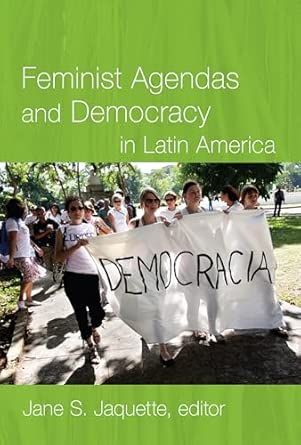
Feminist Agendas and Democracy in Latin America
Author(s): Jane S. Jaquette
- Publisher: Duke University Press
- Publication Date: 10 July 2009
- Language: English
- Print length: 272 pages
- ISBN-10: 0822344378
- ISBN-13: 9780822344377
Book Description
The book is organized around three broad topics. The first, women’s access to political power at the national level, is addressed by essays on the election of Michelle Bachelet in Chile, gender quotas in Argentina and Brazil, and the responses of the women’s movement to the “Bolivarian revolution” in Venezuela. The second topic, the use of legal strategies, is taken up in essays on women’s rights across the board in Argentina, violence against women in Brazil, and gender in the work of the Truth and Reconciliation Commission in Peru. Finally, the international impact of Latin American feminists is explored through an account of their participation in the World Social Forum, an assessment of a Chilean-led project carried out by women’s organizations in several countries to hold governments to the promises they made at international conferences in Cairo and Beijing, and an account of cross-border organizing to address femicides and domestic abuse in the JuÁrez-El Paso border region. Jane S. Jaquette provides the historical and political context of women’s movement activism in her introduction, and concludes the volume by engaging contemporary debates about feminism, civil society, and democracy.
Contributors. Jutta Borner, Mariana Caminotti, Alina Donoso, Gioconda Espina, Jane S. Jaquette, Beatriz Kohen, Julissa Mantilla FalcÓn, Jutta Marx, Gabriela L. Montoya, FlÁvia Piovesan, Marcela RÍos Tobar, Kathleen Staudt, Teresa ValdÉs, Virginia Vargas
Editorial Reviews
Review
“[A] powerful book on the women’s movement in Latin America. . . . This accessible and engaging text is a must read for undergraduate and graduate students in women’s studies, political science, and social sciences in general. Summing Up: Highly recommended. All readership levels.”–I. Coronado “Choice”
“All of the chapters are excellent in this volume. The authors are recognized feminist experts and academics and their penetrating analyses point out the strengths and limits of feminist strategies in the target nations. . . .
Feminist Agendas and Democracy in Latin America is a fascinating, well-organized volume that could be used in advanced undergraduate and graduate courses in feminist politics and history.”–Kathryn A. Sloan H-LatAm “H-Net Reviews”“In several respects, Jaquette has delivered another major contribution to the field, with nine high-quality case studies grouped under three sections. . . . [T]he chapters are excellent, all written by top feminist experts and academics, and providing up-to-date data and perspectives on feminist strategies and work in the region. . . .[
Feminist Agendas and Democracy in Latin America] is a very useful collection of works, and it nicely reveals the vitality of feminist movements and networks in Latin America.”–Stéphanie Rousseau “Perspectives on Politics”“This welcome update on the current state of the feminist agenda in the region is full of strong contributions. . . . Well worth the price of admission is the brilliant concluding chapter, in which Jaquette champions professional women working within their democratic political systems–to build bridges to government agencies, win legal redress through the courts, and provide life-sustaining social services.”–Richard Feinberg “Foreign Affairs”
“This is an important, timely, and fascinating examination of women, feminism, and democratization in Latin America. It is also a terrific read and another major contribution by Jane S. Jaquette, who has brought together a first-rate team of authors with extensive knowledge of the countries about which they write.”–
Valentine Moghadam, author of Globalizing Women: Transnational Feminist NetworksFrom the Back Cover
About the Author
Jane S. Jaquette is Bertha Harton Orr Professor in the Liberal Arts and Professor of Politics, Emerita at Occidental College in Los Angeles. A past president of both the Association for Women and Development and the Latin American Studies Association, she is the editor of Women and Gender Equity in Development Theory and Practice (also published by Duke University Press), Women and Democracy: Latin America and Central and Eastern Europe (with Sharon Wolchik), and The Women’s Movement in Latin America: Feminism and the Transition to Democracy.
Excerpt. © Reprinted by permission. All rights reserved.
Feminist Agendas and Democracy in Latin America
Duke University Press
Copyright © 2009 Duke University Press
All right reserved.
ISBN: 978-0-8223-4437-7
Contents
Acknowledgments………………………………………………………………………………………………………………………………………………..viiIntroduction Jane S. Jaquette…………………………………………………………………………………………………………………………………..11 Feminist Politics in Contemporary Chile FROM THE DEMOCRATIC TRANSITION TO BACHELET Marcela Ros Tobar……………………………………………………………….212 Gender Quotas, Candidate Selection, and Electoral Campaigns COMPARING ARGENTINA AND BRAZIL Jutta Marx, Jutta Borner, and Mariana Caminotti………………………………453 Feminist Activism in a Changing Political Context VENEZUELA Gioconda Espina………………………………………………………………………………………654 The Effectiveness of Legal Strategies in Argentina Beatrz Kohen…………………………………………………………………………………………………835 Violence against Women in Brazil INTERNATIONAL LITIGATION AND LOCAL ADVANCES Flvia Piovesan……………………………………………………………………….1136 Gender and Human Rights LESSONS FROM THE PERUVIAN TRUTH AND RECONCILIATION COMMISSION Julissa Mantilla Falcn……………………………………………………….1297 International Feminisms THE WORLD SOCIAL FORUM Virginia Vargas………………………………………………………………………………………………….1458 Social Accountability and Citizen Participation ARE LATIN AMERICAN GOVERNMENTS MEETING THEIR COMMITMENTS TO GENDER EQUITY? Teresa Valds and Alina Donoso…………………1659 Violence and Activism at the MexicoUnited States Border WOMEN, MIGRATION, AND OBSTACLES TO JUSTICE Kathleen Staudt and Gabriela Montoya………………………………..18610 Feminist Activism and the Challenges of Democracy Jane S. Jaquette……………………………………………………………………………………………….208Bibliography…………………………………………………………………………………………………………………………………………………..219Contributors…………………………………………………………………………………………………………………………………………………..243Index…………………………………………………………………………………………………………………………………………………………247
Chapter One
Feminist Politics in Contemporary Chile
FROM THE DEMOCRATIC TRANSITION TO BACHELET
Marcela Ros Tobar
The election of Michelle Bachelet as president of Chile on January 15, 2006, sparked unprecedented interest in the developments of gender relations and women’s political roles in the country. Her election was undoubtedly a historical milestone. The mass media and international observers alike emphasized the seeming paradox that her election constituted in what was perceived as one of Latin America’s most conservative countries. The result of the presidential election was deemed particularly puzzling in light of who the female candidate was and what she represented politically. She was no “ordinary” woman, but a longtime socialist militant, a recognized agnostic, and a divorced mother of three whose father had been imprisoned and killed during the military dictatorship and who had herself, together with her mother, survived torture, imprisonment, and exile. Moreover, Bachelet had followed a trajectory distinct from that of other women who had reached similar posts in the region. She was elected at the ballot box following an independent political career: she was not the widow or close family member of a notable male politician.
The debate that surrounded the presidential election positioned Bachelet’s life story and personal traits as the point of departure in tracing the evolution of political culture over the past two decades after the formal transition to democratic rule. Issues such as the significance of this event for the correlation of forces between the political left and right in the country, its relationship to more substantive cultural transformations, and the place of women in society became subject to heated debate before, during, and after the elections. Also passionately discussed were the impact of the women’s movement and the ideology of women’s rights and gender equality on electoral politics. Despite the influence and visibility of the women’s movement during the struggle to regain democracy, neither the mainstream media nor the male political establishment had ever paid so much attention to questions of women’s political representation, women’s leadership, and gender relations as they did during this election.
It is difficult to assess whether Bachelet’s election was the product of significant political and sociocultural transformations in Chilean society or of the particularities of a close and contentious electoral competition. Nor is there any consensus regarding the role played by feminism and the women’s movement in Bachelet’s election or in the development of her pro-women policy agenda. While some have argued that her election and platform directly resulted from three decades of feminist activism (and thus support the “cultural transformation” argument), others see only indirect and sporadic connections between an increasingly weak and relatively silent women’s movement and recent political developments.
This article addresses some of the above questions and tries to explain what made the election of a woman committed to gender equity possible in a country in which a once vibrant women’s movement has lost the preeminence it had during the transition from military rule. It does so by tracing the trajectory of feminist organizing and gender politics since the transition to democracy in 1990, including the transformation of feminist movement politics, as well as by analyzing the policies pursued by four consecutive center-left governments on gender issues. It argues that the latest victory of the leftist coalition, the Concertacin de Partidos por la Democracia (Coalition of Parties for Democracy), represents both continuity and significant changes in the way in which social democratic governments, which have generally taken a distant and demobilizing policy toward civil society actors, have related to feminist demands and organizations.
The policy agenda on gender issues has shifted and been invigorated by the election of a socialist woman to the presidency. But, contrary to what others have argued, this analysis suggests that feminist political mobilization had only an indirect influence on Bachelet’s election, largely through the long-term process of changing societal and cultural attitudes in ways consistent with Chile’s economic and social modernization. More egalitarian attitudes and interests have thus made it easier for women to run for office and gain the support of the electorate. Chilean feminism and feminists have had little impact on specific political developments and outcomes, however, with consequences for Bachelet’s presidency. Inequalities in the distribution of power and resources have left feminists to face major opposition from conservative forces with little support from progressive political actors such as left-wing parties. Moreover, internal divisions, professionalization, decentralization, and specialization, as well as a tenuous autonomy vis–vis the state and political parties have all played a role in weakening feminist voices in the political debate.
This weakness has left the initial efforts of the Bachelet government with little support from civil society in its efforts to promote gender parity against the resistance of entrenched conservatism. As a result, incumbent political elites have managed to defend their privileges while casting doubt on the president’s leadership capacity and failing to support the government’s efforts to move forward on issues of women’s sexual and reproductive rights and other gender issues.
The Political Opportunity Structure: Chilean Social Democracy and the Women’s Rights Agenda
The electoral triumph of left-wing candidates in several recent Latin American presidential elections-in Ecuador, Venezuela, and Nicaragua in 2006, and in Bolivia in 2005-constitutes one of the most significant political shifts in the region since the restoration of democratic rule. The latest electoral triumph of the Concertacin in January 2006 is the fourth consecutive victory of this center-left coalition, which has won every single election since the 1988 plebiscite that marked the end of the Pinochet regime. Thus the recent election in Chile is not part of a new wave of leftist victories. Bachelet was elected not by the left per se but by a center-left coalition, in which the Christian Democratic Party has historically played a strong role. Further the Concertacin did not significantly modify macroeconomic policies after the transition to democracy, continuing with a neoliberal agenda strongly criticized by the traditional left at home and abroad.
The fact that the government included a substantial part of the left in its governing coalition had an impact on feminist politics in Chile. The relationship that developed between the successive Concertacin governments and women’s organizations was not a product solely of the success of the left, but part of a broader process of democratization that deeply affected the opportunities and barriers faced by civil society organizations and influenced the decisions of many feminist activists to become involved in democratization processes. The sheer length of the Concertacin’s rule has magnified its effect on society, on state-society relations, and on civil society’s capacity to organize and negotiate vis–vis a strong and stable state and political party system. After seventeen years of uninterrupted rule, the Concertacin has held power as long as the military regime under Augusto Pinochet.
Yet unlike the social democratic government under Luiz Incio Lula da Silva (Lula) in Brazil, or under Hugo Chvez in Venezuela, the ruling Concertacin is not a strictly left-wing coalition. In the current government led by Bachelet, as well as in those led by the previous presidents Patricio Aylwin, Eduardo Frei, and Ricardo Lagos, the Christian Democratic Party has played a central hegemonic role, especially during the first two presidential terms, when it was the largest electoral party within the coalition and two of its members (Aylwin and Frei) held the presidency. The presence of a political party that identifies itself as a confessional organization that follows Catholic social doctrine and maintains close relations with the church hierarchy has limited the kinds of policies that Concertacin governments could pursue to advance women’s rights and gender equity, especially those perceived to be connected to “moral values” such as reproduction and family legislation. Indeed, the survival of the alliance that the traditional left has established with the Christian Democrats has been largely contingent on their mutual agreement to leave these divisive issues outside the policy agenda.
Despite this arrangement, small groups in all of the parties within the coalition have supported the demands put forward by the women’s movement during and after the transition. They were most successful in the first years after the return to formal democratic rule in the early 1990s. Responding to a demand posed by the women’s caucus within the Concertacin de Mujeres por la Democracia (Coalition of Women for Democracy), the government created the Servicio Nacional de la Mujer (SERNAM), which soon drafted a national Plan for Equal Opportunity for Women, designed and implemented specific social programs aimed at improving the living conditions of highly vulnerable groups of women, and supported legal changes to comply with the demands of the women’s movement, most notably a law that penalized domestic violence against women and legislation to eliminate formal discrimination against women in different spheres of life.
Advances did occur in women’s living conditions, most notably a sharp reduction in the level of poverty. Chile is the only country in the region that has been able to significantly reduce its poverty levels in the past two decades, lowering the percentage of the population that live under the poverty line from 38 percent in 1990 to 13.6 percent in 2006. In addition, maternal mortality rates have been cut in half and rank among the lowest on the continent; women’s average schooling has surpassed that of males, and women represent over half of all elementary, secondary, and university students. Most formal legal impediments to inequality have been eliminated from civil, criminal, and labor legislation. Specific social programs have been implemented to address the needs of specific groups of women, such as heads of households and agricultural seasonal workers. The original law criminalizing domestic violence was reformed in 2005 to increase penalties and better assist victims.
Despite these important advances, the pace of change on more controversial issues was glacial after the initial posttransition period. Fourteen years passed before Chile approved a new divorce law, in 2004, and most of the other major changes called for by the women’s movement during the struggle for democratization have not yet been met. Both feminist groups and inter-governmental organizations have called attention to the lack of progress toward gender equality in areas such as abortion, sexual education, teenage pregnancy, women’s political representation, labor-market participation, and affirmative-action measures to combat these and other problems of gender exclusion. The lack of progress is also evident in the Chilean state’s continued resistance to ratifying the Optional Protocol of the International Convention on the Elimination of All Forms of Discrimination against Women (CEDAW), as the majority of other Latin American countries have done.
This deadlock in Chile was evident in 1999 during the CEDAW’S twenty-first session. The United Nations committee set up to monitor progress on the goals set out in the convention found that “Chile’s women had played a leading role in the battle against the dictatorship and for human rights, yet they had no divorce law, were under-represented in decision-making positions and faced severe constraints in reproductive health.” A member of the committee also commented that “the Government of Chile was modern and thriving, so it should have no problem providing certain contraceptives, such as emergency measures, to women and girls who became pregnant, through rape, for example.” Abortion had been permitted for health reasons before 1990, but a few days before the formal transition to civilian rule, the military regime declared abortion illegal under all circumstances. This restrictive legislation remains in place.
Social democratic administrations have also had a problematic impact on women’s political organizing capacity. Concertacin governments have failed to promote or strengthen civil society actors in general and women’s groups in particular. They have tended to privilege technical exchanges with intermediary organizations such as professional NGOS or academic experts, rather than engage in political interaction with social movements and other forces in civil society (Ros Tobar 2003). This has further accentuated the internal divisions and fragmentation of feminist organizations and contributed to the growing isolation of grass-roots women’s groups, which are rarely invited to participate in professionalized exchanges between civil society and the state.
The relative stagnation of a women’s rights agenda that characterized Concertacin governments before the election of Bachelet cannot be attributed solely to the governing coalition’s unwillingness to act or to the inability of the feminist movement to mobilize society in support of its agenda. Both of these factors have indeed played a role, but they might have been overcome had there not been strong conservative opposition to policy advances on gender issues. Mala Htun (2003b) has emphasized the role of the Catholic Church in opposing such change through its close relations with Latin American governments. She observes that in the case of Chile, the ties between the church and the opposition-which later became the government-were strong, a situation that closed opportunities for action on the part of progressive actors on contentious moral issues such as abortion and divorce. Merike Blofield (2006) has also looked at the influence of the Catholic Church, but has highlighted the role income inequalities play in creating power differentials between feminists and their opponents. She argues that the political system in Chile is “status quo-oriented” due to the existence of a “high number of veto points (points at which legislation can be rejected or changed).” The economic and cultural resources at the disposal of conservative actors, the close links between the church and economic elites, and the lack of power and of support from progressive sectors received by feminists have all had a negative impact on the possibility of change.
The electoral institutions inherited from the authoritarian period have also had the effect of overrepresenting the political right and traditional political actors in key political institutions like Congress. This together with a system of legislative quorums makes it extremely difficult for the government to pass legislation without previous negotiation and compromise with the opposition. Add to this situation internal divisions within the Concertacin and the power and policy preferences of the Christian Democratic Party, and it is clear why the scope for action on gender policies was limited to areas of high-level consensus. Despite this difficult scenario, sectors in the feminist movement continued to collaborate with Concertacin governments to achieve goals that would have been impossible had the political right held power instead.
(Continues…)
Excerpted from Feminist Agendas and Democracy in Latin America Copyright © 2009 by Duke University Press. Excerpted by permission.
All rights reserved. No part of this excerpt may be reproduced or reprinted without permission in writing from the publisher.
Excerpts are provided by Dial-A-Book Inc. solely for the personal use of visitors to this web site.