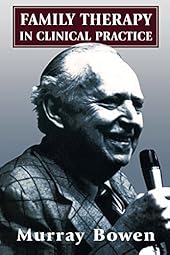
When Bowen was a student and practitioner of classical psychoanalysis at the Menninger Clinic, he became engrossed in understanding the process of schizophrenia and its relationship to mother-child symbiosis. Between the years 1950 and 1959, at Menninger and later at the National Institute of Mental Health (as first chief of family studies), he worked clinically with over 500 schizophrenic families. This extensive experience was a time of fruition for his thinking as he began to conceptualize human behavior as emerging from within the context of a family system. Later, at Georgetown University Medical School, Bowen worked to extend the application of his ideas to the neurotic family system. Initially he saw his work as an amplification and modification of Freudian theory, but later viewed it as an evolutionary step toward understanding human beings as functioning within their primary network–their family. One of the most renowned theorist and therapist in the field of family work, this book encompasses the breadth and depth of Bowens contributions. It presents the evolution of Bowens Family Theory from his earliest essays on schizophrenic families and their treatment, through the development of his concepts of triangulation, intergenerational conflict and societal regression, and culminating in his brilliant exploration of the differentiation of ones self in ones family of origin.
Editorial Reviews
Review
I highly recommend this rich, insightful, warm, and reflective book, not only to those interested in family therapy but to all who must consider the family nexus in their work with their patients or clients. -- Maurice R. Green
A stimulating theoretical exploration of the process of individual development within the family and the subsequent influence of this on society. [I] would recommend it as being of interest to professionals engaged in enabling individuation in various circumstances, from families [and] organizations to the elderly. -- James Atkinson
One of the fathers of family therapy, Murray Bowen is both a pioneer and a chronicler. In publishing his collected papers, he traces the development of his theory from his 1950s research on families of schizophrenics, to his experiment in differentiating himself from his own [professional] family, to his method of working with the family of origin rather than the nuclear family. His book is a historical treasure. -- Marianne Riché, Menninger Foundation
Paperback: 584 pages
List Price
Book Description
When Bowen was a student and practitioner of classical psychoanalysis at the Menninger Clinic, he became engrossed in understanding the process of schizophrenia and its relationship to mother-child symbiosis. Between the years 1950 and 1959, at Menninger and later at the National Institute of Mental Health (as first chief of family studies), he worked clinically with over 500 schizophrenic families. This extensive experience was a time of fruition for his thinking as he began to conceptualize human behavior as emerging from within the context of a family system. Later, at Georgetown University Medical School, Bowen worked to extend the application of his ideas to the neurotic family system. Initially he saw his work as an amplification and modification of Freudian theory, but later viewed it as an evolutionary step toward understanding human beings as functioning within their primary networkDtheir family. One of the most renowned theorist and therapist in the field of family work, this book encompasses the breadth and depth of Bowen's contributions. It presents the evolution of Bowen's Family Theory from his earliest essays on schizophrenic families and their treatment, through the development of his concepts of triangulation, intergenerational conflict and societal regression, and culminating in his brilliant exploration of the differentiation of one's self in one's family of origin. 页面提取自-Family Therapy in Clinical Practice 9781568210117.pdf
 Wow! eBook