 Wow! eBook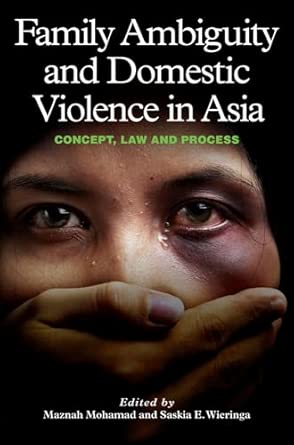
Family Ambiguity and Domestic Violence in Asia: Concept, Law and Process
Author(s): Maznah Mohamad (Editor), Saskia E Wieringa (Editor), Abha Bhaiya (Editor)
- Publisher: Liverpool University Press
- Publication Date: 6 Jun. 2013
- Language: English
- Print length: 256 pages
- ISBN-10: 9781845195557
- ISBN-13: 1845195558
Book Description
Editorial Reviews
About the Author
Saskia E. Wieringa is Professor at the University of Amsterdam. Her field of study includes women’s same-sex relations across cultures.
Excerpt. © Reprinted by permission. All rights reserved.
Family Ambiguity and Domestic Violence in Asia
Concept, Law and Process
By Maznah Mohamad, Saskia E. Wieringa
Sussex Academic Press
Copyright © 2013 Sussex Academic Press
All rights reserved.
ISBN: 978-1-84519-555-7
Contents
Preface by Series Editor Mina Roces,
Acknowledgements,
Introduction: Why the Book? Maznah Mohamad and Saskia E. Wieringa,
1 Domestic Violence: An Introduction to the Debates Saskia E. Wieringa and Maznah Mohamad,
2 Cultures of Violence and Silence Amrita Nandy,
3 Culture, Power and Narratives in Domestic Violence Law Zarizana Abdul Aziz,
4 Domestic Violence in the Harmonious Asian Family and the Enforcement of Heteronormativity in India and Indonesia Saskia E. Wieringa,
5 Domestic Violence and Migration in the Philippines: Transnational Sites of Struggle and Sacrifice Cheryll Alipio,
6 Investigating Intimate Violence: A Problem of Law Narayanan Ganapathy,
7 Malaysia’s Domestic Violence Law: An Epic Passage, and the Clash of Gender, Cultural and Religious Rights Maznah Mohamad,
8 The Indonesian Family as a Contested Site of Women’s Rights: Implementation of the Domestic Violence Act Nursyahbani Katjasungkana,
9 Reflections on Domestic Violence as Gender-Based Violence in European Legal Developments Renée G. Römkens,
The Editors and Contributors,
Index,
CHAPTER 1
Domestic Violence
An Introduction to the Debates
Saskia E. Wieringa and Maznah Mohamad
Violence Against Women (VAW), including Domestic Violence (DV), its most prevalent form, is a human rights and a women’s rights concern as well as a public health issue. DV is generally underreported, ongoing and pervasive, though both prevalence and forms may be context specific. In an unequal gender regime, where DV is both an effect of women’s subordination and an instrument to maintain it, victims are often blamed or they blame themselves for the violence they experience. Such a situation has compelled officials of the United Nations (UN), including the office of the Secretary-General, to recognize domestic violence as “one of the most pervasive and pressing human rights concerns faced by the international community” (Meyersfeld 2010: vii). Reliable statistics being rare, a rough estimate has it that in 1999, one in three women at some stage in their lives experienced a form of VAW. This figure, by Heise and others (1994), has been widely quoted as a window to the gravity of the problem (see also Garcia-Moreno, Heise, Jansen, Ellsberg and Watts 2005). Apart from direct economic costs (loss of work time, costs for health services), the high human and emotional costs warrant urgent attention. Yet, at the national level, DV is still often seen as a private concern, not deserving of systematic state attention. Therefore, committed scholarship must persist in mapping the problem and analyzing issues of prevention, advocacy and resolution.
The discourse on VAW and DV in most countries is significantly initiated and shaped by the women’s movement (see Htun and Weldon 2012 and chapters by Mohamad, Katjasungkana and Römkens in this volume). Since the 1970s, activists and researchers have underscored the serious consequences of this most prevalent form of violence that many women experience. Human rights institutes and public health officials have also taken up the issue and play an increasingly important role in both research and policy making. However, a great variation in levels of prevalence — due to underreporting, differences in research methods, definitional concepts and sampling techniques — has made it difficult to establish actual prevalence rates of DV in any context. For instance, on the basis of an analysis of over 50 population-based surveys, Watts and Zimmerman report that between 10 and 50 percent of women who have ever had partners have experienced physical violence by an intimate partner at some point in their lives (2002: 1233). This wide variation indicates serious methodological discrepancies. Nevertheless, a comparative overview of figures indicating women’s experience of domestic violence has demonstrated its widespread prevalence in both developed and developing societies (see Yount and Carrera 2006: 356).
In Asia, although relative numbers of those abused may vary from one regional or national context to the other, there is still a common thread — that women are the most vulnerable targets of violence within their own homes (see Koenig et al. 2004). Although there are numerous studies that have attempted to find the causal link between the preponderance of domestic violence and factors such as poverty, lack of female education, religious values or access to credit (see for example, Bates et al. 2004), none have conclusively established the root cause of the problem. Still, there is widespread agreement among researchers, activists and concerned policy makers that VAW is a social bane in need of analysis and solution and that the only sure protection for women against violence is the improvement of their social status (Jewkes 2002). Their status is related to patriarchal systems. A broad study of various forms of direct, indirect and structural forms of violence against women in Asia pointed to the prevalence of patriarchal notions of honour, shame and sexual purity linked to VAW (Manderson and Bennett 2003). Most recent research and policy making has concentrated on assessing the substantive harm and social costs that domestic violence has imposed upon society.
Discourses on DV
Domestic violence arose as a major issue in the wake of a so-called second wave of feminism. In the West, slogans coined by feminists, such as “the personal is political”, stimulated women to speak out about their sufferings and shame and revealed the family to be an institution capable of covering up and justifying violence. Brownmiller’s claim that rape is nothing more or less than a conscious process of intimidation by which all men keep all women in a state of fear (1975) highlighted the ubiquity of private and public VAW. In consciousness-raising groups, women discovered that the protective sanctuary of the home is also the most dangerous place for many women. The discovery that the perpetrators of sexual violence were not just unknown rapists but were more likely to be intimate partners came as a shock. From the mid-1970s, interpersonal violence could no longer be recognized as a private problem that was the misfortune of select women being battered by select dysfunctional men.
By politicizing DV, the women’s movement succeeded in redefining the public–private divide, making it possible to conceptualize DV as a human rights issue related to bodily integrity and the right to autonomy. Resolution of such violence then is no longer a private affair, but a state concern, extending to international law. The right to be free from intimate harm has since become a “steady theme in international law” (Meyersfeld 2010: 316). However, intimate partner violence is still not incorporated systematically into mainstream international affairs and legislation. An issue of contention is the compatibility of human rights with group cultural rights, the touchstone of the latter being gender-based inequalities (and of homophobia), according to some of their proponents. However, the contention over this position only shows that cultural or religious norms can never be endorsed as an excuse for injury (see Aziz in this volume). In fact, the failure of some states to comply with anti -VAW laws can be seen as complicity, especially their acts of omission in not taking adequate steps to prevent the risk of violence among the vulnerable (Meyersfeld 2010: 206).
During the first few decades of the second wave of the women’s movement in the West, VAW was seen as a single issue related to women’s subordination. Its interconnections with other variables in women’s lives, such as class, caste, sexual orientation, ethnicity and religion were often ignored. Crenshaw (1991) was among the first authors to point to the danger of white women essentializing the category of woman in the discourse on VAW, just as antiracist politics tended to essentialize racism as the problem of Black men. Since then, many authors (Collins 2000, Lockhart and Danis 2010, to name a few) have enriched our understanding of the complexities of identity politics. Single-issue solidarity politics gave way to strategically informed affinity politics (Wieringa 2009). The emphasis on intersectionality allows researchers and practitioners to understand the unique experiences of each victim of violence within a multi-layered context of individual and psychological traits intersecting with social, cultural, political and religious relations. In this way, both systemic oppression and marginalization, resulting from multiple, imbricating levels of subordination and the individual situation of the victims of gender-based violence can be understood. This avoids simplistic single-factor analyses and allows for an exploration of the various pathways to empowerment. Different levels of education and social and economic status, for instance, bring with them specific forms of social capital that survivors can draw upon. As Brah and Phoenix (2004) stress, the diverse identities of people cannot be separated into discrete and pure strands. One element (poverty or sexual orientation) is always inseparably interlocked with other elements that make up the complex, unique configurations of our subjectivities and identities.
In the global South, DV arose as an issue linked to various factors. In several countries, including Argentina, Brazil, Chile and Indonesia, attention was drawn to VAW in the context of struggles against military dictatorships. As women mobilized to fight state repression, they also decided it was time to end the violence they experienced in their homes. The end of apartheid in South Africa brought with it the political realization that violence within the home was as unacceptable as violence against citizens on the streets.
DV as human rights violation
Another impetus for global debates on VAW came from the UN Decade for Women (1986–1995) and the mobilization of women worldwide on the basis of human rights and development. Women’s NGOs in the global South were originally set up to stimulate increased participation of women in development, but had already identified VAW in their early days as being a major impediment to women’s progress (Yudelman 1987). Interestingly enough, at that time gender and development theorists, predominantly from the West, largely ignored such “personal” issues as DV and sexuality (Wieringa 1994).
Feminist global activists, however, argued for the recognition of VAW as a human rights issue. As Bunch passionately argued:
Significant numbers of the world’s population are routinely subject to torture, starvation, terrorism, humiliation, mutilation, and even murder simply because they are female. Crimes such as these against any group other than women would be recognized as a civil and political emergency as well as a gross violation of the victim’s humanity. Yet, despite a clear record of deaths and demonstrable abuse, women’s rights are not commonly classified as human rights. (1991: 3)
Or, as Ashworth had noted a few years earlier: “violence against the female sex, on a scale which far exceeds the list of Amnesty International victims, is tolerated publicly; indeed some acts of violation are not crimes in law, others are legitimized in custom or court and most are blamed on the victims themselves” (1986:8).
In 1979, the Convention on the Elimination of All Forms of Discrimination Against Women (CEDAW) was adopted by the UN General Assembly. Unfortunately, CEDAW has no specific clause on domestic violence although it addresses many issues of discrimination against women. The UN officially recognized VAW in 1992, when the CEDAW Committee recommended (Resolution 48-104) that periodic country reports should include information about the prevalence of VAW and the measures being taken to protect women.
Since it is a convention, CEDAW is similar to state law for the countries that have ratified it — to date, over 180. This is unlike documents with more far-reaching feminist language, such as the 1995 Beijing Platform for Action (reconfirmed in the Beijing +15 conference in 2010). Unfortunately both CEDAW and the Beijing PFA are among the many documents built on international consensus that governments can put aside once they have pocketed the international goodwill that comes from signing it. CEDAW has legal legitimacy although it has no formal means of enforcement. It can only shame, not bully, countries into compliance. However, as Merry (2003) argues, it is instrumental in fostering a process of cultural change where women’s human rights require legitimacy at the local level. It does so primarily through the periodic reports countries are required to submit. Civil society is actively involved in this review process by the presentation of “shadow reports” at CEDAW meetings, hence providing the “checks and balances” to government reports.
It was due to persistent feminist pressures that the Second World Conference on Human Rights in 1993 addressed VAW as a serious international concern. The United Nations High Commissioner for Human Rights defined VAW in 1993 as:
any act of gender-based violence that results in or is likely to result in physical, sexual or psychological harm or suffering to women, including threats of such acts, coercion or arbitrary deprivation of liberty, whether occurring in public, or in private life, and including domestic violence, crimes committed in the name of honour, crimes committed in the name of passion, trafficking in women and girls, traditional practices harmful to women, including female genital mutilation, early and forced marriages, female infanticide, dowry-related violence and deaths, acid attacks and violence related to commercial sexual exploitation as well as economic exploitation. (quoted in Wies and Haldane 2011: 2)
The European Court of Human Rights followed suit as recently as 2009, while the European Council is only now working on a convention to address VAW as a form of gender discrimination. In Asia, the rise of international and regional networks of women’s NGOs such as the International Women’s Rights Action Watch of the Asia-Pacific (IWRAWAP) and the Asia-Pacific Women in Law and Development (APWLD) have facilitated the exchange of information on VAW and strategies to combat it. Recently, ASEAN has begun paying more attention to VAW issues (UNIFEM 2009) and to human rights issues in general. However, there is great concern among feminists about the wording of the ASEAN Human Rights Declaration which was recently endorsed by leaders of the 10- member association in Cambodia in November 2012. Critics, consisting of some 50 civil society groups, including Human Rights Watch and Amnesty International pointed to clauses which could open up room for human rights violation in the name of national security, public order and public morality, among others (Kozlovski 2012). Before this the Women’s Caucus of ASEAN had already circulated a petition to strike out the “public morality” clause from the Declaration. Members of the caucus feared that the introduction of “public morality” as a collective interest limits human rights and will eventually be used to deny women’s human rights, especially sexual and reproductive health rights.
Over the last decade, the Millennium Development Goals (MDGs) have also provided a major impetus for development issues. International and national actors have committed to reach a number of goals by 2015, including steps to diminish gender inequality. The MDGs stipulate that the UN and all its member states recognize that equal rights and opportunities for women and men are a prerequisite for human development. This entails that VAW must be addressed within the agendas for health, development, equality and human rights.
If VAW is seen as a human rights issue by the very nature of the human rights instruments that it is subjected to, it readily becomes a public issue. However, human rights concepts need to be translated into relevant policies and national laws for them to become effective. In this regard, the main human rights principles applicable in the context of VAW are freedom of expression, protection from violence and the guarantee of personal security.
(Continues…)Excerpted from Family Ambiguity and Domestic Violence in Asia by Maznah Mohamad, Saskia E. Wieringa. Copyright © 2013 Sussex Academic Press. Excerpted by permission of Sussex Academic Press.
All rights reserved. No part of this excerpt may be reproduced or reprinted without permission in writing from the publisher.
Excerpts are provided by Dial-A-Book Inc. solely for the personal use of visitors to this web site.


