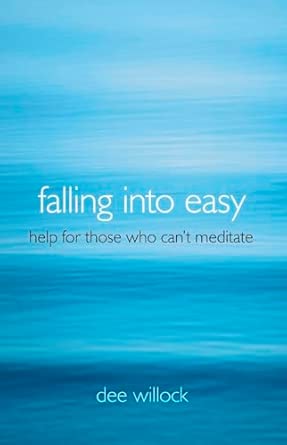
Falling Into Easy
Help For Those Who Can't Meditate By Dee Willock
O BOOKS
Copyright © 2011 Dee Willock
All right reserved.
ISBN: 978-1-78099-026-2
Contents
Foreword..................................................xIntroduction..............................................1Chapter One – How It Started........................2Chapter Two – Watching..............................11Chapter Three – Stepping Back.......................43Chapter Four – Stepping In..........................79Chapter Five – So Where Are We?.....................110Reference Guide...........................................116Notes.....................................................127
Chapter One
How It Started
I woke up one morning from a dream that had two prevailing messages. The first was that my car was out of oil and the second was that I should teach meditation. As I rolled over in bed pondering these messages, I felt a stabbing pain in my right wrist and remembered that I had somehow sprained it lifting boxes in the basement the night before. I got up, wrapped my wrist for the day and wondered if my car really was out of oil. When I got to my car, I realized that I couldn't lift the hood because that would require two fully-functioning hands. So I carefully and awkwardly drove to the closest gas station. When I pulled up to the pump, a service man arrived at the window with a big smile on his face, proudly displaying his nametag which read, Bud. I let Bud know about the possible oil situation. As Bud struggled to open the hood (tricky lever) I got out of the car to offer support. There we both were, leaning over the engine looking for the dipstick. As I pointed to the obscure location of the stick, Bud turned his head and looked straight at me and said, "I'm in a lot of pain. I have had three heart surgeries and haven't found a way to handle the pain. I was thinking of trying meditation but I don't know how to do that." Then he wiped the dipstick and said, "You need oil all right, there is none in your engine!" I stood still for a moment watching his face. Did he just say that? Then I thought, What I should do first? Go inside and purchase a few quarts of oil, or teach him how to meditate? I chose the latter.
I told Bud that when he got home, he should find a comfortable place to sit or lie, and just watch how he was breathing, and how his body moved as he breathed. Then he could take note of any thoughts that distracted him from his focus on the breath. If he found that some thoughts were so strong they stopped him from noticing his breath, he could write them down on a piece of paper, and then go back to noticing what his breath was doing. I told him that this watching of the breath was the first of a few steps to help him gain a little distance from the pain. Bud said with excitement that he would go right home, get his pen and paper, and really work at it. I said, "No, don't think of this as work. See if you can find a way to make it easy, so you can look forward to it." He nodded and said, "Right," and headed off to the next car at the pump.
I thought about Bud all the way home. Bud had heard of meditation but didn't really know what it meant or how to do it. What he did know was that he wanted a way to handle his pain and find some ease in his life. And if you are like Bud, you may be holding out hope that there is some help, some way of easing out of your struggle. You may be hearing a little voice in your head telling you that there has to be another way. Well, there is help and it is close at hand. It sits just below the surface of our awareness as a kind of stillness that will reveal itself as the relief we want. It is lying in wait, only a few degrees from where we are right now. But first, let's begin by taking a closer look at the idea of meditation itself.
A New Look
The notion of meditation can be loaded with images of discipline, structure, commitment, restriction and a whole lot of shoulds. And the idea of having one more should is enough to stop us from developing a practice we can love. The thought of more hard work ahead is just too sad. And, realistically, if we were left in a quiet room with traditional meditation instructions, we would probably end up at the beach, or in front of our computers, or suddenly having to do some very important laundry. Instead, we want to somehow find a way to look forward to meditation. We hope to be saying, I want to meditate not I should meditate. We want to find a way to unhinge, to fall away and to land ... and then discover the amazing richness that we suspect has been here, in us, all along. And guess what? Where we land actually ends up being just here, in this present moment.
What is the present moment exactly? Initially we see it as a concept that lies right smack in the middle of past and future: a little pocket of time that we don't often notice except when it grabs our attention. For a few seconds we are in the present moment when we step off the plane into a foreign country, or when a child is born, or when we receive a call from the doctor asking us to come in for test results. Suddenly, we take everything in, right then. We are so awake that we can almost feel the moment on the tips of our fingers as we rub them together – the moment, just as it is. Our journey now is to obtain this acute aliveness without having to travel, constantly produce children, or regularly receive shocking news.
Our journey is also about being in our world in a new way – a way that will help us sit in a place that is big enough to allow us to breathe freely and see clearly. The little voice in your head is right. There is an easier way. In this new place, we are less reactive, have less fear and anxiety, and can handle physical pain in a new way. We begin to allow layers of compassion, tolerance and quiet reflection to rise to the surface. We release the habits that keep us circling and circling the same old wagon; habits that have been with us forever. Avoidance, repression or reaction have become the norm, and have isolated us from some sort of truth we suspect is at hand. And, in this isolation, we have a tendency to dissociate from the present moment.
Escape
Many of us dissociate and disconnect. Any trauma we have experienced – big or small, childhood or recent – can make us want to escape from feelings or sensations we are experiencing. We have the tendency to leave the present moment by eating, drinking, consuming, repressing or ignoring. Or we cope with our discomfort by shielding and deflecting, as though we are holding our arms over our brows as we walk through the streets.
Shantideva, a spiritual teacher from 8th century India, describes this tendency in one of his many teachings. Shantideva taught that when our life around us is uncomfortable, we feel as though we are walking around all day over hot pavement and sharp stones without any shoes on. We feel every disturbance. We are irritated by noises, smells and sights as well as conversations and opinions. We want to avoid the hot pavement and sharp stones. We want to cover over those things that disturb us. Our attempt to protect ourselves is like trying to cover everything around us with big pieces of leather – our yards, our neighborhoods, our work places, and our lives – all covered with leather so...
 Wow! eBook