Author(s): Frederick D. Seward (Author), Philip A. Charles (Author)
Publisher: Cambridge University Press
Publication Date: November 24, 1995
Language: English
Print length: 414 pages
ISBN-10: 0521437121
ISBN-13: 9780521437127
Book Description
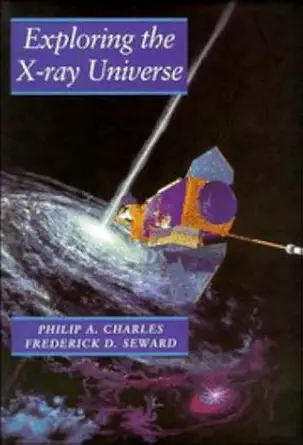
Exploring the X-Ray Universe describes the view of the stars and galaxies that is obtained through X-ray telescopes. X-rays, which are invisible to human sight, are created in the cores of active galaxies, in cataclysmic stellar explosions, and in streams of gas expelled by the Sun and stars. The window on the heavens used by the X-ray astronomers shows the great drama of cosmic violence on the grandest scale. This account of X-ray astronomy incorporates the latest findings from several observatories operating in space. These include the Einstein Observatory operated by NASA, and the EXOSAT satellite of the European Space Agency. The book covers the entire field, with chapters on stars, supernova remnants, normal and active galaxies, clusters of galaxies, the diffuse X-ray background, and much more. The authors review basic principles, include the necessary historical background, and explain exactly what we know from X-ray observations of the Universe.
Editorial Reviews
Book Description
The one-stop general book on the whole of X-ray astronomy.
Author(s): Frederick D. Seward (Author), Philip A. Charles (Author)
Publisher: Cambridge University Press
Publication Date: October 27, 1995
Language: English
Print length: 414 pages
ISBN-10: 0521261821
ISBN-13: 9780521261821
Book Description
Exploring the X-Ray Universe describes the view of the stars and galaxies that is obtained through X-ray telescopes. X-rays, which are invisible to human sight, are created in the cores of active galaxies, in cataclysmic stellar explosions, and in streams of gas expelled by the Sun and stars. The window on the heavens used by the X-ray astronomers shows the great drama of cosmic violence on the grandest scale. This account of X-ray astronomy incorporates the latest findings from several observatories operating in space. These include the Einstein Observatory operated by NASA, and the EXOSAT satellite of the European Space Agency. The book covers the entire field, with chapters on stars, supernova remnants, normal and active galaxies, clusters of galaxies, the diffuse X-ray background, and much more. The authors review basic principles, include the necessary historical background, and explain exactly what we know from X-ray observations of the Universe.
Editorial Reviews
Book Description
The one-stop general book on the whole of X-ray astronomy.
 Wow! eBook