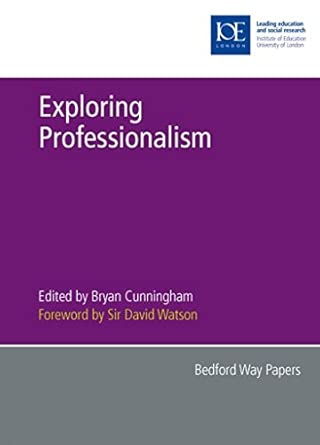
Author(s): Bryan Cunningham (Editor), Professor Sir David Watson (Foreword), Deborah Andrews (Contributor), Stephen J. Ball (Contributor), Ronald Barnett (Contributor), Penny Jane Burke (Contributor), David Crook (Contributor), Christine Edwards (Contributor), Ingrid Lunt (Contributor), Louise Morley (Contributor), Sally Power (Contributor), Geoff Whitty (Contributor)
Publisher: Institute of Education
Publication Date: 1 Sept. 2008
Language: English
Print length: 224 pages
ISBN-10: 0854738053
ISBN-13: 9780854738052
Book Description
Exploring key issues in professional life such as how we define ourselves, how we learn as professionals, and what impact current changes and challenges are having on the nature of professional work, this book will offer a rounded selection of perspectives on professional life, as offered by some of the UK’s most distinguished scholars in the field. Featuring contributions from leading academics and specialists, this book will be useful to those individuals who are embarking on or already engaging in work on a professional doctorate, while also appealing to a broader readership who are interested in the range of issues affecting professionals who work in education, in its most all-embracing sense.
Editorial Reviews
Review
This book has much to say about professionalism in other professions, from which academics can profit if they themselves want to achieve a greater professionalism. — Lewis Elton, University of Gloucestershire ― Times Higher Education Published On: 2009-04-01
The inclusion of this title in core or recommended reading lists for academic courses focussing on professional learning is worthy of consideration. — Dr June Mitchell, University of Strathclyde ―
Education Today
Review
These are testing times for the professions. They are widely regarded politically as roadblocks to modernisation and reform and governments have legislated accordingly. As a consequence of this, we have seen the steady incorporation of professionalism into managerialism as a mode of organising work in complex social and economic systems. It is thus an appropriate time to give deep consideration to the future of the professions. This has been admirably fulfilled in this collection. The issues of professional knowledge, institutions, power, ethics, work-patterns and identities are explored afresh in this scholarly work. — Eric Hoyle ― University of Bristol
About the Author
Bryan Cunningham is Director of Quality Assurance and Enhancement in the Institute of Education, University of London’s Faculty of Policy and Society. He also leads the EdD module ‘Foundations of Professionalism’. He was formerly course leader for the master’s in teaching and learning in higher and professional education.
Deborah Andrews has worked in or around education since graduating in English from Oxford in the 1970s. She went from educational publishing into teaching and, since completing her doctorate at the Institute of Education, University of London, where her supervisor was Bryan Cunningham, has worked in widening participation in higher education, first at King’s College London and now at Queen Mary University of London, where she is Peer Mentoring Coordinator.
Stephen J. Ball is Karl Mannheim Professor of the Sociology of Education at the Institute of Education, University of London. His work is in ‘policy sociology’ and he has conducted a series of ESRC-funded studies which focus on issues of social class and policy. His publications include Education Plc (Routledge, 2007) and Education Policy and Social Class (Routledge, 2006), and with Carol Vincent, Childcare Choice and Class Practices (Routledge, 2005).
At the time of publication, Ronald Barnett was Pro-Director for Longer Term Strategy and Professor of Higher Education at the Institute of Education, University of London. His work has been principally that of developing a social philosophy of higher education. His books include A Will to Learn: Being a student in an age of uncertainty (OUP, 2007); The Idea of Higher Education (OUP, 1990); and Realizing the University in an Age of Supercomplexity (OUP, 2000), among others.
At the time of publication, Penny Jane Burke was Head of Department of Educational Foundations and Policy Studies at the Institute of Education, University of London. She was course tutor on the MA in higher and professional education, which offers a broad approach to understanding changes in higher education in relation to interdisciplinary theoretical frameworks, policy developments and professional practices. She was also the Chair of the Institute’s Widening Participation Committee.
 Wow! eBook