 Wow! eBook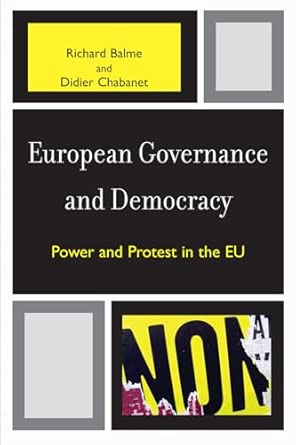
European Governance and Democracy: Power and Protest in the Eu
Author(s): Richard Balme (Author), Didier Chabanet (Author)
- Publisher: Rowman & Littlefield
- Publication Date: 30 April 2008
- Language: English
- Print length: 286 pages
- ISBN-10: 0742529347
- ISBN-13: 9780742529342
Book Description
Editorial Reviews
Review
This is a book well worth reading both for its contributions to EU studies and research on contentious activity. It raises important questions of political action in systems of complex governance. . . . European Governance and Democracy represents the fusion of two distinct research areas: the politics of the European Union (EU) and how social movements/interest groups attempt to influence the political process. This fusion offers new opportunities to study processes of political mobilization in a multilevel, complex system of governance. It also illustrates the challenges of studying mobilization processes in such an environment. The book is well-rooted in both literatures. ―
MobilizationThis book, by two leading French scholars of collective political action, offers a bold and comprehensive study of interest group and protest politics at the European level. The combination of a cross-national structural analysis with a longitudinal comparison of a selected set of policymaking processes allows the authors to uncover the fundamental dynamics of European decision making. They show the complex multilevel mix of these processes, their sectoral compartmentalization, and, most importantly, their politicization. If European decision making now reaches beyond the arcane bureaucracies to which it was originally confined, the analysis, however, also points out that it keeps favoring those groups who already have a long-established record of influence at the national level. — Hanspeter Kriesi, University of Zurich
European institutions and traditional forms of democratic participation have attracted a lot of scholars’ attention, while collective action and social movements directed against the EU, with a few exceptions, have suffered from benign neglect. This book sheds new light on the European dream (for some) or nightmare (for others). The disconnection of EU regulatory powers from distributive or redistributive policies is a powerful trigger for political mobilization. This division of tasks has been a comfortable buffer for the Brussels elite for some time. In the long run it could become ‘the kiss of death.’ — Yves Mény, European University Institute
A gem. The book crisply sets out the relationship between European governance structures and collective political action and explores the implications of this relationship for the future of democracy in Europe. I don’t know of any other work that takes on these important questions so comprehensively or successfully. It will quickly become a well-thumbed reference to European democracy. — Doug Imig, University of Memphis


