 Wow! eBook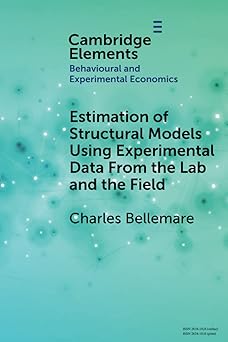
Estimation of Structural Models Using Experimental Data From the Lab and the Field (Elements in Behavioural and Experimental Economics)
by: Charles Bellemare (Author)
Publisher: Cambridge University Press
Publication Date: 2023-02-09
Language: English
Print Length: 82 pages
ISBN-10: 1009362631
ISBN-13: 9781009362634
Book Description
Behavioral economics provides a rich set of explicit models of non-classical preferences and belief formation which can be used to estimate structural models of decision making. At the same time, experimental approaches allow the researcher to exogenously vary components of the decision making environment. The synergies between behavioral and experimental economics provide a natural setting for the estimation of structural models. This Element will cover examples supporting the following arguments 1) Experimental data allows the researcher to estimate structural models under weaker assumptions and can simplify their estimation, 2) many popular models in behavioral economics can be estimated without any programming skills using existing software, 3) experimental methods are useful to validate structural models. This Element aims to facilitate adoption of structural modelling by providing Stata codes to replicate some of the empirical illustrations that are presented. Examples covered include estimation of outcome-based preferences, belief-dependent preferences and risk preferences.
Editorial Reviews
Behavioral economics provides a rich set of explicit models of non-classical preferences and belief formation which can be used to estimate structural models of decision making. At the same time, experimental approaches allow the researcher to exogenously vary components of the decision making environment. The synergies between behavioral and experimental economics provide a natural setting for the estimation of structural models. This Element will cover examples supporting the following arguments 1) Experimental data allows the researcher to estimate structural models under weaker assumptions and can simplify their estimation, 2) many popular models in behavioral economics can be estimated without any programming skills using existing software, 3) experimental methods are useful to validate structural models. This Element aims to facilitate adoption of structural modelling by providing Stata codes to replicate some of the empirical illustrations that are presented. Examples covered include estimation of outcome-based preferences, belief-dependent preferences and risk preferences.


