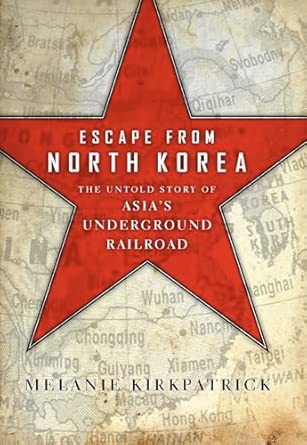
Escape from North Korea: The Untold Story of Asia's Underground Railroad
Author(s): Melanie Kirkpatrick (Author)
Publisher: Encounter Books
Publication Date: 1 Nov. 2012
Edition: Illustrated
Language: English
Print length: 376 pages
ISBN-10: 1594036330
ISBN-13: 9781594036330
Book Description
From the world’s most repressive state comes rare good news: the escape to freedom of a small number of its people. It is a crime to leave North Korea. Yet increasing numbers of North Koreans dare to flee. They go first to neighboring China, which rejects them as criminals, then on to Southeast Asia or Mongolia, and finally to South Korea, the United States, and other free countries. They travel along a secret route known as the new underground railroad.
With a journalist’s grasp of events and a novelist’s ear for narrative, Melanie Kirkpatrick tells the story of the North Koreans’ quest for liberty. Travelers on the new underground railroad include women bound to Chinese men who purchased them as brides, defectors carrying state secrets, and POWs from the Korean War held captive in the North for more than half a century. Their conductors are brokers who are in it for the money as well as Christians who are in it to serve God. The Christians see their mission as the liberation of North Korea one person at a time.
Just as escaped slaves from the American South educated Americans about the evils of slavery, the North Korean fugitives are informing the world about the secretive country they fled.
Escape from North Korea describes how they also are sowing the seeds for change within North Korea itself. Once they reach sanctuary, the escapees channel news back to those they left behind. In doing so, they are helping to open their information-starved homeland, exposing their countrymen to liberal ideas, and laying the intellectual groundwork for the transformation of the totalitarian regime that keeps their fellow citizens in chains.
Editorial Reviews
Review
With the perfect, hypnotic flow of a consummate journalist, Melanie Kirkpatrick has created an encyclopedic, magnificently researched and reported portrait of the dramatic resistance to the slow-motion holocaust that is taking place in North Korea as you read this. Her account is as captivating as a thriller, but unlike a thriller it is morally compelling. What elevates it to the ranks of the finest books is the skill of its author and the selfless urgency of her appeal. Many a prize has been awarded to books not half as deserving.” Mark Helprin, Author of Winter’s Tale and A Soldier of the Great War
Escape from North Korea should be assigned reading for anyonepolicymaker, academic, or journalist alikewho think they know anything about the Kim family dictatorship. Melanie Kirkpatrick shows how the new Underground Railroad” is not only providing an escape route from the prison camp that is North Korea, but something even more important as well. She shows how that escape route, aided and expanded, can bring down North Korea’s despotic regime and free its entire people. Kirkpatrick combines exhaustive reporting with insightful analysis in a powerful and compelling tale of repression and freedom.” John R. Bolton, Former U.S. ambassador to the United Nations
A riveting, meticulously researched account of the harrowing journey North Koreans must take to reach freedom. Kirkpatrick describes in detail the secret network of safe houses, transit routes and brokers that have emerged in China and other countries to enable North Koreans to escape. Similar to the Underground Railroad in the United States that liberated slaves, the network achieves inspiring successes and tragic failures. The book will interest both the general public and serve as a powerful tool for policymakers, academics and advocates interested in lending support to one of the world’s most persecuted people.” Roberta Cohen, Co-chair of the Committee for Human Rights in North Korea
About the Author
Melanie Kirkpatrick is a journalist, writer, and senior fellow at the Hudson Institute. She was deputy editor of the editorial page of The Wall Street Journal, where she was a longtime member of the editorial board and op-ed editor. She lives in rural Connecticut with her husband, Jack David.
When Joseph reached the other side of the Tumen River, he scrambled up the bank and lay very still for a few minutes, his face pressed against the frozen ground. He waited to hear boots come crashing toward him and feel hands grab him under the shoulders, wrench him to his feet and haul him off to a police station. But nothing happened. No boots, no hands, no police. Everything was quiet. Once his heart finally stopped pounding, he lifted his head, looked around and scrutinized the Chinese village he had observed from the North Korean side of the river. He decided to go there to beg for food.
Eventually he pulled himself to his feet and set off toward the nearest house. He knocked on the door, forced himself to smile and made his pitch to the woman who answered. She shook her head and shut the door. He continued to the next house and then the next, each time receiving the same reply: We can’t help you. After being turned away from a dozen houses, Joseph finally found a welcome. A man opened his door wide, invited him inside and gave him a meal. Joseph noticed that despite his generosity, the man did not appear to be any richer than the villagers who had turned him away. The man spoke Korean, and in the course of conversation he told Joseph that he was a Christian.
As Joseph was departing, the Good Samaritan advised him to walk along the bank of the Tumen River until he came to a bigger town, where, the Christian said, he would be more likely to find help. Joseph set off for the town, but night was falling and he stepped off the path and into the woods, looking for a dry place to lie down and rest. He slept for a few hours stretched out on the ground near a fire he lit with matches he fortunately had happened to bring with him. He reached the town the next afternoon and poked around until he discovered an abandoned house. The house became his home for the next three weeks. He hid there during the day, slept on the floor of a closet at night, and ventured outside in the morning and evening to beg for food. On one of his begging missions, he met an old woman who spoke Korean. If you need help, she said, go to a church. Church people help North Koreans.
What’s a church?” Joseph asked.
Look for a building with a cross on it,” the woman told him.
 Wow! eBook