Wow! eBook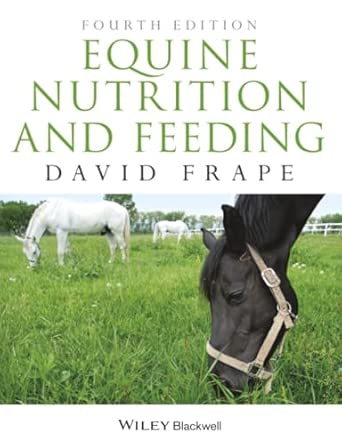
Equine Nutrition and Feeding 4th Edition
Author(s): David Frape (Author)
- Publisher: Wiley-Blackwell
- Publication Date: 18 Jun. 2010
- Edition: 4th
- Language: English
- Print length: 512 pages
- ISBN-10: 9781405195461
- ISBN-13: 9781405195461
Book Description
During the past six years there has been a surprising amount of work on the dietary requirements and husbandry needs of the horse. This will undoubtedly lead to improvements in equine management in an increasingly competitive world where resources of raw materials, from land space to spices become scarcer. The mass of work has encouraged me to revise the 3rd Edition in order to bring the evidence up to date. All chapters and sections of the book have been revised, with, in particular, clarification of the causes and control of several metabolic diseases. In addition the principles of equine nutrition, which evolve gradually with time, and are based upon the best experimental evidence are adequately covered.
There have been two major objectives in preparing the 4th Edition:
(1) to summarize, collate and integrate 647 new research reports and papers not previously reviewed in order to: (a) replace previous speculative evidence by more secure conclusions in several areas of equine husbandry, (b) indicate areas needing further investigation and (c) inquire about issues not previously investigated by experiment.
(2) to integrate the evidence, conclusions and recommendations published by the NRC in their excellent and comprehensive 6th Revised Edition, “Nutrient Requirements of Horses” (NRC 2007), and in particular to compare their estimates for protein and energy with those of INRA (1984, 1990) at the feed level, where two dissimilar systems of measurement have been used.
There have been two major objectives in preparing the 4th Edition:
(1) to summarize, collate and integrate 647 new research reports and papers not previously reviewed in order to: (a) replace previous speculative evidence by more secure conclusions in several areas of equine husbandry, (b) indicate areas needing further investigation and (c) inquire about issues not previously investigated by experiment.
(2) to integrate the evidence, conclusions and recommendations published by the NRC in their excellent and comprehensive 6th Revised Edition, “Nutrient Requirements of Horses” (NRC 2007), and in particular to compare their estimates for protein and energy with those of INRA (1984, 1990) at the feed level, where two dissimilar systems of measurement have been used.
The book covers all types of horse, all ages and conditions, in sickness and in health, kept for whatever purpose, sport, work, show or companionship.
All the relevant science is covered with practical advice on the prevention and treatment of disease, the control of pests and parasites,the design of facilities, including horse boxes. The book is designed to inform and help the whole range of those concerned, from the student to the most practical, from the rider to the breeder and all those involved in the care of the horse. The book can be used for easy reference or read as a narrative, helped by clear diagrams and tables.
Editorial Reviews
Review
Select Guide Rating
Excerpt. © Reprinted by permission. All rights reserved.
Horses are ungulates and, according to J.Z. Young
(1950), members of the order Perissodactyla. Other extant
members include asses, zebras, rhinoceroses and tapirs.
Distinctive characteristics of the order are the development
of the teeth, the lower limb with the peculiar plan of
the carpus and tarsus bones and the evolution of the hind
gut into chambers for fermentation of ingesta. Each of
these distinctive features will play significant roles in the
discussions in this text.
The domesticated horse consumes a variety of feeds,
ranging in physical form from forage with a high content
of moisture to cereals with large amounts of starch, and
from hay in the form of physically long fibrous stems to
salt licks and water. In contrast, the wild horse has evolved
and adapted to a grazing and browsing existence, in which
it selects succulent forages containing relatively large
amounts of water, soluble proteins, lipids, sugars and
structural carbohydrates, but little starch. Short periods of
feeding occur throughout most of the day and night,
although generally these are of greater intensity in daylight.
In domesticating the horse, man has generally
restricted its feeding time and introduced unfamiliar materials,
particularly starchy cereals, protein concentrates and
dried forages. The art of feeding gained by long experience
is to ensure that these materials meet the varied requirements
of horses without causing digestive and metabolic
upsets. Thus, an understanding of the form and function
of the alimentary canal is fundamental to a discussion of
feeding and nutrition of the horse.
The Mouth
Eating rates of horses, cattle and sheep
The lips, tongue and teeth of the horse are ideally suited
for the prehension, ingestion and alteration of the physical
form of feed to that suitable for propulsion through the
gastrointestinal (GI) tract in a state that facilitates admixture
with digestive juices. The upper lip is strong, mobile
and sensitive and is used during grazing to place forage
between the teeth; in the cow the tongue is used for this
purpose. By contrast, the horse’s tongue moves ingested
material to the cheek teeth for grinding. The lips are also
used as a funnel through which water is sucked.
As distinct from cattle, the horse has both upper and
lower incisors enabling it to graze closely by shearing off
forage. More intensive mastication by the horse means that
the ingestion rate of long hay, per kg of metabolic body
weight (BW), is three to four times as fast in cattle and
sheep than it is in ponies and horses, although the number
of chews per minute is similar, according to published
observations (73-92 for horses and 73-115 for sheep) for
long hays. The dry matter (DM) intake per kg of metabolic
BW for each chew is then 2.5 mg in horses (I calculate it
to be even less – author) and 5.6-6.9 mg in sheep.
Consequently, the horse needs longer daily periods of
grazing than do sheep. The lateral and vertical movements
of the horse’s jaw, accompanied by profuse salivation,
enable the cheek teeth to comminute long hay to a large
extent and the small particles coated with mucus are suitable
for swallowing. Sound teeth generally reduce hay and
grass particles to less than 1.6 mm in length. Two-thirds
of hay particles in the horse’s stomach are less than 1 mm
c01.
(1950), members of the order Perissodactyla. Other extant
members include asses, zebras, rhinoceroses and tapirs.
Distinctive characteristics of the order are the development
of the teeth, the lower limb with the peculiar plan of
the carpus and tarsus bones and the evolution of the hind
gut into chambers for fermentation of ingesta. Each of
these distinctive features will play significant roles in the
discussions in this text.
The domesticated horse consumes a variety of feeds,
ranging in physical form from forage with a high content
of moisture to cereals with large amounts of starch, and
from hay in the form of physically long fibrous stems to
salt licks and water. In contrast, the wild horse has evolved
and adapted to a grazing and browsing existence, in which
it selects succulent forages containing relatively large
amounts of water, soluble proteins, lipids, sugars and
structural carbohydrates, but little starch. Short periods of
feeding occur throughout most of the day and night,
although generally these are of greater intensity in daylight.
In domesticating the horse, man has generally
restricted its feeding time and introduced unfamiliar materials,
particularly starchy cereals, protein concentrates and
dried forages. The art of feeding gained by long experience
is to ensure that these materials meet the varied requirements
of horses without causing digestive and metabolic
upsets. Thus, an understanding of the form and function
of the alimentary canal is fundamental to a discussion of
feeding and nutrition of the horse.
The Mouth
Eating rates of horses, cattle and sheep
The lips, tongue and teeth of the horse are ideally suited
for the prehension, ingestion and alteration of the physical
form of feed to that suitable for propulsion through the
gastrointestinal (GI) tract in a state that facilitates admixture
with digestive juices. The upper lip is strong, mobile
and sensitive and is used during grazing to place forage
between the teeth; in the cow the tongue is used for this
purpose. By contrast, the horse’s tongue moves ingested
material to the cheek teeth for grinding. The lips are also
used as a funnel through which water is sucked.
As distinct from cattle, the horse has both upper and
lower incisors enabling it to graze closely by shearing off
forage. More intensive mastication by the horse means that
the ingestion rate of long hay, per kg of metabolic body
weight (BW), is three to four times as fast in cattle and
sheep than it is in ponies and horses, although the number
of chews per minute is similar, according to published
observations (73-92 for horses and 73-115 for sheep) for
long hays. The dry matter (DM) intake per kg of metabolic
BW for each chew is then 2.5 mg in horses (I calculate it
to be even less – author) and 5.6-6.9 mg in sheep.
Consequently, the horse needs longer daily periods of
grazing than do sheep. The lateral and vertical movements
of the horse’s jaw, accompanied by profuse salivation,
enable the cheek teeth to comminute long hay to a large
extent and the small particles coated with mucus are suitable
for swallowing. Sound teeth generally reduce hay and
grass particles to less than 1.6 mm in length. Two-thirds
of hay particles in the horse’s stomach are less than 1 mm
c01.