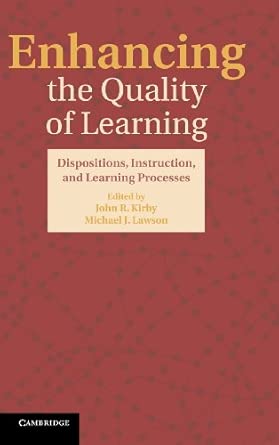
Enhancing the Quality of Learning: Dispositions, Instruction, and Learning Processes
Author(s): John R. Kirby (Editor), Michael J. Lawson
Publisher: Cambridge University Press
Publication Date: 12 July 2012
Language: English
Print length: 414 pages
ISBN-10: 0521199425
ISBN-13: 9780521199421
Book Description
High quality learning is extensive, well integrated, deep, and supports the use of knowledge in new situations that require adaptation of what has been learned previously. This book reviews current research on the nature of high quality learning and the factors that facilitate or inhibit it. The book addresses relationships between quality of learning and learners’ dispositions, teaching methods, cognitive strategies, assessment and technologies that can support learning. The chapters provide theoretical analyses, reports of classroom research, and suggestions for practical application for both teachers and learners. The book will be of value to teachers at all levels of education and provides guidance for students about how to approach classroom tasks in order to develop high quality learning.
Editorial Reviews
Review
‘Kirby and Lawson have succeeded admirably in organizing a strong collection of chapters around a timely theme – high-quality learning. In doing so, they offer readers a number of diverse perspectives on teaching and learning. An unswerving optimist, I remain steadfast in the belief that books like this stimulate our thinking about how to promote deep and enduring understanding in our students and, along with our colleagues, how to develop well integrated curricula, instruction, and assessment.’ Howard Everson, PsycCRITIQUES
Book Description
This book reviews current research on the nature of high quality learning and the factors that facilitate or inhibit it.
About the Author
John R. Kirby is a Professor of Educational Psychology at Queen’s University, Kingston, Ontario, Canada. He is a graduate of McGill University and the University of Alberta. Prior to 1987, he taught in the Faculty of Education at the University of Newcastle, Australia. He has been president of the Canadian Association for Educational Psychology and a member of the Board of the Society for Scientific Studies of Reading. He is a member of the American Psychological Association, the European Association for Research in Learning and Instruction and the Society for Scientific Studies of Reading. He is a Fellow of the Association for Psychological Science. His research interests concern the psychology of reading and learning from text. Current research projects include the development of the cognitive processes underlying learning to read (especially phonological awareness, naming speed, orthographic processing and morphological awareness), dyslexia in university students, cognitive processes in reading comprehension and learners’ use of text and graphics in studying. He has published 5 books and more than 100 research articles.
Michael J. Lawson is Professor of Education at Flinders University, Adelaide, Australia. Until recently he was Director of the Educational Futures Research Institute at the university, where a focus of his work was establishing school-university research partnerships. He is a member of the Australian Association for Research in Education and the American Educational Research Association. A graduate of Monash University and the University of Alberta, his teaching and research focus on applications of cognitive psychology to teaching and learning, particularly the use of strategies for learning in classroom and study situations. In recent years his research has been concerned with teachers’ facilitation of student use of learning strategies.
 Wow! eBook