 Wow! eBook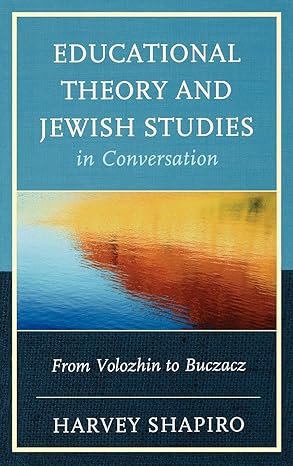
Educational Theory and Jewish Studies in Conversation: From Volozhin to Buczacz
Author(s): Harvey Shapiro (Author)
- Publisher: Lexington Books (UK)
- Publication Date: 1 Dec. 2012
- Edition: 1st
- Language: English
- Print length: 186 pages
- ISBN-10: 9780739175316
- ISBN-13: 0739175319
Book Description
Shapiro shows what is at stake when students and faculty think and communicate together across discourses—in particular, between the fields of education and Jewish studies. Presenting an alternative to conventional notions of interdisciplinarity, this book’s import extends to virtually all relationships between the humanities and professional education when these different discourses illuminate and challenge one another.
Editorial Reviews
Review
Harvey Shapiro’s book is an absolute “first” among writers of Jewish interest, and among the first in the world of educational thinking in general. In the tradition of Jerome Bruner, who joined narrative theory, psychology and philosophy to change our way of understanding learning, Shapiro takes two fields which most people read separately, (education and literary theory), and illuminates both fields through his unique energy and wide ranging intellect. The author has been working on narrative for many years, and I have looked forward to this level of thinking from him for a long time. And here it is!
Shapiro’s learned and philosophically rich treatise makes a compelling case for mutually illuminating points of connection among educational theory, political philosophy, and classical Jewish learning. In creating these encounters, Shapiro exemplifies the value of what he calls “interdiscursivity,” showing the benefits of educational theory for Jewish Studies and vice versa, the ways that Jewish thought can enhance contemporary educational philosophy and theory. Yeshivah scholar Reb Hayyim of Volozhin and pragmatist philosopher John Dewey or Mikhail Bakhtin’s concept of heteroglossia and the fictional machinations of Nobel laureate S.Y. Agnon create new thought collages of surprising interest and beauty.


