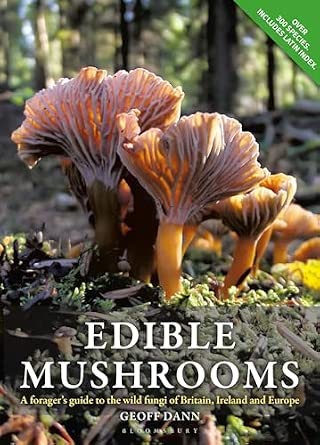
Edible Mushrooms
A forager's guide to the wild fungi of Britain, Ireland and Europe
By Geoff Dann
UIT Cambridge Ltd
Copyright © 2017 UIT Cambridge Ltd.
All rights reserved.
ISBN: 978-0-85784-397-5
Contents
Introduction,
Part I: Fungi and foraging,
1. What are fungi?,
2. How to identify fungi,
3. Where and when to find fungi,
4. Safety and equipment,
5. Culture and laws,
6. Poisonous fungi,
7. Edible fungi,
Part II: The fungi,
How to use this guide,
Visual index,
Species guide,
Glossary,
References,
Resources,
Index,
Photograph credits,
CHAPTER 1
What are fungi?
Fungi belong to Eukaryota (or the eukaryotes) – a large group of living things that includes plants, animals and all multicellular organisms. Fungi are actually more closely related to animals than plants, which might seem strange but only because fungi cannot move. Animals and fungi both derive their sustenance from external sources, whereas plants generate food internally, using energy from sunlight to photosynthesize carbohydrates.
The life cycle of fungi
For most of their lives, fungi are almost invisible. They exist in the form of a "mycelium" – a network of fine fibres ("hyphae") that colonizes whichever substrate the particular species prefers: wood, soil, dung or any sort of organic matter (dead or alive, plant, animal, even other fungi). During this part of their life cycle they are very hard to study, and even in the 21st century very little is known about them. Only when the time comes for them to reproduce do they make their presence known to us, when their "fruit bodies" appear as if from nowhere and sometimes in a very short space of time.
These fruit bodies, of which mushrooms (things with a stem and a cap) are just one variation among many, are not analogous to the fruits of plants. In sexually reproducing, flowering plants, the seeds already have a full complement of genes (the male half from the pollen and the female half from the ovule) and they are ready to grow into an adult organism the moment they arrive in a suitable habitat. By contrast, fungal fruit bodies produce spores, and these, like the sperm and egg cells of animals, have only half a set of genes. The spores are produced in their millions from the spore-bearing surfaces of the fruit bodies, which in the case of mushrooms are usually gills. Nearly all those spores end up in the wrong place, but a few get lucky and there follows a frantic battle for survival. Spores of many other species will have landed nearby, as well as other spores from the same species, and there may well be mature fungi already in residence. Most fungi are highly specialized, and will only prevail if they find themselves in the precise habitat that evolution has adapted them for (which is why we have to sterilize the growing medium for the familiar cultivated mushrooms – eliminate the competition). But even if a spore outcompetes its immediate neighbours, the process still isn't finished, as the unmated (or "primary") mycelium it becomes as it starts growing still needs to find a mate – another primary mycelium of its own species. So not just one but two compatible spores have to land in roughly the same area. If and when they find each other, the two primary mycelia can combine to form a secondary mycelium with a full complement of genes, enabling it to get on with the business of growing, fighting off the competition and acquiring resources. This is the adult organism, and when the conditions are just right, its life cycle is completed with the production of more fruit bodies.
The life cycle described above is typical of the fungi featured in this book. There are many variations, but mostly among microscopic fungi not relevant to foragers, so I won't go into any further details here.
Fairy rings
Sometimes fungi appear in rings, which can be hundreds of metres across. Why do they do this? The answer is simple: the mycelium started growing in the centre of the circle and is steadily getting bigger; then it runs out of food in the original patch, and there is only one place for it go – outwards, creating a small ring. As it continues to feed, the ring has to continue expanding outwards. The largest of these rings have been growing for centuries. They are usually incomplete because parts of them have bumped into something, leaving a gap in the ring that might eventually close again if the ring continues to expand beyond the obstruction.
When the rings are in grass, you can sometimes see their position even when there are no fruit bodies, because of various effects the mycelium has on the grass. In some cases it damages the roots, or uses up all the nitrogen, leaving a zone of dead or withered plants. In others, the fungi produce hormones that stimulate lush growth. Often, both effects are present at the same time.
Evolution and ecology
Because fungi very rarely leave a fossil record, it is only recently that palaeontologists have developed their evolutionary history. In the last few decades, the first hazy theory emerged – the so-called "modified spike" theory of how effectively the spores are protected and dispersed. The first large fungal fruit bodies were simple "spikes" (or "clubs", as we call fruit bodies of this form that exist today), where the spores were produced on the surface. Then a cap slowly appears at the top of the spike to provide the most basic protection for the spores, and innovations such as wrinkles, gills and tubes increase and further protect the spore-bearing areas. Eventually "veils" of one sort or another protect the developing fruit body, especially gills. (Different sorts of veil leave different sorts of features on the mature fruit body – see Chapter 2, page 37.)
The first organisms to stand tall on the Earth were not plants. Four hundred million years ago, plants grew no taller than an adult human today, but there were club-shaped fungi called Prototaxites 1m across and 8m tall. The first plants that matched the height of Prototaxites weren't trees, but giant, segmented relatives of the horsetail ferns (Equisetum species) that now rank among the most ancient of plants. Trees finally appeared at the start of the Carboniferous period, around 360 million years ago, growing far higher than anything had before, safely out of the reach of the herbivorous dinosaurs that themselves grew to be the tallest animals ever to walk the Earth. Wood had arrived on the scene, and to make it, the trees used a new and very tough organic molecule we call lignin – the first substance strong enough to support structures of such great height.
Nothing in those first great forests could break down lignin. When they died and fell over, the trees just piled up on top of each other, and continued to do so for the next 60 million years. The resulting gigantic heap of wood was destined to become the vast coal deposits after which the Carboniferous is named, and the wood deposit only stopped growing when finally something evolved that could decompose lignin. That something was the ancestor of today's wood-decomposing fungi, without which coal would still be forming at the same rate and our woodlands would look very different. Even now, those fungi capable of degrading lignin only do so when they've run out of easy sources of nutrition – they degrade lignin to gain access to more cellulose, though this may require energy in the form of glucose to do so. However,...
 Wow! eBook